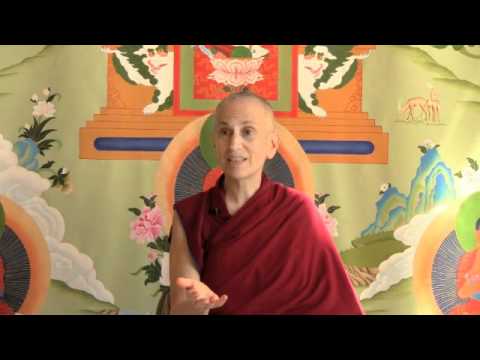
Four observed objects
 Venerable Thubten Chodron
 A Presentation of the Establishment of Mindfulness
 Sep 2, 2010
Part of a series of teachings on A Presentation of the Establishment of Mindfulness by Gyalwa Chokyi Gyaltsen.
- Continuation of the instruction on the six types of breathing meditation
- Explanation of the four observed objects, or focal objects, for the establishment of mindfulness—body, feelings, mind and phenomena
Four Establishments of Mindfulness 05: The four observed objects and breathing (continued) (download)
Let’s generate a very acute awareness of the transient nature of our life and the opportunity a precious human life affords us. Let’s have a strong determination to use our time very well because at the time we die no worldly objects come with us. Our friends don’t come with us; our reputation, our possessions, our money, all the worldly acclaim, our whole ego identity, even our body—none of it comes with us. The only thing that goes on with the mindstream is the imprints of the actions we’ve done, the mental habits we’ve created.
Seeing those are quite important and that we have the opportunity—if we take the opportunity—to create positive actions that leave good imprints in our mind, let’s familiarize ourselves with the Dharma and virtuous emotions and attitudes. Seeing that we can do that if we take the opportunity, if we choose, then seeing how valuable that is, let’s make a conscious choice to follow that path and not simply let our mind be on automatic, grasping at whatever seems is going to give us a little bit of temporary pleasure.
And yet, preparing for a future life, while good, isn’t the end-all of the path—it’s a stopgap measure to prevent the misery of the lower realms. But what we really want is to be free of all of cyclic existence, and that entails overcoming the wrong views, the incorrect, innate graspings that we have. That’s done by generating wisdom, which is gained on the basis of concentration, which is attained on the basis of ethical conduct. And yet, even our own liberation isn’t sufficient because we’re always surrounded by the kindness of others. We’re surrounded by other living beings who are exactly like us in wanting happiness and not suffering. And these are other living beings on whom we’re completely dependent to stay alive. It’s only right that the aspiration for liberation includes them because we can’t survive without sentient beings. When we really care about them, then we want to attain buddhahood to be able to lead them on the path to liberation themselves. So, let’s generate that bodhicitta motivation.
Distinguishing Attachment from Genuine Love
Sometimes a question may come into our mind because on one part of the path, we’re saying other sentient beings can’t come with us, that we have to separate from all of our friends and relatives, and so being attached to them is basically a burden. And being attached to them also serves as the impetus to create a great deal of negative karma in trying to please them and get them to like us and all that kind of thing.
On one hand, we say that, and then on the other hand, we say that sentient beings are so kind to us, and we can’t live without them, and we should really have this incredible, profound love and compassion for them. So sometimes, we may think, “Well, wait a minute, I don’t get it. First you’re telling me just don’t get so involved in sentient beings and detach from them. Then you’re telling me to be really involved with them and really love them. Isn’t that contradictory?” It seems like it, doesn’t it? They can really seem contradictory. Am I supposed to gravitate towards them; am I supposed to gravitate away from them and move away from them? Are they people that are only going to lead me to create nonvirtue? That’s what you tell me one time and the other time you tell me my enlightenment depends on them. How am I supposed to relate to all these other sentient beings?
It’s a very good question, and it’s something that it really takes a great deal of thought in our practice to understand on an intellectual level and even more thought to be able to practice. What we’re getting at is when we exaggerate the good qualities of someone or something, we’ve made it better than it is, and then this clinging and craving arises in our mind. “Oh this sentient being is so wonderful; I always want to be near them. Being near them is going to make me happy forever, and they’ve been so kind, and I so much appreciate it. I feel such a heart connection with them.” This kind of thing can just spill into attachment because we’re only feeling that way about some people, not about everybody. There’s some bias going on in there. Then also, there’s some exaggeration because the mind is only seeing good in those particular people. They can’t do anything wrong. The mind is somehow distorted, isn’t it? People you’re attached to, they don’t do anything wrong, do they? Maybe they do wrong a little bit, but not much. And even at that level, they didn’t really mean it because they’re so wonderful. Basically, it’s because they make me happy. So, you can see, there’s a lot of self-concern in there and exaggeration and a lopsided balance and then a very sticky mind. There’s a feeling of “I’m going to be miserable if I can’t be with them.” So, that’s the area of attachment that creates the difficulties.
On the other hand, when we see that sentient beings have been kind to us, we’re not exaggerating some specific quality of an individual. We’re seeing that all sentient beings have been kind to us. And we’re not saying that sentient beings have only been kind to us, because we’re also realizing that they’re overwhelmed by afflictions. So, while they’ve been kind, they also were overwhelmed by afflictions. When we see sentient beings like that, then we don’t exaggerate their good qualities. We don’t cling onto them thinking that they’re going to make us forever happy because we see that they’re unable to. But at the same time, we see that they want happiness like we do and that they’ve been kind to us. And they’ve also been kind to everybody else. So, it’s not just based on how they’ve been kind to me, like it is when we have attachment for somebody.
We have to really learn to discriminate attachment from genuine love. And we need to not only discriminate it on an intellectual level, but discriminate it in our own heart. And we need to learn to recognize when we feel one and when we feel the other. Because we so easily call attachment love, and as soon as we learn some Dharma jargon, we just kind of gloss over our attachment with Dharma jargon saying that it’s love. But if we really look carefully, we’ll see that there’s a lot of bias there. There are a lot of strings. There’s a lot of self-centeredness. If that person changed their behavior in any way, we certainly would change our feelings about them. Whereas when we have love, even if a sentient being doesn’t act nice towards us, we still see that they have been kind, and we still see that they are overcome by afflictions. So, our underlying feeling for them doesn’t change even though they mistreat us.
We can see that because that’s one of the qualities of a buddha: Buddha treats everybody equally in terms of the Buddha’s own feelings—even though one person may praise him and make offerings and the other person criticizes and is obnoxious. When we really have a bodhisattva mind, our feeling of closeness to sentient beings is not going to quiver and shake depending upon how they treat us at any particular moment.
There needs to be a lot of strength in that mind to really have love and compassion; the mind has to be very strong. Because as soon as we slip into self-concern, then our feeling of closeness and care for others slips as soon as their behavior changes. Right? Can you see that? This whole thing of really caring for others, it goes beyond just how this person is being nice to me at this particular time. But we’re suckers for people being nice to us, aren’t we? We’re suckers for people who give us presents and tell us we’re wonderful and praise us; we’ll just do anything to get that. Then we wonder why we have difficult relationships. It’s all because of the choices we make from our own blindness. Whereas if we increase the scope of our mind, we can learn to view everyone we see with an attitude of, “This is a sentient being who has been kind to me, but who is also overwhelmed by the three poisons, so there’s nothing to get attached to. But there’s every reason to work for their benefit and to appreciate their kindness.” That becomes more of our motivation.
Mindfulness and Introspective Awareness
We had one question from last week before I get into the teachings for this week. Somebody said, “How can we work with the interplay of two factors: mindfulness and introspective awareness? I believe it’s the case that mindfulness needs a high degree of relaxation to be most effective, but it seems that introspective awareness has a task that requires more firmness, although not that of a taskmaster.” So, the question is how to regulate the relaxation of mindfulness and the firmness of introspective awareness to be most effective in the meditation.
Now, behind this question I think there’s an assumption that firmness is tightness. And firmness is not tightness. When I lead you through the body relaxation before we meditate, I have you relax all the different parts of the body and let go of the tension. At the end, I always say, “Feel how your body is at ease, but also your posture is very firm.” I always say that.
I always say that so people can see that physically your body can be relaxed, but your meditation position can be firm. Relaxed doesn’t mean Jello, okay? And firm doesn’t mean tight. If our body can be without tension and yet very firm, our mind can also be without tension and yet very firm. What’s the job of mindfulness? It’s to place our mind on an object that we’re already familiar with in such a way that we’re not going to get distracted. So, mindfulness requires firmness. However, if the mind confuses firmness and tightness and goes to tightness, that mental tightness is going to make us lose the object because the mind is too brittle. You need a relaxed mind so that you don’t go to the extreme of being tight and brittle, but you also need to be firm. Think a little bit about how being relaxed and being firm can go together. It’s like a really good chocolate cake. A really good chocolate cake is moist, but it also stands up straight, doesn’t it? It isn’t moist and mushy; it wouldn’t have a very good texture. Yet, to stand up straight it doesn’t have to be all dried out. It’s the same thing with our mind.
Then also, last week I was talking about the importance of sitting up straight when we meditate, and I gave the example of imagining that somebody was pulling you from the top of head so that your spine was straight. Somebody else told me that what he finds helpful is to say elongate your waist. Kind of sit so that your waist is elongated. If you do that then you’re going to be sitting up straight. We want to do that as much as possible because when we start to slouch then we very easily get drowsy.
Review: Meditation on the breath
Let’s just review a little bit. Last week I started talking about the six meditations from the Abhidharmakośa, The Treasury of Knowledge, by Vasubandhu. This is part of the preparatory practice for the four establishments of mindfulness. We started out with counting the breath: counting each cycle of out and in as one and going up to ten. We discussed not going higher so we don’t get distracted, and not doing fewer so that we don’t get too lax and lazy. There you’re just trying to be able to keep your mind on your breath, and you’re using the counting as a way to do it. In the Theravada tradition, at least in Thailand, they often use the syllables of “Bu-dho.” I don’t know why they don’t say “Buddha.” That would make more sense, but they always put o’s on the end of everything, so they use the “Bu” for one part of the breath and “dho” for the other. Similarly, one out and in can be one, another out and in two. That’s just to get you fixed on the breath, to get your mindfulness on the breath.
Then the second part is called following the breath. Here, you follow the breath as it enters, and you experience it going down through your throat, in the heart, in the center of your body, to the soles of your feet, and then coming up again. When you exhale, it goes a little bit out, and you breathe in to the soles of your feet and out again. When your concentration is better, then when you exhale you imagine the air goes a little bit further away—maybe a foot away or something. But don’t go too far at the beginning because it will bring confusion and distraction. Now you’re getting more introspective and really following the feeling of the breath in your body as it fills your body.
Then the third one is called placing, and here you see your breath as it comes in and goes down through your body into the soles of your feet. You see it as a very fine thread, and here you’re not focusing at all on the inhalation and exhalation, but rather you’re examining the internal sensations in the body along this thread. The breath becomes this thread through your body, and you’re examining: is it hot, is it cold, is it comfortable, or is it uncomfortable? Here you’re going to a much more refined level of the breath because you’re not paying attention to the gross inhalation and exhalation. You’re paying attention to a much more subtle movement of the internal wind in the body, because we have a wind element moving in our body all the time.
Then the fourth step is analyzing, and here you’re starting to inspect things more closely. You’re not just observing hot, cold, comfortable, or uncomfortable, or rough and coarse, but you’re seeing how the breath has the other elements in it. You can have a heaviness to the breath, which is the earth element; a moistness, which is the water element; a warmth, which is the heat element; motility, which is the air element. So, you begin to be aware of how the breath, although it’s primarily the wind element, has other elements involved in it. And then you examine how the breath is not only the four principal elements but also the derivatives. You question: “Does your breath have color?” Well, maybe—if it’s pretty smoky out and has color. “Does it have scent?” If you’ve been painting the door in a closed room, yes, your breath is going to have scent. “Does it make noise? Does it have a taste?” We know it has a tactile sensation. So, you’re analyzing the breath there in terms of the four elements and the four elemental derivatives.
Then another part of analyzing, which is really interesting is to observe, is how the mind and mental factors relates to the breath. We usually think of the breath as the body. We think my mind and my mental factors are the mind, never the twain shall meet. But in actual fact, when we sit and watch, we see there’s a lot of correlation and relationship between our breathing and our mental states. When we’re emotionally relaxed, what is our breathing pattern? It’s slower, isn’t it? When we’re excited, what is our breathing pattern? It’s faster. That’s why I find it interesting for people to say, “I sit down and watch TV to relax.” Because when you watch TV, all the scenes actually make your mind excited. I doubt that when you watch TV your breath is very slow and relaxed. I think when you’re watching the movies and there’s war in the movies or there’s sex or something like that, your body reacts. It reacts by getting more excited, getting more adrenaline going. That’s not relaxation.
But it’s very interesting to watch how our moods relate to our breath. When you do that then you can see how sometimes just changing your breath a little bit can change your mood a bit. This can also be very good when you’re working with other people. Sometimes you’re with people and you can watch what their breathing pattern is. You can listen for it; you can watch the movement of their body. And you can learn a lot about what they’re really feeling when you see what their breathing pattern is. Because when somebody is really upset, their breathing pattern is disturbed, isn’t it? It can be very helpful if you’re trying to help the person calm down to start out maybe matching their breathing pattern for a minute so that they feel understood, and then you can slow down your breathing pattern and see if they start to slow theirs down. And then when their breathing pattern is slower, you can see if they’ve calmed down. They usually have.
Similarly, if we find that we’re getting excited or we’re trembling or we’re nervous or we’re afraid, we can watch the breath in the body and how our breathing pattern is. Don’t force it to change, but just try and maybe slow it down or become more mindful of it. You don’t want to be doing deep breathing or anything. But if you slow your breath, your mind is going to change. If you become really sensitive to this relationship between your breath and your mind, you’ll start to notice that people are quite different. Some people don’t understand what they’re feeling emotionally, but they will get a clue when they understand how their body feels. So, for some people, tuning into the feeling in their body will help them see how they feel emotionally.
Other people are much more in tune with how they feel emotionally, but they’re completely out of touch with what’s going on in their body. And some of us are out of touch with both our body and our mind. So, this is a very good exercise for helping us to get in touch with both our body and our mind, which is important for being able to take care of them just in an everyday way and keep them healthy. But it’s also very important for regulating the mind so that we don’t get overpowered by afflictions and create a lot of negative karma. It’s very interesting; try and work with that. Watch the relationship with the breath and the mind.
And watch how sometimes, sometimes we sigh a lot. The Tibetans consider that when somebody does that, there might be some imbalance of the wind—or that sighing can cause an imbalance of the wind. Because in some ways it’s quite unnatural, isn’t it? “Ahhhh.” We do that when we’re tired, don’t we? When we’re exhausted, when our mind isn’t completely peaceful and calm, we just go, “Ahhhhh.” And so, in some ways, that can actually create that kind of mood in us if we tend to do that a lot. In the same way, start to be sensitive to your body and watch when your body starts tensing up. I went to the dentist yesterday, and I’m not afraid of the dentist at all. My father was a dentist. I am quite used to sitting in a dental chair and having people poke around in my mouth.
On one hand, I’m used to that, but still, every so often I would just pay attention to my body, and there was some tension. And I would relax it and then I’d check back a minute later, and I found that tension is there again. How did it get there? I thought I was paying attention, but I wasn’t, so I had to relax again. It’s quite interesting what you can observe in all these situations. Especially watch when you’re impatient, like you’re standing in line and you’re in a hurry and you want everything to go quicker than it’s going, watch your mental state and watch your breath. See how your breath and your mental state both change while you’re standing in line. And you can see that sometimes with the people in front of you in line. If you just watch, you can tell people’s internal state by watching their breathing patterns. Analyzing is becoming clued into that and aware of that. And this awareness is very very, very good. In tantric practice you get into the internal winds and how they relate with perception and mental states and so on.
Then the fifth one is called transforming, and here you’re not on the breath any more at all, not even on the fine line of the breath. You’re not analyzing the breath at all, but rather the awareness that is familiar with concentrating on the breath is now transformed into the four stages of the path of preparation. In other words, the mind that has become calmer and more focused and concentrated by meditating on the breath, you now conjoin with an understanding of emptiness—at least an intellectual understanding of emptiness—which leads you to the union of serenity and insight, also called the union of samatha and vipassana. At that point, that’s the entrance into the path of preparation, which has four stages: heat, peak, patience, and supreme Dharma. You’re now starting to meditate on emptiness and starting to meditate on the four noble truths.
Then the sixth step in this meditation is called purifying, and here that mind that was previously focused on the four progressive parts of the path of meditation is now transformed into the path of seeing and the path of meditation so that that conceptual realization of emptiness is now becoming a direct perception of emptiness, still a union of serenity and insight.
This is taught in the Abhidharmakośa, so it’s a practice that the hearers, solitary realizers, and also the bodhisattvas engage in, and it can be very, very helpful. Clearly there’re progressive, and the initial ones are much easier than the later ones, so you do them in that order. As I explained, you can do a little bit of one and then go onto the next in one session or in one day one, or you can do one today and another tomorrow. But if you’re really trying to gain realizations, then you want to really master one before you go on to the next. You might still experiment with the next and try it out and get some familiarity, but you really want to gain some stability in the first before you put all your attention on doing the second one.
Those six are often taught to stop mental business and distraction and lots of discursive thinking. So, that’s part of the preliminary practice for doing the four establishments of mindfulness because it’s good to have a little bit of concentration before you start becoming aware of these four objects.
Four observed objects
Now we’re going to continue on in the root text. The root text says:
There are eight parts to this decisive final analysis of the establishment of mindfulness.
This is the outline for the basic text. We went through this before. First we talk about the observed objects, or it’s also translated as “focal objects.” In other words, it’s what we are meditating on. Then the second, the manner of meditation, is how we meditate on these focal objects. Three is the reasons for doing the meditation. Four is the nature of the four establishments. Five, the divisions: what kinds there are. Six, the boundaries: where on the path we find them.
Seven is the etymology of the term “the four establishments of mindfulness,” and eight is demonstrating that the establishments of mindfulness of the Mahayana are superior. Here we’re really establishing that this is a bodhisattva practice, so it has to be done with bodhicitta. And doing this practice with bodhicitta transforms the entire practice. And I might remark here that just as doing the practice with bodhicitta transforms the whole practice, according to your view of emptiness, too, that is going to transform the entire practice.
We’re going to move on to the first point now, which is the observed objects or the focal objects. There are four observed objects for the establishment of mindfulness. The text says they are the body, feelings, mind, and phenomena. We’ve got to remember those four first of all. Now we’re going to talk about what does it mean when we say body, feelings, mind, and phenomena? There are three types of body: the external body, the internal body, and the body that’s both external and internal. Here, you have to remember that the word “body” in Tibetan is “zuk.” Zuk also means form. Similarly, the Sanskrit/Pali word is “rupa.” Rupa can mean body; it can also mean form—form as in matter, or material. So, sometimes we translate that word “body” sometimes as “matter” or “material” or “physical substance” or something like that. When we’re talking about the external body, maybe a better translation would be “external form” or “external matter.”
Those are the things external to the body, the table, the different things, the colors and shapes that are not our body that we contact through our sense powers; the sounds that we hear; the colors and shapes we see; the smells that we smell; the tactile sensations—rough, smooth, hot, cold—things like that that are external to us. That’s the external body or the external matter. The internal body, or internal matter, is referring to the very subtle substances that are the sense powers. They didn’t call it “cones and rods” in Buddha’s time, but they said that there was a very subtle substance at the back of the eyeball that was the actual eye sense power that enabled us to see colors and shapes. They didn’t have the name “anvil and stirrup” for our ears, but they said there was a very subtle substance in the ear that allowed us to hear sounds and so on. And it’s the same thing with the tongue or with the nose. What do they call the sensors in the nose? We have taste buds, what do we call what’s in our nose?
Audience: [Inaudible]
Venerable Thubten Chodron (VTC): Anyway, whatever we call it, I’m sure somebody online will write in and tell us the name of that very subtle sense power or the taste buds—not the whole tongue but the taste buds.
Audience: Isn’t it olfactory?
VTC: Yes, it’s olfactory, but olfactory just means pertaining to smell. So, it’s some kind of sensors of some sort.
And then the nerve endings in our body that enable us to feel things or the sensors in our stomach so that we know when we’re hungry or thirsty, those are the inner body. The body that is both inner and outer, or both internal and external, refers to the gross object. So, that’s the eyeball or the ear or the nose or the tongue or the skin. That is external in the sense that it has color and shape and we can perceive it and everything, but it’s internal in the sense that it is affiliated with our mindstream and it contains the subtle sensors, the subtle sense powers. There are those three kinds of body.
Then the second focal object is feeling. There are three kinds of feeling. Here we’re using the word “feeling,” but it doesn’t mean emotion. In English, the word “feeling” is very vague, and it can often mean emotion: we say, “Somebody’s feelings got hurt.” So, the word “feeling” in English has many, many different meanings. Here we’re specifically talking about pleasant, unpleasant, and neutral feelings. Sometimes they’re called happy, painful, and neither happy nor painful feelings. There are many words we can use. Sometimes we might call them pleasant, happy, pleasurable, painful, suffering, unpleasant, neutral, although the actual term is neither pleasant nor unpleasant, neither happy nor suffering.
This is referring just to those feelings—kind of a pleasurable or happy feeling. It’s not referring to attachment or anger or those kinds of things. Although they may have this feeling component to it because when we have attachment, there’s very often a pleasurable feeling. Although sometimes there’s quite a painful feeling, too. When we’re angry, there’s usually a painful feeling. When there’s ignorance, it’s usually a neutral feeling, not always. Sometimes it’s unpleasant; we’re upset because we’re ignorant or whatever.
So, we’re just talking about those three: pleasant, unpleasant, and neutral feelings. And those three feelings run our lives because whenever we experience some pleasant feeling, how do we react? “I want more! I don’t want it to go away, and I want more and I want better.” When we have an unpleasant feeling, there’s a painful feeling, a suffering feeling, how do we react? “I don’t like it! Get rid of it. I’m mad. I am averse to this.” When we have a neutral feeling, how do we react? “Duh!” That’s ignorance. These feelings are very, very important. When we study the twelve links of dependent arising, the link of feeling is followed by the link of clinging. Because as soon as we feel something, we cling in some way to “I want more and better,” “Get it away,” or “Bleh.”
And it’s based on our reactions to these three feelings that we generate afflictions, and the afflictions lead to the creation of karma. Karma leads to rebirth in cyclic existence. So, when we talk about cutting the twelve links, one place where we can cut it is between feelings and clinging. But we need to have a lot of mindfulness and a lot of introspective alertness to notice that. Watch as you go through your day how you react to pleasant, unpleasant and neutral feelings. Just watch. It seems like there’s no gap between them, doesn’t it? Somebody says, “Why did you do that?” There’s an unpleasant feeling from the sound. Immediately we’re ticked off. The anger follows so close that it feels like the other person made us angry. It’s like they gave it to us, or we caught it from them. But actually, there’s an unpleasant feeling and we’re reacting to that feeling.
It’s the same thing with pleasure. We have a pleasurable feeling and seamlessly, our mind goes into, “I want more, and I don’t want it to go away.” We don’t analyze the feeling; we don’t ask ourselves, “Is this going to bring me everlasting happiness?” We don’t examine how this feeling is making me act or anything like that. We just immediately go from pleasant feeling into attachment. And it’s the same thing with a neutral feeling. We fall asleep, get lazy, space out—our favorite habits. So, this kind of mindfulness of feeling is going to be a real important one.
Then the third object, mind, here refers to the primary consciousnesses. When we study the mind and mental factors, we often divide them into primary consciousnesses and mental factors. With primary consciousnesses, we are referring to the consciousness that corresponds with the sense organ that enables us to contact a certain kind of object. So, there’s the visual consciousness that is stimulated when the eye organ meets with color and shape. There’s the auditory consciousness that arises when the ear sense power contacts sound. There’s the olfactory consciousness that arises when whatever they’re called in our nose comes in contact with smells. And similarly, there’s the gustatory consciousness that arises when the taste sense power contacts taste. And there’s the tactile consciousness that arises when the sensors in the skin or the stomach contact their objects, external things.
And with the mental consciousness that arises often when we’re thinking, there’s conceptual mental consciousness and then there’s non-conceptual mental consciousness, such as yogic direct perception or clairvoyance or the direct perception of emptiness, the direct perception of impermanence, things like that. But a lot of the time, when our mental consciousness is thinking, it’s conceptual mental consciousness. According to the field, the object, and the sense organ, then we have those consciousnesses. I keep saying sense organ, but I mean sense power. The sense power for the mental consciousness can be any of the other consciousnesses. After we smell something, we think about it. After we see something, we think about it. After we hear something, we think about it. So, all those other consciousnesses can actually be the power that make a mental consciousness arise. When we’re talking about mind, we’re just talking about those primary consciousnesses. When we go on to the fourth object, phenomena, that includes the mental factors. Actually feeling is a mental factor, but it’s its own object. We have 52 mental factors according to the Compendium of Knowledge. We actually have 84,000 mental factors, except we all feel that we’re special, and we either have one more or one less. But we all have 84,000. Those are different mental factors, and the mental factors fill out the consciousness.
Mindfulness is a mental factor. Attention, contact with the object, wisdom, ignorance, anger, attachment, confidence, responsiveness, the balanced mind of non-attachment, compassion, love: these are all mental factors. They affect how we relate to the object that the primary consciousness is apprehending. So, the mental factors are part of what we include in phenomena. But also, in the Pali tradition, they list specific phenomena in the five hindrances. These are the five hindrances to serenity: sensual desire, ill-will, sloth and torpor, dullness and drowsiness, regret and restlessness, and doubt. They talk about those.
The five aggregates are also included under phenomena: the body or form, feeling, discrimination, conditioning factors, and consciousness, the twelve sense sources or ayatanas. These include the six objects, and then the six sense powers, the seven enlightenment factors. That’s one group of seven, and those seven are seven of the 37 harmonies to enlightenment. They’re mindfulness, discrimination of phenomena, effort, rapture, responsiveness, concentration, and equanimity. Those are the seven enlightenment factors. Other ones are the four noble truths—contemplation of the four noble truths falls within the establishment of mindfulness on phenomena. Here there follows a quote from the Compendium of Knowledge which states:
What are the objects of observation, or the focal objects of the establishments of mindfulness: the body, feelings, mind, and phenomena?
We just talked about what those are in more depth.
Q & A
So, we have a couple of minutes for questions if you have any.
Audience: [Inaudible]
VTC: So, when you were doing the breathing meditation, you were getting hung up on the numbers and just the fact of saying them and like that. Yes, sometimes that can be an interference. If it’s an interference, then try and just be aware of exhalation and inhalation.
Audience: [Inaudible]
VTC: Well, those are the first ones that you’re doing that help you—like the counting and the placing, those are the ones that you do. I don’t think I’m understanding your question.
Audience: [Inaudible]
VTC: So, instead of counting the breath, are there other meditations you can do to just calm the mind down before you start a meditation? Usually they recommend watching the breath as a way of calming the mind down before we start meditation. That doesn’t mean that you have to watch the breath for a long time, but that’s what they usually recommend. If you sit down to meditate and your mind is turbulent or whatever, it’s recommended to sit and just focus a few minutes on the breath.
But they never talk about what to do if you have allergies and stuffed nose, because some of us have difficulty breathing. I remember one time I was teaching a breathing meditation during a retreat, and my sinuses were just going completely berserk. Both nostrils were stuffed, and there was no way I could watch my breath. In that case, you’re not going to be able to watch your breath here. But it is difficult, when you’re completely stuffed up. Some people have told me that it makes them actually more anxious in that situation because they’re breathing through their mouth, and they have asthma, and they can’t breath smoothly. So, it makes them more anxious.
If that were happening, then I would say use the figure of the Buddha. Usually, the figure of the Buddha is said to be one of the objects that you generate serenity on, and we’ll talk about that this weekend, but if the breath is not working to calm your mind, then use the figure of the Buddha and focus on that to calm your mind.
Audience: It seems like when you did the counting, that you really didn’t focus on physical sensations.
VTC: Then you’re emphasizing too much the counting, and that might have been your problem, too. The counting is just an aid to help you stay focused. The counting is not the object of meditation.
Audience: [Inaudible]
VTC: No, it’s the inhalation, the exhalation. We’re watching: “I’m about to breathe in, I am breathing in, the in-breath is about to finish, it has finished, I’m about to start exhaling, I am exhaling, the exhalation is almost finished, it has finished.” That’s what you’re focusing on; that’s your object of meditation. The counting is just designed to help you observe your breath in that kind of detail and not space out, but the numbers are not what you should be focusing on. If the numbers are distracting to you, that’s because you need to focus on the breath and so, if you want to drop the numbers, go ahead. But you need to be more aware of the different phases of the breath, okay?
Audience: Yes, what I think I’m intuiting is that before I always paid attention to the sensation of air passing the nose, but I feel like I need to pay attention to the air.
VTC: Well, you said that you usually pay attention to the stomach or the nose, and you’re paying attention to the sensation of the air as it passes through here or the sensation of your belly as it rises and falls. That is very intimately linked with the air. Because what’s the sensation you’re feeling at your nose? It’s the air going by. Why are you feeling your belly expand? It’s because the air is going in. So, it’s not like you’re differentiating these things out.
Audience: I guess I had the impression from last week that we weren’t to pay attention to those physical sensations.
VTC: Yes.
Audience: Then what’s the measure of accomplishment?
VTC: That you can get up to ten and your mind isn’t all over the place, and you’re able to really focus on these different phases of the breath for a period of time.
Audience: It feels like almost half of my mind is focusing on the breath and the other half, maybe a little bit more, is focusing on other things.
VTC: So, half of the time, we’re kind of on the breath. Part of our mind is on the breath, and part of our mind is roaming the universe.
Audience: [Inaudible]
VTC: Right, actually your mind is going back and forth—kind of on the breath, kind of away from the breath. It’s going back and forth quite quickly. What you need to really do is anchor your mindfulness and your attention to the breath and cut out all that discursive stuff.
Audience: Also, I have a question about what the end should be, because when I’m working on my breath, I’m aware of the relaxation that comes with my body. But when I use the Buddha, which I do sometimes, the quality of my mind is so much brighter than both times. Then I will go and do the rest of my practices after doing so much concentration, and so the quality of the mind that comes from focusing on the Buddha is so much clearer and brighter, I’m wondering if that should be what I’m hoping to achieve by also focusing on the breath.
VTC: You know, a number of people have said that, and I’ll talk about that this weekend. One of my friends just did a retreat on developing serenity, and she said that usually she would focus on the breath. She didn’t like at all focusing on the Buddha. But since the instructions were to focus on the Buddha, she decided to try that, and she said she was amazed at how much clearer her mind was focusing on the Buddha and that she was able to see immediately when she got distracted. Whereas, with the breath, she couldn’t always tell immediately when she was distracted. That could be one of the reasons why the Buddha is recommended as an object. But, of course, everybody is different, and it’s not going to work for everybody.
Audience: So, this is the measure of having gotten somewhere with breathing meditation: if my mind feels as clear on the breath as it feels on the Buddha? Or is that just irrelevant?
VTC: You use whatever meditation works.
Try and observe what are the three feelings this next week, and try and observe what’s the primary consciousness, what’s the mental factors. Observe the three types of body or three types of form; try and just discern those in your meditation and out of your meditation as well.

Venerable Thubten Chodron
Venerable Chodron emphasizes the practical application of Buddha’s teachings in our daily lives and is especially skilled at explaining them in ways easily understood and practiced by Westerners. She is well known for her warm, humorous, and lucid teachings. She was ordained as a Buddhist nun in 1977 by Kyabje Ling Rinpoche in Dharamsala, India, and in 1986 she received bhikshuni (full) ordination in Taiwan. Read her full bio.