Karma: cause and effect
Excerpt from Buddhism for Beginners
 Venerable Thubten Chodron
  Books
Books  Jan 1, 2001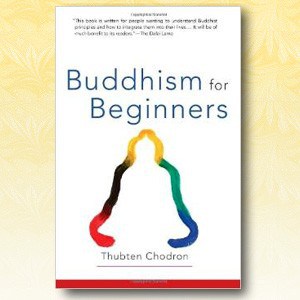
Buy from More on this book… or Amazon or Banyen Books & Sound
Does karma influence who we will meet and the relationships we’ll have with them?
Yes, but this doesn’t mean those relationships are predetermined. We may have certain karmic predispositions to feel close to or to have friction with certain people. Nevertheless, these relationships may not continue along those same lines. If we are kind to those who speak ill of us and try to communicate effectively with them, the relationships will change. We’ll also create positive karma, which will bring happiness in the future.
We are not karmically bound to others. Nor are there “soul mates,” special people who are the one and only one for us. Since we’ve had infinite past lives, we’ve had contact with every being sometime before. Also, our relationship with any particular person constantly changes.
Nonetheless, past karmic connections can influence our present relationships. For example, if someone has been our spiritual mentor in a past life, we may be drawn to that person this lifetime, and his or her teaching the Dharma may have a very strong effect on our minds.
Can understanding karma help us to understand the events in our lives better?
Yes, it can. The happiness we experience comes from our previously created positive actions. Understanding this encourages us to act constructively and not sit back passively when opportunities to be kind appear.
When we experience some difficulties in life, we should reflect on the type of action we must have done that created the cause for this result. This will encourage us to be more aware of what we think, say, and do. Studying the Buddha’s teachings enables us to learn more about specific actions and their results. Then we can change our behavior and plant more seeds in our mindstreams to experience desirable results. A text called The Wheel of Sharp Weapons is particularly good in explaining the effects produced by certain actions and the way to change our attitudes and actions to create the causes of happiness.
Can people be reborn as animals and animals as people? How is that karmically possible?
Yes. Based on our actions, our minds are attracted toward certain types of rebirth when we die. It may seem difficult to imagine that a human being could be reborn as an animal, but if we consider the fact that some people act worse than animals, it doesn’t seem so far-fetched. For example, animals kill only when they are threatened or hungry, while some human beings kill for sport, fame, or power. If someone’s mind habitually goes in a certain direction, it makes sense that his or her body could correspond to that mental state in a future life.
Similarly, animals can be reborn as humans. Although it’s difficult for most animals to do many positive actions—it’s hard to teach a dog to meditate or to offer community service—it is possible. For this reason, Tibetans take their animals when they circumambulate holy monuments in order to put good imprints on the animals’ minds. Many people enjoy saying their prayers or mantras out loud so their pets can hear them and be exposed to such soothing sounds, even though the animals do not understand the meaning.
Ordinary people have both positive and negative karmic imprints on their minds. What rebirth we take is not a sum total of all of our past karma. Rather, certain seeds ripen while others remain dormant. Thus, if someone is angry at the time he dies, some of the negative imprints could ripen and he could be reborn as a dog. However, the positive imprints still remain on his mindstream and when causes and conditions come together, they could ripen, causing him to again be reborn as a human.

Venerable Thubten Chodron
Venerable Chodron emphasizes the practical application of Buddha’s teachings in our daily lives and is especially skilled at explaining them in ways easily understood and practiced by Westerners. She is well known for her warm, humorous, and lucid teachings. She was ordained as a Buddhist nun in 1977 by Kyabje Ling Rinpoche in Dharamsala, India, and in 1986 she received bhikshuni (full) ordination in Taiwan. Read her full bio.