Receiving an initiation
05 Introduction to Tantra
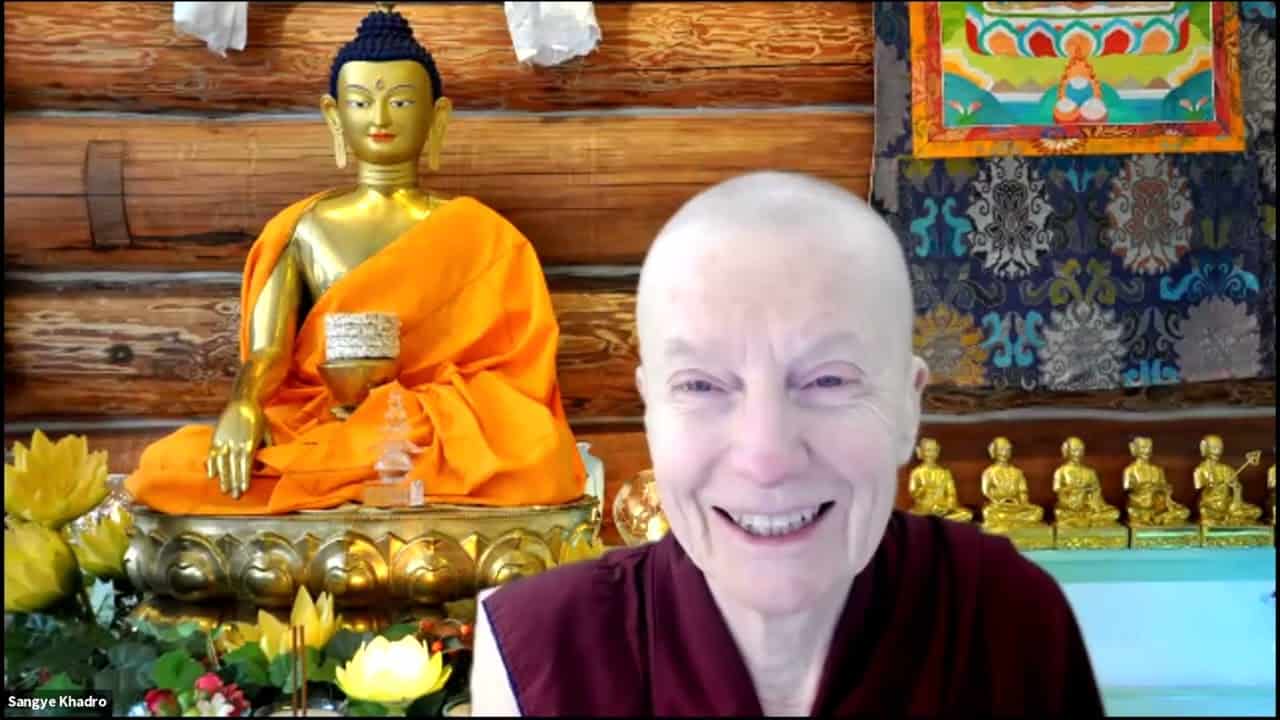
 Venerable Sangye Khadro
  Introduction to Tantra
  May 11, 2021
 Part of a five-part course introducing Tantra taught during an online weekend retreat organized by O Sel Ling in Spain, May 2021
- Q & A
- Initiations: overview
- Three kinds of initiations
- Vajrayana master and disciple relationship
- Three levels of practice
- Qualities of a Vajrayana master
- Qualities of a disciple
There are some questions I’ll try to answer about what we discussed last time. The first one is about karma: “The most important thing in terms of generating karma is motivation, will, volition. But at the same time it is said that in every millisecond we are creating karma, even when we sleep. How can we generate karma if at that moment there is no will as we understand it?”
There are a number of mental factors. It’s good to study the mind and mental factors or lorig as it’s called in Tibetan. That subject explains all the different aspects of the mind and all the different mental factors that come and go in our mind. There is one mental factor that is said to be ever-present. It’s present in every moment. There are actually five mental factors that are ever-present. And one of those is what we sometimes call intention. That’s one translation: intention. Another translation is volition. That seems to be what he’s talking about here. So, this mental factor of intention or volition is present every single moment with every single state of mind that we have. Even when we have our five senses—seeing, hearing, smelling, tasting, touching—there is that mental factor that is always present.
And also with mental consciousness—thinking—and also when we are asleep and our five senses aren’t operating, our mental consciousness is operating. That mental factor is still there every moment. And the way it works or the function of this mental factor is to draw the mind to an object. That’s its function. It connects the mind to an object—whatever the object may be. When we’re awake, with our eyes open, then we’re looking at things or hearing things. It’s that mental factor, intention, that causes the mind to look at an object or hear a sound or whatever. And then even when we’re asleep, that mental factor is still there.
And when we’re asleep, we may have dreams. There are dream objects: people and things and events that our mind is creating. So, the mental factor of intention is still there and taking the mind to those objects. That mental factor is said to be very, very important because that’s actually what karma is. Karma is that mental factor of intention. By itself, it’s neutral. It’s not virtuous or non-virtuous. It’s not good or bad. But if there are other mental factors present—for example, if there’s a non-virtuous or negative state of mind present, like anger or attachment or desire—then the intention will also become non virtuous.
For example, we see somebody we don’t like, and even just looking at that person, we may have negative thoughts about them. We may also speak negative words towards them. We might even do something physically aggressive towards them. It’s the mental factor of intention that kind of pushes the mind towards that object. It’s very complicated, and I don’t fully understand all these different factors, all these different ways that the mind works. But the point I’m trying to make here is that intention happens automatically. It’s an automatic thing. It’s not that we deliberately choose to look at an object or focus on something. It’s just something that happens automatically.
And yes, it’s true that each moment, because intention is always present, we are creating karma. Karma is being created. And whether it’s virtuous karma or non virtuous karma or neutral karma depends on whether or not there are other mental factors present that are non virtuous or virtuous or neither. And then even when we’re asleep, this mental factor is still there. It’s still operating. We don’t have to be conscious, awake, in order for that mental factor to be operating and for karma to be created. Even when we’re asleep, that mental factor is there, operating and creating karma. We do create karma when we’re dreaming. Even in our dreams, we sometimes may get angry and act aggressively, or we may have very positive thoughts and feelings and do things that are positive.
So, we create karma in our dreams, but it’s not the same as the karma we create when we are awake. Because for one thing, if we kill somebody in a dream, we are imaginging killing somebody; there isn’t really somebody who’s killed. There’s no real victim. It’s only an imaginary person that we are killing, and no sentient being has actually been killed. So, it’s not like a complete karma, but still it’s negative. And there’s some negative karma created by the things that we do in our dreams. And in the section on karma in the Lamrim, the kind of karma that we create in dreams is said to be in a category that’s called indefinite karma, meaning it’s not sure what kind of result will come of that karma. It’s not definite that there will be a result and what kind of result it will be.
It’s not as serious as the karma we create during the day when we’re awake. But since we do create karma in our dreams, it’s recommended that before going to sleep, we try to have a positive state of mind, a virtuous state of mind, that will affect our mind while we’re asleep and dreaming. There are different practices we can do. We can go to sleep thinking of the Buddha, for example. You can imagine your head is in the Buddha’s lap when you’re going to sleep, and you’re feeling devotion to the Buddha—or Tara. It could be any of the buddha figures. But feeling their presence there while you’re sleeping can help your mind to remain positive even during your sleep. And we can go to sleep with thoughts of loving kindness, bodhicitta, and reciting mantras. Those are good things to do when going to sleep. Definitely try to avoid going to sleep feeling angry because that might cause your mind to be angry the whole night and have angry dreams and maybe do violent things in your dreams. It is important to try to go to sleep with a positive state of mind, not a negative state of mind.
But there is a difference between this mental factor of intention and motivation. I haven’t really come across an actual explanation of what motivation is other than we are encouraged to try to have a positive motivation for the things that we do. That’s why before a Dharma talk or before meditation, we are advised to bring into our mind positive thoughts and altruism—wanting to become a buddha to help all living beings and so on—just to make sure that the motivation we have for what we do is something positive and virtuous. That’s more like something we do deliberately and consciously by generating a motivation. Whereas intention seems to be more automatic and maybe not always at the conscious level. Often it is just unconscious. The mind is just drawn to an object. It is good to follow the course on lorig to learn more about the mind and the mental factors.
How anger destroys merit
Then the next question is: “When you talk about anger destroying positive karma, is it because our anger has had a harmful consequence, or does any kind of anger burn merit?” Well, one place where this topic comes up is in Chandrakirti’s text. It’s a commentary to Nagarjuna’s Fundamental Wisdom. It’s called the Madhyamakavatara or Entering the Middle Way. And in one section, he’s merely talking about anger at bodhisattvas. He says that if you’re a bodhisattva and then you get angry at another bodhisattva, it’s really, really negative. And that anger can set you back a lot in your practice. It’s almost like you go backwards—you destroy a lot of merit and so on. But it’s also said that anger at anybody is destructive. Anger is always destructive. And my understanding is that it doesn’t have to be anger that motivates you to act out and actually do something harmful.
I could be wrong about this. But even having angry thoughts in our mind, even if you don’t act them out and speak words or do something physical, just the angry thoughts in your mind can have a destructive effect on your virtue, your good karma. So, I think it’s best to try to not get angry. Of course, that’s difficult to do. Even the Dalai Lama says that he still gets angry sometimes. We have to be at a very high level of our spiritual development before we are free of anger altogether. But in the meantime, while we still do have anger in our mind, we should try our best to not let ourselves act it out and also not let it proliferate in our mind. We should try to not let ourselves get caught up in a tsunami wave of anger and instead apply antidotes, work on antidotes. There are lots of wonderful methods that can be used to deal with anger.
Shantideva’s Guide to the Bodhisattva’s Way of Life has a whole chapter on this. Chapter 6 of that text is all about how to have more patience and how to have less anger. He gives many, many, many methods for dealing with anger. And I know there are other books about how to work with anger that explain these different methods. So, we should really try to work on our anger and try not to act it out. Even if it’s there in your mind, try to prevent yourself from speaking or acting in an angry way. Find methods to deal with it.
Mantra recitation and visualization
Then there’s a question about mantras: “When we recite mantras, but not within a sadhana, should any visualization also be done?” Well, it’s good if you visualize while you’re reciting mantras. There’s usually some visualization, but that depends on a particular mantra, a particular practice. For example, probably the most popular mantra is Om Mani Padme Hum, the mantra of Chenrezig, the Buddha of Compassion. While reciting that mantra, it’s good to visualize Chenrezig. If you receive the initiation and you’re qualified to visualize yourself as Chenrezig, you can do that. And while reciting the mantra, you can imagine sending light out from your heart to all living beings and purifying their suffering and causes of suffering and helping them progress along the path.
Or if you haven’t had the initiation, then you can visualize Chenrezig in front of you or above your head and light flowing from Chenrezig filling you. You can also imagine Chenrezig above the head of other beings and light and nectar flowing and purifying them. This is a very good thing to do when somebody is sick. One of the Western monks that I know, he’s been a monk for a long time, and recently there was the news that he’s got COVID and he’s in the hospital in Nepal. And so Lama Zopa Rinpoche sent the message requesting that we imagine Chenrezig, Avalokiteshvara, above the head of this monk, and then light flowing into him, purifying him, healing his sickness, and so on. That’s a very nice practice to do. It’s good to visualize something together with mantras. But even if you don’t, I think it’s still nice just to recite the mantras. It’s a good thing to do.
Working with desire
The next question is: “What is better for the spiritual path, to consciously suppress desire or to realize the desire consciously?” Well, I don’t know what you mean by suppress. My understanding of that word suppress, the way I think of it, is not a positive thing. But it’s like you’re kind of pushing down the desire, just keeping it under control, maybe even denying it. That’s possible that the desire is there in the mind, but you’re denying it, pretending it’s not there. That’s my understanding of the meaning of suppression. And that is not helpful at all, because the desire doesn’t go away. It’s still there in your mind. And it could even create other kinds of problems. When we suppress emotions, they can come out in other ways, like physical tension, or sickness, or even other kinds of mental problems.
Maybe it comes out in your dreams in the form of a really out-of-control dream. It’s not a solution to suppress desire, or anger, or any disturbing emotion. It isn’t a real solution, it isn’t a real remedy. It doesn’t go away. It’s still there in the mind, and it can create problems for us, and possibly for other people. For example, sometimes somebody may suppress their anger for a long time. Maybe they’re angry at their husband, or they’re angry at their wife, and they just try to keep it under control for a while. But then at some point, it’s like the dam bursts, and then it comes out all over the place. I’m sure you’ve all had some experiences like that. Suppression is not a helpful way of dealing with any disturbing emotion. Instead, what’s helpful is to acknowledge that the emotions is there in your mind and then to find solutions. There are remedies that we can use to deal with it.
Here, it’s talking about desire. There are meditations that you can use, methods you can use in meditation. The ideal thing is to transform your mind so that instead of having desire, you have another state of mind. There’s a virtuous mental factor called non-attachment, and it’s the absence of attachment. This is the opposite of seeing that object as being so wonderful and so fantastic and exaggerating its attractiveness and then wanting to possess it and thinking it’s the source of happiness and so on. That’s what attachment or desire is all about. Non-attachment, the opposite of that state of mind, is being able to look at that object and not have all those kinds of thoughts and feelings. You don’t want to go to the opposite state of mind of anger or aversion. We have to be careful about that. It’s not that we’re trying to develop aversion for the object, but just a neutral state of mind where we just see it and are not attached to it, where we don’t have desire.
This is very difficult to do, and in fact, to be completely free of desire and attachment, it’s necessary to realize emptiness. It’s the wisdom of emptiness that is the actual antidote that eliminates desire and all the other afflictive emotions. But in the meantime, until we gain that realization, then we use these other methods, these other tools. What I find helpful in working with desire is thinking about impermanence: how everything is subject to change, and it is changing. You can do this by imagining or visualizing this object of desire that you have, and then imagining how it’s going to look in the future—after one year, after two years, after five years, ten years, fifty years, a hundred years.
Right now, maybe it looks very beautiful—really beautiful, really fantastic. But if you imagine how it’s going to look later on in the future, it’s definitely not going to look as wonderful as it does now. That can help to kind of pull the rug out from under your desire, your attachment. And another thing that can help is to contemplate how other people see that object. I mentioned this yesterday. Different people have different ways of seeing and different feelings about the same object. An object that you find really wonderful and attractive and fantastic, think about how other people see it.
And sometimes you just hear people make comments like this. Maybe there’s a person that you find really attractive, and you hear somebody say, “Oh, that person, they drive me crazy, or they’re really unattractive, or they’re really ugly.” You might hear somebody else make a comment about that same person or that same object that shows that they don’t find it attractive. They don’t see the object in the same way you do. And that’s always the case. It’s always the case that different people have different perceptions and different likes and dislikes. And so that brings you back to yourself, to your own mind, and how it’s your mind that’s seeing this object in a certain way. And the object doesn’t exist that way from its own side.
But your mind is probably projecting and exaggerating, making up stories, and so on and so forth. So, it’s helpful to contemplate that and recognize the role that your mind plays in seeing that object as attractive and desirable when the object from its own side probably isn’t as attractive as you make it out to be. And we can also see how our own mind changes over time. I mentioned that woman who thought her husband was like a Greek god, and he was just so wonderful, so fantastic, and she was just really, really full of desire and attachment for him. But then at some point, that changed.And she stopped seeing him in that exaggerated way, and then saw him in just the way he was. We’ve probably all had experiences like that, where at one point in time, towards a certain person or towards a certain object, we were thinking, “Wow, it’s so wonderful, so fantastic.” But then later, after some time, maybe we just felt neutral—blah—or maybe even felt aversion.
Looking at the role our mind plays in the way we perceive objects can help. Don’t suppress the desire; accept it, acknowledge it. Be honest about it. But then don’t follow it. Don’t let your mind get carried away on that tsunami wave of desire. And instead, use your wisdom, your intelligence, to investigate and analyze and find a remedy for the desire.
Tantric initiations
The next part of the outline is about initiations. In order to practice Tantra fully, and by that, I mean you’re able to visualize yourself in the form of the Tantric deity, and do all the other visualizations as well. To do that, you need to first receive an initiation. Initiation is said to be like the entrance to tantra. But even if you haven’t had an initiation, some practices that are included in tantra can still be done as long as you don’t visualize yourself as the deity. For example, the practice of Nyungne is a retreat related to Avalokiteshvara, and it’s usually conducted over two days. There are a number of sessions that you do, and you spend part of that time fasting—not eating, not drinking, not speaking. People are allowed to attend a Nyungne and do a Nyungne, even if they haven’t received the initiation of Chenrezig. They just can’t visualize themselves as Chenrezig.
Instead, you visualize Chenrezig in front of you or at your heart, but you don’t generate yourself in the form of Chenrezig. That’s actually quite nice to do, just to be able to get some taste of visualizing these deities, because they are manifestations of enlightened mind. It’s like the enlightened mind speaking to us and taking that form in order to communicate to us the kind of qualities of enlightenment, like compassion and love and so forth. It’s a beautiful, inspiring practice to do, even if you haven’t had an initiation.
An initiation is a ceremony, and it’s conducted by a master. And the master who gives the initiations needs to have certain qualifications, such as they themselves must have received the initiation before, and they must have done a retreat of the deity. That’s actually a later topic we’ll get to—the qualities of an ashrama master. But anyway, it can’t be just anybody. Not just anybody can give initiations. The person needs to have the right qualities. But then the person receiving the initiation, the disciple, also needs to have certain qualities or prerequisites. You need to have taken refuge. That’s usually the first step people take fter studying Buddhism for a while and really getting to the point where they feel “I want to be a Buddhist.” They go through a ceremony of taking refuge. And they also need to have a good understanding of the three principal aspects of the path. You’ve received teachings on those and meditated on those, and you have some experience of those three: renunciation, bodhicitta, and the wisdom of emptiness. And your motivation for taking the initiation and doing tantric practice is altruism, bodhicitta.
You really want to help sentient beings. You really want to reach enlightenment to help all sentient beings. That’s your reason. You shouldn’t have ulterior motivations, wanting to achieve something just for yourself. You really should have an unselfish dedication to helping all sentient beings. And it’s also said it’s important to have faith in tantra—that you feel tantra is genuine, valid, a good practice. It was taught by the Buddha. And following it, practicing it, is going to be a cause for your enlightenment. It’s really going to enable you to reach enlightenment. There needs to be faith. And you also need faith in the teacher, the master. Because when you take an initiation from a master, a lama, then you’re making a relationship. You’re entering into a teacher-disciple relationship with that teacher. I’ll talk more about that later. But you have certain responsibilities in the way that you view that teacher and the way you behave with regard to that teacher. So you need to have enough faith to be able to do that.
And then also you need to have a willingness to keep whatever commitments there are. Sometimes when an initiation is given, the lama will give a commitment, which could be recitation of a certain number of mantras. But it’s also sometimes more than just reciting mantras. Sometimes you’re asked to do a sadhana, a practice, every day for the rest of your life. So, you’re making a commitment. Sometimes it’s quite a big commitment, so you really have to think carefully, “Am I willing to do that? Am I able to do that? Do I have the ability to do that?” Because it’s said to be quite negative if you make commitments and then don’t keep them. It’s like breaking a promise to the Buddha, breaking a promise to the tantric master.
And with some initiations, there are also vows. This is mainly in Highest Yoga Tantra. There are tantric vows. There’s a whole set of tantric vows that you take on, and you have to keep those for the rest of your life. And also with all tantric initiations, there’s the taking of bodhisattva vows. There’s a whole set of bodhisattva vows. So, it’s important to learn about those before taking an initiation, and to check to see if you really are willing to keep those and able to keep those. Taking an initiation usually involves commitments that you make for the rest of your life, and you have to be willing to keep those to the best of your ability.
And then finally, when you attend an initiation, it’s not enough just to sit there, and that’s all you have to do to get the initiation. You have to participate. You have to keep your mind focused and concentrated to the best of your ability, not falling asleep, and not letting your mind wander all over the place. You have to be very alert, very attentive; you have to pay attention to what the lama is saying, and the lama will ask you to do certain visualizations, and think certain thoughts. You have to participate to the best of your ability. You have to at least try to do those visualizations, and have those thoughts, in order to actually receive the initiation. Those are the things you have to do from your side in order to receive an initiation. And like I say, it’s not enough just to sit there, just to be there in the room.
One time I was at a Dharma center, and this high lama came and gave an initiation. I think it was the Highest Yoga Tantra initiation. And there was one woman there for the first time. This was her very first experience in a Tibetan Buddhist center. I don’t know how she ended up there. Maybe a friend said, “Oh, there’s this lama coming. You should come, you should come.” And so she came, and she was there in the room, but she really didn’t understand anything that was going on. She had no idea what Tibetan Buddhism was all about, what tantra was all about, and initiations and so on. She just came there to see this lama. And then when it was all over, someone told her, “Now you have these commitments. You have tantric vows, and you have these commitments that you have to do every day.” And she just completely freaked out. She didn’t know what she was getting herself in for and didn’t understand any of it. So, she kind of got very upset.
Someone brought her to see the lama. He was back in his room, and he was told what had happened. And he said, “Don’t worry. You didn’t receive the initiation.” So, that’s a confirmation of what I’m saying—that it’s not enough just to be in the room when an initiation is happening. You have to be qualified to receive the initiation. You have to understand what’s going on. You have to participate in what’s going on. And you have to have the actual intention to take this initiation and to take the vows and commitments. In the case of that woman, she didn’t have any of those things, so she didn’t actually receive it. I’m sure she was very relieved when she was told, “Don’t worry. You haven’t received it. You don’t have those commitments.”
And also in India and Nepal, sometimes the Dalai Lama or another high lama is giving an initiation, and thousands and thousands of people come, Tibetan people. They love initiations. And they bring their kids and their grandparents. And the little kids are sitting there and playing. They’re playing with each other, playing with toys, during the initiation. So, they’re not receiving the initiation just because they’re sitting there physically present. They’re not receiving it because they don’t understand what’s going on. They’re just going there because it’s like a family picnic. It’s like a party. To actually receive an initiation, we need to have those qualifications and now what we’re receiving, and have the intention to take it and do our best to follow it. And so, during the initiation, in a very general way, it’s an opportunity to have our Buddhanature awakened because of the visualizations that the lama is doing and the recitations that they are reciting and so on and so forth.
It’s a way of awakening our Buddhanature, our Buddha potential, and our body, speech, and mind are purified—not totally, of course. But to a certain extent, there’s some purification that takes place. And we receive the permission to do the practice related to that deity. If it’s Avalokiteshvara, for example, then after an initiation, you’re allowed to fully practice this deity and even visualize yourself as the deity. All of these factors are like nourishment to our Buddhanature. Our Buddhanature is a bit like a seed inside of us. And with an ordinary seed, like a flower seed or a vegetable seed, it has the potential to grow into a plant and make a beautiful flower or make beautiful vegetables, but it needs the right conditions. It needs water, it needs soil, fertilizer, heat. If those conditions come together, the seed is able to open up, transform, turn into a plant, and then have these beautiful flowers and so on. Our Buddhanature is similar to that. It’s like a seed inside of our mind. It has the potential to transform and bring about enlightenment, the state of enlightenment—our mind transforming into an enlightened mind.
The initiation is providing the conditions—at least some of the causes and conditions—for our Buddhanature, our Buddha potential, to start to grow and transform. But, of course, we need more than just attending an initiation. We also need to practice. So, after receiving an initiation, then we need to engage in practice to further nourish our Buddhanature, our Buddha potential.
Different kinds of initiations
There are three kinds of initiation. And I received this explanation from one Lama named Dakpo Rinpoche who has been living in France for many years. He’s about the same age as His Holiness, so he’s in his 80s. He’s a very wonderful, very knowledgeable, Lama. I was quite happy to receive this explanation because it’s unusual. Normally, people just talk about initiations, and it’s not always easy to learn about different kinds of initiations. But there are different kinds of initiations. They’re not all the same.
One kind of initiation is called a Great Initiation. In Tibetan, it’s Wangchen. And a Great Initiation is the actual door or entrance to tantra. If you want to practice tantra, it’s necessary to first receive a Great Initiation. Not all initiations are this kind of Great Initiation. And as far as I know, there’s only certain deities, certain buddha figures, for which there is a Great Initiation. And this would also depend on the class of tantra. So for Kriya Tantra or Action Tantra, the first class of tantra, there’s a Great Initiation of Avalokiteshvara, Chenrezig. And I also know that there’s a Great Initiation for Medicine Buddha.
And there’s one for Mitupa, another deity that’s not very well-known. I believe there’s also a Great Initiation associated with that deity. And a Great Initiation usually extends over two days. It’s in two parts. On the first day, there’s sort of preliminary aspects: vows are taken, like the Bodhisattva Vows, and certain teachings are given, certain visualizations are done. And usually, at the end of the first part of the initiation, you’re given two pieces of kusha grass. And you’re asked to take these home and put them under your mattress. You put the longer one under your mattress and the shorter one under your pillow. And then you’re asked to watch your dreams that night. And there’s also a piece of red string that is tied around your arm. That’s a kind of protection. Some of you may have attended an initiation. This may sound familiar. You’ve had that kind of experience.
And then you come back the second day, and that’s the main part of the initiation, which is usually rather long. So, if you’ve been to an initiation that’s lasted for two days then that was probably a Great Initiation. Although I’ve also attended initiations where they did everything in one day because of a shortage of time. The lama didn’t have the time to do it over two days, so he did everything in one day. But he still passed out the kusha grass. So anyway, a Great Initiation is the main kind of initiation you need to attend in order to enter tantra and be fully qualified to practice tantra.
And the second kind of initiation is in Tibetan. It’s called Jenang, which means subsequent permission. This means that after you have already received a Great Initiation and have entered tantra, then you can attend a subsequent initiation, which is usually much shorter in time. It doesn’t take as long. And then you have the permission to do the practice of that deity. Most of the initiations that are given, as far as I know, like in dharma centers and so on, are the second kind. So, for example, Tara, Vajrasattva, Manjushri, and even some initiations of Chenrezig or Avalokiteshvara are usually the second type of initiation. And strictly speaking, if you haven’t already attended a Great Initiation and you only attend the second one, subsequent permission or Jenang, you’re not really qualified to do tantric practice in the full way of visualizing yourself as a deity. The lamas don’t always explain this. But anyway, that’s what I’ve learned from Zopa Rinpoche. There also may be different opinions about that. Anyway, it is good to check before attending an initiation to see what kind of an initiation it is, whether it’s the Great one or if it’s the subsequent permission, the Jenang. It’s a little bit complicated, I have to say. It’s not so straightforward.
And then the third kind of initiation is called the Long Life Initiation. This may be very common, but it sometimes happens, for example, when the Dalai Lama is teaching. If he’s giving teachings in India then on the final day of his teachings, because of having somebody requesting it, he may sometimes give a Long Life Initiation. But it can also happen sometimes in other situations as well. And there are only certain deities that I know of that have a Long Life Initiation. The White Tara is practiced for long life. It’s said that if you do the practice of White Tara, you can clear away obstacles to your life and extend your lifespan so that you can live longer. So, there’s a Long Life Initiation for White Tara. Another Long Life Deity is Amitayus, the Deity of Long Life. And another one is called Ushnishavijaya or Namgyalma in Tibetan. It’s a female deity. She’s also white in color, and she has multiple arms—I think eight arms. This practice is not very common, but she’s also a Long Life Deity.
That’s another kind of initiation. And in some cases, I think, a Long Life Initiation can be given, and you don’t have to take the Bodhisattva Vows or any commitments. It’s more like a blessing. It’s given as a blessing to help you have a longer life. So, that’s just a little bit about initiations.
Q & A
Audience: After years dedicated to studying and reading about Buddhism, how can you take refuge or initiation when you do not have the possibility of attending a temple?
Venerable Sangye Khadro (VSK): Well, nowadays I’ve heard that there are cases of people taking refuge without being physically present in a temple. For example, there are people in prison who wish to be Buddhists and wish to take refuge. And sometimes the teacher will give them by telephone. If the teacher can’t physically visit the prisoner and be in the prison, they’ll sometimes talk on the telephone and give them refuge over the phone. If that can be done with prisoners, I think it could be done with anybody. So, if someone is unable to go to a Buddhist temple or Buddhist center and be physically present with a teacher, then they could request something like that. And now we can also do it on Skype or Zoom, one of these media where you can actually physically see the other person. That’s an option that you could try.
If you wish to take refuge with a certain teacher, you could request that they give you refuge by Zoom or Skype. And then with regard to initiations, in recent years, the Dalai Lama has given permission for people to receive initiations from him by, I don’t know what they use, Zoom or Livestream. I don’t know if this has happened this year, but I think last year and the year before, he was giving some initiations in India and they were being broadcast over Livestream. And he said that if you wish to take this initiation then you can do so in your own home. But you have to do it live. You can’t watch later, like on YouTube, and receive it. If you’re there at the same time that the Dalai Lama is giving the initiation and you’re sitting in your home, watching on Livestream and you really think, “I am taking this initiation; I am doing all the visualizations along with the Dalai Lama,” then you can receive the initiation.
I did this. I was in Israel at the time and wanted to attend an initiation with His Holiness the Dalai Lama in India, so I was following it on a livestream. I heard there was some controversy about this. When other lamas heard about this, they were not very comfortable about it. They were saying this isn’t really proper. You’re supposed to be physically present with the lama during an initiation. But I figured that it’s the Dalai Lama—he knows what he’s doing. To me, it’s an act of kindness and compassion, because not everyone is able to be physically present when a lama is giving an initiation or giving refuge. But this is making it possible for such people to do those, to attend those ceremonies, if they really, really wish to.
Audience: A great initiation and empowerment, is it the same?
VSK: Empowerment is another English word that’s used. And it’s actually quite close to the Tibetan term, wang. Wang means power. So, empowerment is another way that people translate wang. That’s why I think it is helpful to know the Tibetan term. If there’s an initiation being given—maybe they’re saying initiation or maybe they’re saying empowerment—it’s good to ask, “What kind of initiation is it?” And if you know the Tibetan term, then Wangchen is the great initiation and Jenang is subsequent permission. So, it may actually be a Jenang, but they’re still calling it an empowerment or an initiation. But if you know the Tibetan terms then you can be more clear about which type it is.
Tantra is very complicated. There are many details and also many deities. There are just so many different deities. And the deities are practiced for different purposes in some cases. I don’t know how it came to be this way. They do say that all the deities are different manifestations of the Buddha. And it’s because the Buddha wants to help all sentient beings. And sentient beings are different. They have different personalities, different inclinations, different levels of intelligence, and so on. So, because sentient beings are different, the Buddhas will appear or manifest in different forms that are suitable. That way they’re able to help different sentient beings according to their level. That’s what I find helpful—just to think that all the different deities are just different appearances of the Buddha’s mind. They’re different manifestations of the enlightened mind to help different kinds of people.
And I may feel that one doesn’t seem to suit me. I don’t feel so attracted to do that particular practice. But I find other deities, other practices, that I do feel very attracted to, very comfortable with, that I feel like “This is something that I need. This is something I want to do.” That’s fine. You don’t have to take initiation in all the different deities and do all the different practices. You can just take one or two and focus on those.
Audience: What is the lung referred to?
VSK: Well, that word can have different meanings. The word lung is the word for energy or wind or air. It’s the same like when we say the wind is blowing. Lung, I call it lung. But that word is also used when a lama is giving a transmission of a text—for example, the Heart Sutra or a mantra, like Om Mani Padme Hum. They say that if you want to recite a mantra, it’s best if you do so after receiving either an initiation or a lung. And a lung means the lama is just reciting the mantra and you repeat it after them. Usually they do that three times. For example, Lama Zopa Rinpoche might say, I’m going to give you the lung of Om Mani Padme Hum, the mantra Om Mani Padme Hum. So then they’ll recite it.
And I think usually you are asked to repeat it after the lama. Then there’s some more power to your practice after receiving the lung of the mantra. When you recite it on your own, it’s going to be more effective, more powerful. That’s the lung of a mantra. But they also give lungs of texts—like I said, the Heart Sutra or the Lamrim Chenmo or one of the Buddha sutras. There the lama is just reading it in Tibetan, usually, which means you probably won’t understand what they’re saying. But it’s still said to be very good to be present when this is happening and to hear the sound of the words of the text. Then afterwards, if you study the text or if later you teach the text yourself, it’s going to be more effective. That’s the meaning of lung. Sometimes it’s translated as transmission. And it’s done for texts as well as for mantras.
Reliance on a spiritual teacher
The next point is about Vajrayana masters and disciples. In Vajrayana, the relationship between you and your master or your lama, the one who gives the initiations, is very important. And in general in Tibetan Buddhism, this whole topic of gurus—sometimes called guru devotion or reliance on a spiritual teacher—is something that’s emphasized a lot. There’s a lot of importance given to this. And this is sometimes difficult for us in the West because we don’t really have this tradition in our societies of having a guru, of having and relating to a spiritual teacher. So, one thing I’d like to discuss at the beginning here, just in general, is how you establish a relationship with a teacher. How is it that a teacher will become a guru, and not just in terms of Vajrayana but in terms of Buddhism in general?
It doesn’t happen just by you attending a teaching and listening to a teaching given by a teacher. But it mainly depends on your attitude, your decision. If you hear about a teacher giving a teaching and you’re interested in that teaching, it’s fine to just go and listen, like attending a lecture in university or attending a lecture in a town hall or something like that. And you attending that talk doesn’t mean that person is now your guru. You don’t suddenly have this guru-disciple relationship with them. It doesn’t happen just like that. It mainly depends on you making a decision that you want to take a person as your teacher, as your guru. And ideally, we are advised to take time and really get to know a teacher, to observe them and look for qualities.
There are certain qualities that we need to look for in a spiritual teacher. And this is explained in the Lamrim, so probably many of you have heard that already. There’s a list of ten qualities that we should look for in a spiritual teacher. And they include things like ethical behavior—living ethically—and having a lot of knowledge. So, they’ve done a lot of study, and they have wisdom; hey have compassion and love. That’s their motivation for teaching. They really care about sentient beings and want to help them. And they’re not looking out for their own gain and fame and that kind of thing. They need to have the right motivation: an altruistic motivation for teaching. We’re told we shouldn’t rush into making a teacher-disciple relationship with a teacher. That’s very risky. Because unfortunately, there are teachers who don’t have the right qualities and might even be motivated to teach for the wrong reason. So, even if a teacher is famous and charismatic and we’re really impressed—”Wow, this person is so wonderful, and they speak really well, and they seem to know so much”—that’s not enough to take someone as a teacher.
Instead, we should really look for these qualities. There are ten of these qualities of a Mahayana teacher. And take your time in finding a teacher. They said, for example, that Lama Atisha, the great Indian master who was very important in the development of Buddhism in Tibet, actually had many teachers. But the teacher he had the greatest respect for was Lama Serlingpa. He lived in Indonesia. That’s the teacher from whom Atisha learned bodhichitta and developed bodhichitta. So, he had great respect for that teacher. But he spent 12 years getting to know that teacher—being around him, observing him, just getting a feel for what kind of person he was—before making the decision to take him as a teacher. Twelve years! So, that meant he was really careful. He was being really, really, really careful before making a commitment.
Nowadays, some people, as soon as they meet a teacher, feel, “He’s my teacher; I’m going to take him as my teacher.” We’re advised not to do that. We’re advised to wait at least a couple of years. It doesn’t have to be 12 years, but we should wait at least two or three years so we can get to know a teacher, observe them in different situations. And that is difficult nowadays, because we don’t usually have the chance to be around a teacher that much. Teachers themselves are traveling a lot. Sometimes they may come for a few days or a week in the place where you are. And you don’t really have the chance to get close to them and see what kind of person they are. And also now with Zoom and so on, there are a lot of teachings available online, where you can learn from the teacher without ever even meeting them.
It’s a bit tricky nowadays to get to know a teacher. But nevertheless, it’s still wise to be cautious, to take time, to get to know the teacher before making a commitment. And then it’s mainly up to you to decide if you want to take someone as a teacher. And you don’t have to communicate that with them. You don’t have to say to them, “Please, can I be your disciple? Please, will you be my teacher?” It’s okay to do that if that’s possible. But it’s not always possible. For example, take the Dalai Lama—he’s so popular; thousands of people see him as their teacher. But it’s not possible for every single person to communicate to him and say, “Please, will you be my teacher? I want to be your disciple.” It’s not possible. So, we can just make the decision on our own after checking and deciding, “Yes, this is a good teacher. I want to take him as a teacher.” And then we can make that decision on our own, even if we don’t communicate it verbally or by letter with the teacher. Now, that’s in general.
However, there are exceptions to that. There are certain cases where a teacher will automatically become our guru—where we will have this guru-disciple connection with them even if we don’t make that decision of “I’m going to take this person as a teacher.” Those cases are when we receive an initiation. If you go to an initiation and you’re there because you want to take the initiation—it’s not an accident—then if you receive an initiation from a teacher, then that person becomes one of your teachers. There’s no choice in that. Other cases would be when you attend a lung, an oral transmission of a text or a mantra. If you attend that and receive a lung from a teacher, then that person becomes a teacher. Also, when we take refuge or precepts, there are different levels of Pratimoksha or individual liberation precepts. Monks and nuns take precepts, and lay people take precepts. So, anyone with whom you take precepts, vows, that person also becomes your teacher. And that applies to the bodhisattva vows as well. If you attend any of those situations of initiation, vows, lung, then that person who is giving that becomes one of your teachers. You need to practice seeing that person as a teacher.
Levels of teachers and teachings
I want to share with you something that the Dalai Lama explains. Some texts and some teachers will say that with any lama who is one of your teachers, you must see them as a buddha. However, the Dalai Lama says that is not the case. Because there are different levels of teachings and practices. And there are different ways of seeing a teacher, depending on these different levels. He talks about three different levels of teachings and practices. The first one is related more to the Hinayana, or fundamental vehicle, level of practice. That would include, for example, if the teacher is explaining the Four Noble Truths. That is a topic that is common to all Buddhist traditions: the Four Noble Truths. That is the very first thing the Buddha taught. Also included in that level is taking refuge in the Three Jewels and taking precepts like lay vows, five precepts, or monastic precepts.
So, any teacher from whom you are receiving that kind of teaching or vows, refuge in vows and so forth, that is on this level of the fundamental vehicle. And the Dalai Lama says the way that you need to view those teachers is as a representative of the Buddha, as someone representing the Buddha. He says we see our teacher as a teacher and relate to him or her on a human level. We regard him or her as a wise elder, a sincere practitioner from whom we can learn. We don’t have to see that person as a buddha, but more like someone who represents the Buddha.
The second level of teaching and practice is related to the perfection vehicle, the Mahayana. Here, we’re talking about Mahayana but not yet Vajrayana. These will be teachers from whom we learn how to develop bodhichitta and practice the six perfections, and teachers from whom we receive the bodhisattva vows. That’s general Mahayana, Paramitayana. Any teacher like that, we should view them as an emanation of the Buddha or a high bodhisattva. And so he says the teacher is seen as equal to or like a buddha in the sense that the karma accumulated in relation to our teacher is similar to the karma we accumulate in relation to the Buddha. So, they’re equal to the Buddha, but we’re not yet seeing them as the Buddha.
Then the third level of teaching and practice is the Vajrayana tantra. These are the teachers from whom we receive initiations and tantric vows, tantric commitments. With regard to those teachers, we should see them as Buddha. And that makes complete sense because both during the time of initiation as well as when we’re practicing Vajrayana, we see everybody as a buddha. We see ourselves as a buddha. And we see all sentient beings as buddhas. And we see everywhere as a pure land, a celestial mansion, a mandala. So, of course, we also see our teacher as a buddha. It would be strange not to do that. The Dalai Lama says only in tantric practice is it essential to regard the tantric master as a buddha. And he also says this view of seeing the teacher as a buddha should not be taught to beginners who are not mature in the Dharma because it is open to misinterpretation and confusion.
Many students, especially us Westerners, were not born into Buddhist families and in a Buddhist society. We come to Buddhism when we’re already adults, most of us. And so we have to learn Buddhism from the ground up, from the basics up. And so he says it’s best to do this in a gradual way. He said first form a relationship with a fundamental vehicle teacher, a Hinayana teacher. Learn about The Four Truths, take refuge when you’re ready to do that, and take some lay precepts. Do that in the beginning. Later, as your practice progresses, you can seek a teacher who can teach you the bodhisattva path, who can help you practice the six perfections and take the Bodhisattva vows. And then later still, when you’re properly prepared and you want to enter tantra, then you can seek a qualified tantric master and take initiation and then do daily yoga. I think that’s very wise to go about it in a gradual way, not jump into tantra right from the beginning before we really understand what we’re doing and are able to practice it properly.
And then there are some qualities that we need to look for in a teacher—both in the Mahayana tradition but also in a Vajrayana master. There’s a good text if you are interested in learning more and practicing more about Vajrayana called The Fifty Verses of Guru Devotion. It’s actually a very ancient text. I forget who the author is, but it was written a long time ago. And it gives advice on how to relate to a spiritual teacher—in particular in the context of Vajrayana. So, if you are serious about doing that kind of practice, you should look for that text and study it and try to practice.
More questions and answers
Audience: There are practices that are not deities, such as, for example, Chö or the preliminaries. Do they have a specific name?
VSK: As far as I know, there are initiations given to qualify someone to practice Chö. That’s in the Gelugpa tradition. I can’t say about other traditions, whether it’s required that you first receive an initiation in order to do the Chö practice. But my understanding is that when you’re doing that practice, at least the way I’ve learned it, you’re visualizing yourself as a deity. To me, it seems you must have an initiation first. I don’t know that much about Chö. It’s not a practice that I’ve done much of. And you’re also visualizing deities outside of yourself.
As for the preliminary practices, those are practices to purify your karma and your afflictions and accumulate merit as preparation for more advanced practices. In Tibetan Buddhism, there are four main traditions, Gelugpa, Nyingma, Kargyu, and Sakya. I mainly stayed with the Gelugpa tradition. Each of those four traditions has their own way of doing preliminary practices. They might involve different deities, and maybe not always deities. So, for example, it might involve doing prostrations. In the Gelugpa tradition, when it comes to the preliminary practice of prostrations, it’s recommended that we do those to the 35 Buddhas. Some of you may have learned that practice. It’s very beautiful. You visualize 35 Buddhas in front of you, prostrate to them while reciting their names, and then confess. There’s a text that you follow to confess negative actions that you’ve done. We’re supposed to do 100,000 prostrations, at least—the more the better, but the minimum is 100,000 prostrations with the 35 Buddhas.
That’s not really a tantric practice. Those 35 Buddhas are all in sutra aspect, like Shakyamuni Buddha. One of the preliminary practices in tantra is the Vajrasattva practice. Vajrasattva is a tantric deity, but I don’t know if it’s required to take an initiation. I don’t think it is. Some lamas may say yes, but I think in the Foundation for the Preservation of the Mahayana (FPMT) literature it said you don’t have to receive the initiation of Vajrasattva. But then you’re not visualizing yourself as Vajrasattva. You’re visualizing Vajrasattva above your head and then reciting the mantra and light is streaming through and purifying you and so on. So, that does involve a deity, Vajrasattva deity.
And then with mandala offerings—although we should visualize the refuge objects or the merit field in front of us, and those are the objects to whom we’re offering the mandala—there’s no need to have an initiation to do that. So, I think many of the preliminary practices don’t really involve a deity and an initiation. But I don’t know what you mean when you ask if they have a specific name? They are mainly called “preliminary practices” or ngondro in Tibetan.
Audience: You can talk about lung in relation to the condition when practicing, similar to anxiety.
VSK: Yeah, so that’s another meaning of the word lung. Again, lung is the word for wind or energy or air. And it’s said in Vajrayana that we have within our subtle body, these different energy winds. And these can sometimes get out of balance. And this happens a lot to Western people, especially when we try to meditate, we try to do retreat. Then our winds can get out of balance. In Tibetan medicine, they have a word for this. They call it lung. And it’s like a disease or like a condition, an unhealthy condition. And they have medicine for it. If you go and see a Tibetan doctor and they fill your pulse, they might say, “Oh yes, you have lung disease.” And they’ll give you medicine for it. It does help. That’s another meaning of lung. It’s this condition that I think is similar to stress or anxiety. It happens when you push it, because we tend to push ourselves really hard.
With American people especially, we start doing meditation, we start doing Buddhist practice, and sometimes we just really want to go fast and reach enlightenment as quickly as possible. So, we tend to push ourselves more than is good for us. And that’s when we can get this condition of lung. And it can be really bad. There are different ways it manifests. In my case, I usually feel this tightness in my chest—a really hard, solid, tight feeling. Other people may feel it in their head. I don’t know; there are different ways that people experience it. But what you need to do if you start having that is to take it easy. Don’t keep pushing yourself. You need to take it easy, relax, go for walks. And if you can, get some Tibetan medicine. I think nowadays you can even get Tibetan medicine online. I guess you have to know what you need, but if you already know the medicine you need, you can order it online. So, be careful about lung.
Audience: Why are some Tantric deities represented with consort and union? What role does the consort have?
VSK: That’s a good question. Those deities are only found in Highest Yoga Tantra, as far as I know. They’re not in Kriya or Charya, and I don’t think Yoga either. I think it’s only Highest Yoga Tantra that depicts deities in union. And it’s kind of complicated to understand the role of a consort, because you have to have an understanding of what Highest Yoga Tantra involves. And to do that, you really need to take time and study it. But I mentioned a little bit before that in Highest Yoga Tantra, there are practices to work with the energy channels in the body. We have these psychic channels running all through our body, and then there are also these energy winds. There are ten different energy winds also running through our body. And there are also chakras. The main one is the heart, but there’s also throat, crown, navel, lower chakra. And there’s also something called drops, which I don’t fully understand what a drop is. Anyway, those are also in there. And the idea in Highest Yoga Tantra is that right in the middle of our heart chakra—and the heart chakra isn’t the physical heart, but it’s more here in the center of the chest—is this little drop. I think it’s a non-physical thing. And inside this little drop is the very subtle mind of clear light. And it sort of abides there from the moment of our conception until the moment we die, and then it leaves the body.
The idea in Highest Yoga Tantra, as I mentioned before, is to make that very subtle mind, the clear light mind, manifest—to gain control over it and make it manifest, and then use that mind to meditate on emptiness, to realize emptiness. And if you’re able to do that—it’s very difficult to do, of course—but if you’re able to do that, then quickly you are able to clear your mind of the obscurations that prevent enlightenment and reach enlightenment in a relatively short time. And the way to make this very subtle mind of clear light manifest is to gain control over all the energy winds—all the lungs in the body—in order to bring them all into the central channel. They’re kind of running all over the body. So, a tantric yogi will do various practices to bring these energy winds into the central channel, bring them right to the heart chakra, where the very subtle mind is. And if you’re able to do that—to bring all those winds in and dissolve them into the heart chakra—that will enable one to make this clear light mind manifest.
This is extremely difficult to do. You have to be a highly accomplished yogi. I said there are ten winds, but there are five main ones, five main winds. And four of those winds, a yogi, a meditator, will be able to bring into the central channel and dissolve in the central channel just through the power of meditation. Through doing tantric practices, they can do that. But there’s one wind, the fifth wind, that is very difficult to bring it into the central channel and dissolve it there. And it’s said that to be able to do that, you need to engage in consort practice. It’s by using a consort that you will be able to gain control over that wind, bring it into the central channel, dissolve it there, and then awaken the clear light mind. Someone who’s at that point—having spent a lot of time, a lot of energy, doing this—has gone through many different stages. There’s the development stage, and then there’s the completion stage. So, this is like a very high level of practice. Someone who’s at that level is qualified to use a consort, but most people are not. And some people might think they’re at that level and start using consorts, but they’re actually not.
How do you know if you’re at that level to be able to use a consort? In the text, there’s different criteria. Here’s one example: let’s say there’s an apple tree, and just with the power of your mind, you can cause an apple to fall down from the tree. And with the power of your mind, you can also cause the apple to go back up and be reattached to the tree. If you have that ability, then you’re qualified to do consort practice. I think there are some other kinds of tests as well to see who’s ready for that. But you have to be quite highly developed and highly advanced in your practice to use a consort and use that kind of practice properly. So, that’s the use of consort practice.
But then the visions or the images that show male and female deity in union, they are said to represent the indivisible union of method and wisdom, of bliss and emptiness. As I mentioned before, those are the two main practices one needs to cultivate and develop in tantra: wisdom realizing emptiness and method, which in the Parmitayana mainly means bodhicitta. In Vajrayana it has an additional meaning of great bliss. But to really understand all of that, you need to understand tantra. But anyway, that’s the meaning of the symbolism of the male and female union. It’s a reminder that we need to cultivate those two states of mind and unite them simultaneously in one state of mind and practice in that way as much as we can.
Audience: Is it necessary for a master or guru to have the experience or realization of everything he teaches?
VSK: Well, that’s the ideal. That’s the best case scenario if the teacher actually does have realizations of what they’re talking about, because then, of course, when that teacher is teaching, they’re talking from their own firsthand experience. And that makes it easier for the listeners to also have that experience. Like, for example, in the life story of the Buddha, he meditated and then became enlightened. And then he started teaching. And it’s said that sometimes just hearing one teaching would lead those listening to gain the realization of emptiness, or they would even become arhats, liberated. They were people who had already been meditating and their minds were quite highly developed, but to me, it just highlights how powerful it was being in the presence of the Buddha. They were physically present with the Buddha and looking at him and hearing his words. And he knows what he’s talking about. It’s not just words, but he has the experience behind those words. That must have been so powerful to be able to get the realization as well.
And so, that’s best if the teacher has the actual experience. They know what they’re talking about. But it may be difficult to find teachers like that. His Holiness the Dalai Lama, and Lama Zopa Rinpoche have gotten realizations, but, look at me: I’m a teacher. I teach Dharma, but I don’t have any realizations. Except I do feel confident that by practicing the Buddha’s teachings, you can bring about a change in your mind. I’ve seen that in myself. I’ve become a much nicer person—more kind and more patient. I’m definitely convinced about that. So, when I talk about that kind of thing, then I think people can be convinced, too: “Yes, this really does work.” That’s the best thing.
But in the Lamrim it says that if you can’t find a teacher who has all those ten qualities, then try to find a teacher who has three. There are three minimum qualities to look for. One is that the person has more good qualities than false. So, they might still have some false, but their good qualities outweigh their false. And the second quality is they care more about others than themselves. They might still have some selfishness there, but you can see that they’re very altruistic, very caring, very kind towards others—not so selfish. And the third quality is that they are more concerned about future lives than this life. They’re not so concerned about the eight worldly dharmas and just being happy and comfortable in this life, but they’re really concerned about future lives and trying to get the disciples to be concerned about that as well. So, we don’t have to find a teacher who is 100% perfect in every way, but at least someone who has those qualities is good.
Audience: I understand that in your youth you read Autobiography of a Yogi. Do you know Kriya Yoga? If yes, does it have any parallels with some tantra teachings?
VSK: I did read that book, Autobiography of a Yogi. I think I was still a teenager then. So, that was a long time ago. And I don’t remember much of that book at all, except that it was very inspiring. I felt really inspired to go to India and look for spiritual teachers. But I don’t remember any of the details of Kriya Yoga. I think in Hinduism, as far as I know, there is something called Kriya Yoga, but I haven’t studied it. And so I don’t know how that compares with Kriya Yoga in Tibetan Buddhist Vajrayana.
Qualities of a qualified student
There’s just one last point about the qualities of a disciple. We want to be a practitioner of Vajrayana, so what are some qualities that we need. There’s a quotation here from a text called Vajra-garland. I guess that’s a tantric text. It says:
Faithful and full of respect for the guru, abiding always in the practice of virtue, with wrong view completely abandoned, such a one must have received many teachings, free of the thoughts of killing and harming, with his or her mind intent on liberating beings, always diligent and very pure. These and others are the virtues he or she should have. The best of all is strong faith.
It is said that to be successful in tantric practice, it’s necessary to have faith: faith in the practice of Vajrayana, and also faith in the teachers. And I think some people find it easy to have faith. I think Spanish people probably have an easier time than Americans and Northern Europeans. We tend to be more skeptical, more questioning, more doubtful. And faith sometimes doesn’t come very easily. But I notice when I’m in Italy or in France or in Spain, with Latin people, it seems that faith comes more easily. Maybe I’m wrong, but that’s just my observation. Tibetans are amazing; they have such incredible faith and devotion. But again, it shouldn’t be blind faith. Like the Dalai Lama says, we should investigate, we should check carefully and be sure about what we are doing before we do it. But then I think the point is that once you have done that investigation, and you really do feel that Vajrayana practice is good and you want to do it, then from that point on, if you don’t have faith, and if your mind has doubt, that can become a hindrance.
For example, say you’re doing a visualization of a deity, and you’re thinking, “How do I know this deity really exists? How do I know that I have the potential to become buddha?” If those kinds of thoughts come up in your mind, then that can kind of ruin your practice. So, you have to be willing to say, “Yes, the deity does exist. Tara does exist, and I can become Tara.” You need to have that kind of confidence and just jump in: “I can do this.” I think that’s the point, and that’s what will bring results—doing it with that kind of attitude, rather than thinking, “Is this really good for me? Or maybe I’m wasting my time.” If you let your mind go in that direction, then it’s very difficult to get the results.
Okay, so this has been just a brief introduction to a very complex subject, and I hope that you will have a chance to learn more, study more, practice more. It’s a really beautiful tradition, and we’re very fortunate that we have the chance to learn about it, because they say that not all the Buddhas teach tantra. There’s a saying that in our world, in this age, there will be 1,000 Buddhas who come into the world and teach and establish the Dharma. But out of those 1,000 Buddhas, only four teach tantra. And so one of those four is Shakyamuni Buddha. So, we are very fortunate to be in a time when Shakyamuni Buddha came to this world and taught Tantra, Vajrayana. That means we have a chance to learn it.
Even if we can’t practice it fully—even to just dabble our toes in it, to just get a little bit of taste of tantra, to make some connection with tantra—is good. That will enable us to meet the tantric teachings and tantric practices again in the future, in future lives, and hopefully continue practicing it to reach enlightenment.

Venerable Sangye Khadro
California-born, Venerable Sangye Khadro ordained as a Buddhist nun at Kopan Monastery in 1974 and is a longtime friend and colleague of Abbey founder Venerable Thubten Chodron. She took bhikshuni (full) ordination in 1988. While studying at Nalanda Monastery in France in the 1980s, she helped to start the Dorje Pamo Nunnery, along with Venerable Chodron. Venerable Sangye Khadro has studied with many Buddhist masters including Lama Zopa Rinpoche, Lama Yeshe, His Holiness the Dalai Lama, Geshe Ngawang Dhargyey, and Khensur Jampa Tegchok. At her teachers’ request, she began teaching in 1980 and has since taught in countries around the world, occasionally taking time off for personal retreats. She served as resident teacher in Buddha House, Australia, Amitabha Buddhist Centre in Singapore, and the FPMT centre in Denmark. From 2008-2015, she followed the Masters Program at the Lama Tsong Khapa Institute in Italy. Venerable has authored a number books found here, including the best-selling How to Meditate. She has taught at Sravasti Abbey since 2017 and is now a full-time resident.