Unique features of tantra
03 Introduction to Tantra
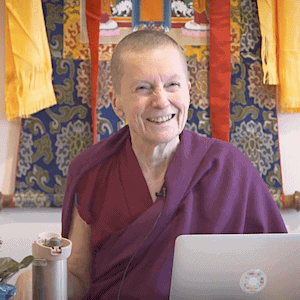
 Venerable Sangye Khadro
  Introduction to Tantra
  May 10, 2021
 Part of a five-part course introducing Tantra taught during an online weekend retreat organized by O Sel Ling in Spain, May 2021
- Tantra (Vajrayana) and Paramitrayana differences
- Kayas: truth and form bodies
- Paramitrayana: wisdom and method practiced separately
- Tantra (vajrayana): wisdom and method practiced simultaneously
- Lama Yeshe “concrete view”
- Different views on Buddha’s attainment of enlightenment
- Three aspects of deity yoga
- Tantra as a quick path
- Emptiness, a quality of phenomena
There were some questions that were sent in, so I will start by answering these questions. The first question is, “What is the meaning of intrinsic from the Buddhist point of view?” It’s a little complicated because within Buddhism, there are different schools of thought, different philosophies, with regard to the meaning of selflessness, the meaning of emptiness. Not all Buddhists agree about this. And usually, the Tibetans prefer the school of philosophy called Madhyamika, which means the middle way. And this began with Nagarjuna, a great Indian master who lived a few hundred years after the Buddha and wrote a number of texts explaining emptiness. He’s the founder of the middle way view. But his explanations were based on the teachings of the Buddha. In particular, there’s a group of sutras called the Perfection of Wisdom Sutras, the Prajnaparamita Sutras.
Those are the sutras in which the Buddha explained the emptiness of inherent or intrinsic existence of all phenomena. Nagarjuna simply clarified that and explained what the Buddha meant. But then later, other scholars, other Indian masters, wrote other texts explaining different points of view. So, it’s a bit complicated. But we usually follow the system of Nagarjuna. Most of the FPMT centers in Spain are called Nagarjuna: Nagarjuna, Barcelona; Nagarjuna, Granada; and so on. Nagarjuna is famous in Spain, at least for Buddhists.
Within the Madhyamika system founded by Nagarjuna, they use the term inherent or intrinsic—it depends on how you translate it from Tibetan. Some translators use intrinsic existence. Some translators use inherent existence. And I think those are words we don’t usually use in our everyday language; they aren’t part of our everyday vocabulary. But the meaning of intrinsic or inherent existence is the false way that our mind sees things. And it’s what I was explaining before. For example, it’s the sense of an “I” that we have that seems to exist on its own, from its own side, objectively. We could also say seem to exist autonomously, like it stands by itself without having to need anything else or depend on anything else. It’s really there all by itself. That’s how it appears to our mind when we don’t think about it, when we don’t analyze it. It’s just the raw, gut-level appearance of our “I.”
And we have the same perception about everything else, like other people—people we like, people we don’t like. They also seem to have a real way of existing. We think “There’s a real person over there existing on their own objectively.” And we think this way also with inanimate things—with everything. Everything appears to exist in that way. They use terms like intrinsic existence or inherent existence, and that’s the meaning of those terms. It means that things appear to exist all on their own, from their own side, objectively, as if they don’t depend on anything else for their existence. For me personally, I find it more helpful to use the term independent existence. That’s more clear for my mind. I can understand the meaning of independent existence. But inherent or intrinsic existence is a little harder to understand. You can use whatever term you prefer.
And the thing is, we have to observe our experience. We have to look at our experience and try to notice if this is the way we see things. Like with our sense of self or “I”: does it seem to exist all on its own, independent of everything else, objectively, from its own side? Does it seem to have that appearance, that way of existing? And there are lots of books or texts that explain more about this, about how we can search for this sense of an inherently or intrinsically existing “I.” It’s not easy. I have been learning about this for many, many years—more than 45 years. I still find it difficult. It’s not an easy topic. It’s very difficult. But anyway, that, I hope, gives more understanding of the meaning of that term “intrinsic.”
Being wisely selfish
The next question is: “If we cultivate altruism and compassion in order to be happier, are we still caught in attachment? Should we not cultivate altruism and compassion without expecting anything in return?”
Yes, the best way to cultivate altruism and compassion is without seeking any benefit for ourselves, even wanting to be happier. That’s the best way. That’s the most ideal way. But we do tend to be selfish creatures. Self-centeredness is very much a part of our mind and our feelings and our experiences. And we can’t just immediately stop that. We can’t just immediately cut off our self-centeredness, our concern for our own happiness. It’s been part of our mind for such a long time. It’s really, really, really deeply embedded in our mind. And it won’t go away just like that. It takes time to go away.
But while it’s still there—while we still have this self-concern and wish for our own happiness—we can utilize that. We can use that self-centered attitude in a beneficial way. If what we want is happiness, if we want to be a happy person, then we’ll realize that being completely selfish won’t make us happy. That doesn’t bring happiness. That just makes me unhappy. But on the other hand, if I can be more kind, more compassionate, more generous, more altruistic, and help other people, that will make me feel better. That will make me a happy person. So, I want to do that. I want to be a happier person. And the way to be a happier person is to be more altruistic.
The Dalai Lama actually talks about this. He says, “If you’re going to be selfish, at least be wisely selfish.” What he means by that is, if you really want your own happiness, do the things that will bring you happiness. And what are the things that will bring you happiness? It’s altruism, kindness, compassion, generosity, caring about others. Those are the things that will bring you happiness. And they will also benefit others, by the way. So, it’s kind of logical. It makes sense if you think about it. “I want to be happy. And if I’m kind to others, that will make me happy. And it will also make others happy, so it’s a good thing to do for everybody.” Then, while we are in the process of doing this—trying to be more kind and more compassionate, more altruistic—our self-centeredness will gradually decrease. It will go down. Our focus will shift more towards others and less towards oneself. Then self-centeredness gradually decreases.
Like I said, right from the beginning, we can’t expect ourselves to be totally unselfish. It’s just not possible. It’s just not realistic. I like what the Dalai Lama says. If you’re going to be selfish, at least be wisely selfish. Be selfish in a smart way, in an intelligent way—help others.
How can enlightened beings helps us?
Then the next question is, “How can an enlightened being, if he is no longer reborn in samsara, if he is no longer here, help sentient beings?”
Even before becoming an enlightened being, one becomes a bodhisattva. A bodhisattva is like someone who’s training to be a buddha, training to be an enlightened being. They’re not there yet, but they’re working towards that. And so a bodhisattva cultivates bodhicitta, practices the six perfections, and creates the causes to become a buddha, an enlightened being. This happens gradually over many stages. It’s said that there are 10 stages of the bodhisattva’s path. These are called bhumis. The Sanskrit term is bhumi. There are the 10 bhumis. I don’t know if you’ve heard about that. But those are the stages for a bodhisattva, as the bodhisattva is cultivating more and more wisdom, compassion, and merit, and creating the causes to become a buddha, to become fully enlightened. A bodhisattva who’s on these 10 bhumis is someone who has already realized emptiness. They’ve had a direct realization of emptiness.
They have incredible compassion, altruism, love, and so on and so forth. And they still have things in their mind they need to purify. They have some afflictions, some obscurations that they have to gradually get rid of, gradually purify from their minds, as they’re progressing through these 10 stages or bhumis. And that can take time. It can take many, many lifetimes to pass through these 10 bhumis and then finally reach enlightenment. So, this bodhisattva still takes birth in samsara. However, they aren’t reborn because of karma and afflictions. Instead, they are born because of compassion and prayers. They’ve actually gained some control over the process of death and rebirth. They can choose where they are born instead of us ordinary beings who don’t have any choice, but it’s our karma that throws us into a life. This kind of bodhisattva is no longer controlled by their karma and affliction.
They can choose where they are born. And so they will take birth in places where they can continue to help sentient beings to practice and follow the path to enlightenment. And so the factors causing their rebirth, instead of karma and afflictions, are compassion and prayer. That explains how a bodhisattva will continue to take birth in samsara, because they want to help sentient beings. And they want to be in samsara in order to help sentient beings. They are not born in samsara because of attachment and wanting to experience samsaric pleasures. And they’re not born because of confusion and ignorance, as if they don’t have any choice. They deliberately choose a rebirth because of their compassion and prayer. And then when a bodhisattva becomes a buddha, a fully enlightened being, it’s true that a buddha is no longer in samsara.
However, a buddha continues to have this wish to help sentient beings. And one of the powers of a buddha is being able to manifest different forms. They can manifest many, many different forms at the same time. They can send these emanations or manifestations all throughout the world, all throughout the universe, in places where they can help sentient beings. We don’t call this rebirth. This is not called rebirth. Buddhas don’t have to be reborn. But they send emanations, they send manifestations, to help sentient beings. That’s how a buddha continues to help sentient beings. And they do this even though they’re not in samsara—in the sense that they are free of the causes of samsara; they’re free of karma and afflictions. So, I hope that answers that question.
Tantra and consort practice
The next question says, “Does the sexual misinterpretation of tantra have to do with consorts?”
I think there was a degenerate time in Tibet related to tantra and monks practicing sex. Well, apparently this happened in India as well. tantra was practiced in India and then later brought to Tibet. And what I heard was that there were some people who misused tantra and were corrupt and deluded and were using it in the improper way. And this probably happened in Tibet as well. I don’t know. I’m not a historian, so I can’t say for sure what was going on in Tibet. But it’s just what I heard or what I read. There were some people who misunderstood and misused tantra for their own sexual gratification, sensual gratification.
Starting in this session and then continuing tomorrow, I’ll talk more about what is actually involved in tantra. And hopefully I’ll come back to this question about consorts—what consorts are all about, and what’s the real purpose within tantra. But it’s quite easy to get confused about tantra because if you look at Tantric images, like thangkas and statues and so on, many of them do show two figures, a male and a female, in sexual union. I think originally these kind of images were meant to be kept secret and only used by practitioners and not displayed publicly. But things got out of hand. And now these kind of images are everywhere on the internet, in museums, bookstores, and so on. So, people can see these images. And if they don’t know what tantra is all about, they can easily misunderstand and get the wrong idea and think it’s just about sex. As we go on, hopefully that question will be cleared up.
What goes from life to life?
Then the last question says, “If everything exists interdependently, how is karma and mental continuity between lives related? What continues from one life to the next?”
This is a very good question. And again, it’s a little complicated because Buddhism has existed in this world for more than 2,500 years. That’s a long time. And it’s spread to many different places. And it was taken up by many different people. So, there’s been plenty of time for people to discuss Buddhism and write texts about Buddhism and come up with different ideas about it. Within Buddhist philosophy, there are different points of view about questions like this one. Because it is an important question. If Buddhism says there’s no fixed permanent self—if none of us have a fixed permanent, independently existing self—then when we die and take rebirth, what is it that continues from one life to the next? And how is it that the karma that is created in one lifetime will show up in another lifetime as results, experiences that we have? This is a really good question, a really important question.
And there are different answers. Different Buddhist schools will answer this question in different ways. Not to get into all the complicated details of this, but just to answer it in a general way: we do have a mind, and our mind is that part of us that is aware and perceives things, feels things, has thoughts and emotions and memories and so on. All of our conscious experiences are included in what we call mind in Buddhism. And mind is something that is impermanent. It’s changing all the time. It isn’t a fixed thing that is always the same. But it’s more like a stream or a river that’s kind of flowing in a way, although it’s not a physical thing. We need to understand that—it’s nothing physical. It’s not made of cells or molecules or atoms; it has no physical properties at all.
It can’t be seen or touched. We can’t put it under a microscope and examine it. It’s totally non-material, non-physical. And it’s made up of all these different conscious experiences. Each one of us has a mind. And our minds are unique. They don’t get mixed up with each other. Each one has our own mind, our own mental continuum. And that’s the thing that passes from one life to another. When we die, our mind separates from our body and leaves the body. And that’s when the body becomes a corpse—a dead body that has no more life, no more movement, no more feeling. And it needs to be buried or cremated or whatever. So, the body comes to an end and has to be disposed of. But our mind doesn’t end. Our mind doesn’t stop when our body does. It continues to exist, separate from our body. And that’s the thing that will take a new life, a new rebirth.
But the mind is composed of different parts, different types of mind. And the mind that goes from this life to the next life, doesn’t mean all of our thoughts and all of our perceptions and all of our experiences. It’s not one whole lump that goes to the next life. Again, there are different explanations about this, but since we’re talking about tantra or Vajrayana, the Vajrayana teachings have probably the most clear, detailed explanation about this whole process of dying and taking rebirth, about what actually happens. The process of dying involves eight different steps or eight different stages. And as we go through these eight stages, our mind will go from a more gross level of experience—like all our usual thoughts and our perceptions; those stop happening—to subtler and subtler levels, until finally it reaches the most subtle level of the mind, which is called the clear light. You’ve probably heard that term. The Dalai Lama talks about it a lot. There are books about it and so on. But it’s only in Vajrayana Buddhism that you find that term of clear light. No, actually, that’s not true. Dharmakirti mentioned it as well. That term might exist in other forms of Buddhism, but the way it’s explained in Vajrayana Buddhism is unique.
The clear light mind is the most subtle level of mind. And during our life, it usually doesn’t manifest. It’s not something we are aware of, except, they say, at certain moments in our life. For example, when we’re going to sleep, as our mind is passing from a waking state to a sleep state, there is a very brief moment when the clear light mind manifests. But most people don’t notice. Most people aren’t aware of it. They also say it can manifest when we faint or when we have a sexual orgasm. It can also manifest then. I think it can manifest with sneezing as well; I don’t know. But again, it’s so subtle. Most people don’t notice it, don’t recognize it. But the main time when it becomes manifest is when we die. As our mind is going to deeper and more subtle levels then this clear light mind manifests.
And that is the aspect of our mind that leaves the body and then goes out, away from the body, to take a new life, a new rebirth. It’s the clear light mind. This is according to Vajrayana Buddhism. Other schools of Buddhism would say something a little different. Some would say it’s the mental consciousness. Because all Buddhist schools say that we have six consciousnesses—six different aspects of our mind. The first five are related to our senses: seeing, hearing, smelling, tasting, and the sense of touch. We have a different consciousness for each of our five senses. And then we have the sixth consciousness, which is called the mental consciousness. And that’s the part of our mind that thinks and has emotions and memories and fantasies and so on. So, that’s like a separate aspect of the mind as opposed to the five sense consciousness.
Some Buddhist schools will say that it’s the mental consciousness that leaves this body and takes rebirth in the next life. And when we create karma, karmic imprints are kind of left in the mind, a bit like when we plant seeds in the ground. And then when those seeds get water and light and the right temperature, they will grow and produce flowers, vegetables, and so on. In a similar way, actions that we do, karma that we create, leave seeds in our mind. And those seeds stay in the mind unless we can purify. If we do negative actions and create negative karma, we can purify those seeds so we don’t have to experience suffering. And seeds of virtuous actions, unfortunately, can be destroyed or damaged.
Anger is a very powerful negative energy that can destroy our good karma, our virtuous karma, which we don’t want that to happen. So, it’s really good to try not to get angry. But anyway, if the seeds of our karma don’t meet some countermeasure, some counterforce, they stay in our mind and go with the mind into the next life. And then even for many, many lifetimes, for many thousands of years or millions of years, they stay in our mind. And then finally, when the right circumstances come together, they ripen and become experiences that we have. That’s a brief explanation. And it’s all interdependent. All of this is interdependent. Karma is something that exists dependently. Our mind exists dependently. Our experiences exist dependently. There are many, many different factors and causes and conditions that come together for this process to take place. It all happens without things existing independently or inherently.
Unique features of tantra
Now, let’s get back to looking at how tantra or Vajrayana differs from the other branch of Mahayana, the Paramitayana or the Sutrayana. I mentioned the ways in which they are the same. But there are ways in which they are different. One difference is that in order to practice tantra, in order to practice Vajrayana in a complete way, you need to first receive an empowerment or an initiation. I don’t know how you call that in Spanish. But in English, sometimes we use the word “empowerment.” Sometimes we use the word “initiation.” This is a ceremony that is conducted by a tantric master, a qualified master. You need to attend this ceremony and participate in it. And I’ll talk more later about what is an initiation and different kinds of initiations.
But that’s a necessary step to be able to engage in tantric practice. And that’s not the case with the sutra path. You don’t have to be initiated into that, although you do need to have a teacher or you can have more than one teacher. But the path, whether it’s Paramitayana or tantrayana, or even the Theravada path to nirvana, it’s not something you can do just by yourself. There are lots of books, lots of material online, and courses you can do. You can stay at home and read and listen to teachings online and learn a whole lot about Buddhism and meditation and start to practice on your own. But if you’re doing this without a teacher, without connecting to a qualified Buddhist teacher, then you won’t get very far. You might have some helpful experiences, some good experiences.
But if you really want to go all the way to nirvana, to enlightenment, it is necessary to have teachers that you rely on. I’ll talk more later about what kind of teacher to look for, how to relate to a teacher, and so on. But it’s true both for Paramitayana and for Vajrayana that there’s the need for a spiritual teacher that you connect with, that you rely on. But in particular in tantra and Vajrayana, the role of the teacher is really emphasized, and the relationship with the teacher is something very, very important.
The main difference between Vajrayana and Paramitayana lies in methods that are used for attaining enlightenment or buddhahood. The state of buddhahood that we want to attain consists of a number of what are called kāyas. The word kāya is a Sanskrit word, and it’s sometimes translated as body. But we shouldn’t think of body like this kind of body, skin, blood, flesh, bones. It doesn’t mean that. I don’t know another term. I usually just keep the word kāya. Maybe corpus. I don’t know, because the word corpus, we use that word in English. Do you use that in Spanish as well, corpus? It’s a Latin word. The word corpus can sometimes refer to a body like a collection of knowledge, a collection of literature. So, corpus doesn’t necessarily mean like a physical body. It’s more like a collection. Maybe that’s a better word for kāya than body. But anyway, I like to keep it as kāya.
A buddha, an enlightened being, has a number of different kāyas. And there are different ways of explaining these. But the most simple way is in terms of two kāyas. One is called the dharmakāya. Dharmakāya is sometimes translated as truth body. And the other kāya is called the rūpakāya. Rūpa means form, like physical form, material form. So, that’s translated as form body. The dharmakāya of a buddha is the Buddha’s mind, which is totally pure, free of all negative states of mind, all afflictions, all delusions; it has no ignorance, no attachment, no greed, and all good qualities. There are only good qualities in the Buddha’s mind. Compassion and love and generosity and wisdom—all the good qualities—have been fully developed and fully perfected. So, Buddha’s mind is completely pure, fully developed.
Also, we say in Buddhism that a buddha’s mind is omniscient, meaning they know everything. A buddha knows everything. A buddha can see everything, even in one moment. This is really amazing. It’s kind of mind-blowingly difficult to conceive of, but they say even each moment of a buddha’s mind is able to see everything that exists—all the different living beings, and also what’s going on in their minds—all their thoughts, their feelings, their experiences—and is able to see their karma. Buddha can see our karma: our good karma, our bad karma, our neutral karma. The Buddha can see the past. Buddha can see all our past lives: everything we’ve ever done, every kind of being we’ve ever been. Buddha can also see the future. So, the Buddha is able to see everything throughout the universe: living beings, phenomena—everything. That’s what we call an omniscient mind.
Those are some of the qualities of a buddha’s mind. It’s mind-blowing for us to even try to think about, to try to understand. Buddha’s mind is just amazing. So anyway, Dharmakaya refers to the mind of a buddha. And the Rupakaya, the form body or corpus, refers to forms that a buddha can manifest, can emanate. As I mentioned before, a buddha has the ability to emanate many different bodies at the same time. And these bodies can be like human bodies. They look like us, or they could be animal bodies in order to help animals. Or they could be deva bodies in order to help devas, the gods. They could also be inanimate objects. They could be trees or cars or food or whatever. A buddha can manifest in any form at all that will be helpful for sentient beings. That’s their purpose in manifesting these different forms: to help sentient beings to wake up, to emerge from suffering, and eventually reach enlightenment.
The term rupakaya refers to these different forms that a buddha will take to help sentient beings. Those are the two kayas. Maybe “aspect” would be a good word to describe this—two different aspects of an enlightened being. There’s the mental aspect, the mind of a buddha, and then there’s the form aspect, the emanations that a buddha will create and send out to help sentient beings. If we want to reach enlightenment, if we have the aspiration to become an enlightened being, this is what we are aiming for. This is what we want to achieve. We want to achieve these two kayas: the Dharmakaya and the Rupakaya.
Creating the causes for enlightenment
How do we do that? It’s not just by wishing or praying, but we have to create the causes. There are causes. Most things in the world have causes and conditions. If you want to bake a loaf of bread then you have to put together the right ingredients—the flour and the water and whatever else you put into it—and then put it in the oven. If you want to grow some flowers, you have to get the right kind of seeds, put them in the ground, add water, look after them, and then they will grow. Things occur because of causes and conditions. And this is true for enlightenment as well, with these two kayas. They have their causes and conditions.
If we want to achieve enlightenment with those two kayas, we have to create the right causes and conditions. The main causes are what we call method and wisdom. You may have heard this before. They sometimes use the analogy of a bird having two wings. For a bird to be able to fly, it needs two wings. It can’t fly with only one wing or no wings. It needs two wings to fly. Similarly, if we want to become a buddha, we need the two wings of method and wisdom. Wisdom is what I was talking about earlier: understanding the true nature of everyone and everything, understanding the true nature of ourself, true nature of all other people, all other beings, all phenomena. The wisdom that sees things as they really are is one of the causes for enlightenment. And that’s the main cause for the dharmakaya. If we want to achieve this dharmakaya—the mind of a buddha—we need to practice wisdom, cultivate wisdom.
And the other wing is method. And method is the main cause to achieve the rūpakaya, the form body of a buddha. And what is method? In general, we can say method consists of cultivating bodhicitta and compassion, love, and then practicing the first five perfections. There are six perfections, which I mentioned before. The first five perfections are included in the method side of the path. Those are generosity, ethics, patience, joy, effort, concentration. Those five practices constitute the method side of the path. And also, to become enlightened, one needs to accumulate a lot of merit, a lot of positive energy. A bodhisattva will do that by giving—for example, making large gifts, being very generous for sentient beings—but also by making offerings to buddhas and bodhisattvas. There are different ways of accumulating the merit that’s needed to reach enlightenment. And this is done on the basis of compassion and love and bodhicitta.
So, those are the two main practices a bodhisattva will engage in: wisdom and method. And wisdom becomes the main cause for the dharmakaya, the mind of a buddha. Method becomes the main cause for the rupakaya, the body, the forms of a buddha. This is true for both branches of the Mahayana, both the Paramitayana and Vajrayana or tantra.
Differences in method
But when it comes to the way that you practice, there are differences. And the differences are more on the side of the method, rather than the wisdom side. The wisdom is pretty much the same. Whether you’re following Paramitayana or Vajrayana, you need to meditate on emptiness; you need to cultivate this wisdom realizing emptiness of the true nature of things. That’s the same. But on the method side, there are some differences. In the Paramitayana, when a bodhisattva is practicing method and wisdom, they are done separately—on separate occasions with separate minds. For example, at certain times, a bodhisattva is meditating on emptiness. They’re sitting in meditation and meditating on emptiness and cultivating the wisdom that understands emptiness.
A bodhisattva needs to do that quite a lot, so that they cultivate this wisdom and it gets stronger and stronger and better and better and powerful enough to overcome the afflictions and the obscurations in the mind. Part of a bodhisattva’s practice is to cultivate wisdom. And at other times, a bodhisattva will be out of meditation, and they will be interacting with the world, with sentient beings. They’ll be practicing generosity, and ethical conduct, teaching sentient beings, and so on. So, they’re practicing the other aspects of the bodhisattva path, which are more the method side. These occur at different times, and the bodhisattva’s mind will be different at these different times.
But method and wisdom affect or influence each other. So, for example, when the bodhisattva decides to sit down and do some meditation on emptiness in order to cultivate wisdom, they will precede their meditation with a cultivation of the bodhicitta motivation. That way they have the bodhicitta motivation for doing this meditation on emptiness. Their awareness is “I’m meditating on emptiness in order to become enlightened for the benefit of all sentient beings.” And that bodhicitta motivation will influence their mind while they are meditating on emptiness. It’s like the mind meditating on emptiness has this kind of flavor of bodhicitta, you might say. They’re not doing it with self-centeredness just for their own benefit, just to reach nirvana and be free of suffering. They’re doing it because they want to help all sentient beings. Their strong bodhicitta will influence their mind while they’re meditating on emptiness.
And this is true even though while they’re sitting there and meditating on emptiness, they are not actively thinking about sentient beings and actively thinking about how to help them. Instead, they’re focusing on emptiness. And they may even get into a state of single-pointed meditation, of directly perceiving emptiness. And at that point in time, they’re not thinking about sentient beings at all. Sentient beings completely disappear from their mind. And yet, there’s still this influence, this flavor of bodhicitta influencing their mind. Don’t ask me what that means because I’m not there yet. I haven’t reached that point. I’m not talking from first-hand experience, but this is just how it’s described. And then they finish their meditation on emptiness. They have a strong experience of the wisdom realizing emptiness and then they rise from their meditation at a certain point.
Then they go out and interact with sentient beings and help sentient beings. And while they’re interacting with sentient beings, their bodhicitta is much more on the surface, much more manifest. But the experience of emptiness, the wisdom of emptiness that they had while they were meditating on emptiness, that’s not there in the forefront of their mind. But there’s still some influence there. Their understanding of emptiness will influence the way in which they interact with sentient beings. For example, let’s say the bodhisattva sees a homeless person sitting in the street looking very unhappy and hungry and miserable. The bodhisattva will feel this strong sense of compassion and will find something to give to this poor person.
But while they’re engaged in this practice of giving, they have this awareness that there’s no inherently existing I over here in themselves. They also see the person that they’re helping as empty of inherent existence. There’s no inherently existing beggar or homeless person over there. And whatever they’re giving—food or money or whatever—they also understand that as empty of inherent existence. So, this whole experience of giving, even though it may only take less than a minute, is within the understanding of the emptiness of inherent existence. And that’s because they’ve been spending a lot of time meditating on emptiness. They have a strong experience of emptiness. And that experience of emptiness still carries over into their actions for helping sentient beings.
Practicing wisdom and method together
So, this is talking about Paramitayana and how method and wisdom interact with each other, how they affect each other. Even though they are practiced at different times and with different states of mind, they do support each other. That’s how a bodhisattva practices method and wisdom and creates the causes to finally become a buddha and have the two kayas. Now, the unique feature of Vajrayana that makes it different from Paramitayana is that there’s a way of practicing method and wisdom simultaneously at the same time with one single mind. Let’s say you’re practicing with Avalokiteshvara, also called Chenrezig; that’s one of the deities in Vajrayana. Let’s say that’s your main practice. The practice is called a sadhana. Sadhana is the literal meaning of a method of accomplishment.
It’s a practice that contains different prayers, recitations, visualizations, and so on. Once you’ve taken a Vajrayana initiation, then you can do one of these sadhanas. So, let’s say you’re doing the sadhana of Avalokiteshvara, Chenrezig. And right at the beginning, you need to generate the bodhicitta motivation to make sure you’re doing it for the right reason. It’s essential that you have the right motivation for doing this practice. And at a certain point in the sadhana, you meditate on emptiness. So, ideally, you have a good understanding of emptiness; you know what that means, and you can meditate on it. And you can dissolve everything into emptiness, including your sense of self or I: “There’s no inherently existing I or me over here.” And also the deity Avalokiteshvara that you’re meditating on is also empty of inherent existence. And all sentient beings are empty of inherent existence. And all phenomena—everything in samsara, everything in nirvana, all things, whatever exists—is empty of inherent existence. So, you meditate on that.
And ideally, you really know what that means. And you can generate an experience of that. So then, your normal appearances of things dissolve or disappear. And from within that, that mind that understands emptiness and is influenced by bodhicitta arises in the form of the deity Avalokiteshvara in this case. That means you visualize Avalokiteshvara appearing. And you meditate on all the details; you try to see it as clearly as possible. And it’s right here, not over there, or up there; it’s here, where you are. And you identify with that. This is what’s called divine pride or divine identity. It’s where you feel, “This is me. This is who I am. I am Avalokiteshvara.”
Now, you can only do that if you’ve received an empowerment and initiation and instructions from a qualified teacher. And like I say, ideally, you do need to have a good understanding of emptiness and genuine bodhicitta, or at least the bodhicitta motivation for doing this practice. That practice of seeing yourself as Avalokiteshvara is a combination of method and wisdom in one single mind simultaneously. The appearance of the deity Avalokiteshvara is the practice of method, because it’s this appearance in a form to benefit sentient beings. The whole purpose of appearing as Avalokiteshvara is to benefit sentient beings. This is a form that will help sentient beings be free of suffering, help them reach enlightenment.
And simultaneous with that visualization, you have the understanding that it’s empty of inherent existence. So again, you have to have a very good understanding of emptiness. And you see this appearance of Avalokiteshvara’s form as empty. It’s appearing, but you know that it’s empty of existing inherently, independently. That feature of Vajrayana practice is sometimes called deity yoga: having the appearance of a deity, identifying with that appearance of the deity, while simultaneously understanding its emptiness of inherent existence. That’s the way in which method and wisdom are practiced in Vajrayana Buddhism or in tantra.
And it’s said that if you can do that practice where you’re combining method and wisdom simultaneously with one mind, that enables you to reach enlightenment more quickly than with the Sutrayana or Paramitayana practice. Because that is one of the features. It’s said that Vajrayana or tantra is faster. It’s a faster way to enlightenment. I think I mentioned that yesterday. It takes less time to reach enlightenment than in Paramitayana. With paramitayana, they say the minimum amount of time it takes is three countless great eons. Shakyamuni Buddha spent that long. He spent three countless great eons practicing to reach enlightenment. Whereas with Vajrayana Buddhism, it’s said that it’s even possible to reach enlightenment in this very lifetime. But that’s not for everybody, so don’t get excited about that.
I’ve heard the Dalai Lama say that’s actually kind of like propaganda. He said that realistically, maybe one person in a million will be able to reach enlightenment in one lifetime. Definitely not everybody—many people will still take many lifetimes. But it’s still faster. It’s said to be still faster than Paramitayana. And the reason it’s faster is because of this feature that you are practicing method and wisdom, the two main causes for enlightenment, together in a single mind at the same time. That’s one of the special features, one of the unique features, of Vajrayana Buddhism, tantra. But you can see how difficult it is to actually do this. It’s not easy, because you really need a good understanding of what emptiness means, not just the words, but some taste of emptiness, some experience of emptiness. You also need bodhicitta—again, some taste of bodhicitta, not just the word. It’s not easy. It does take time and effort to cultivate those two things and then bring them together in one kind of practice.
Guided Meditation
We didn’t do a meditation on emptiness. I talked about it, but we didn’t have a chance to meditate on it. So, maybe we can start this session with just a brief meditation to try to get more understanding of that topic. Make yourselves comfortable. Take a few minutes to settle down. Pay attention to your breath, coming in and going out. Just stay focused on the breath for a few minutes. And if other thoughts come up in your mind, don’t get caught up in them. They are impermanent, like clouds in the sky. You can put them aside, let go of them, and come back to the breath. Really try to stay in the present moment, stay aware of your breath flowing in and out, and do your best not to think about other things.
See if you can remember a time when your sense of self, I, came up very strongly. This happens when we feel some strong emotion, such as fear—we feel like some terrible thing is about to happen to me—or because of anger. Somebody did something that we found hurtful, and we resent what they did. It could also be excitement—something wonderful happens to us or somebody praises us. Those are some examples of times when a strong sense of I, me, self comes up in our mind. Try to remember such a time, such an experience.
And once you have remembered this, don’t think so much about the actual situation. Instead, try to focus on that sense of I—that feeling of I—inside of you. Try to get a clearer picture of that I. What exactly is it? Is it something physical, some part of your body? Can you point to some part of your body and say, “That is me. That is I”? Some of you might think, “The body isn’t me. I’m not any part of my body. I am my mind.” You may identify more with your mind, your thoughts. But according to Buddhism, mind is also something made up of parts. It’s not just one thing. It’s there and always the same. It’s more like a river or a stream of different experiences, thoughts, memories, perceptions, emotions. So, think about that idea of your mind being the I. If that is the case, which part of your mind is the I? Which kind of thought or emotion or perception is the I?
Some of you might think, “I’m not just one part of my mind. I’m all of it. Every part of my mind is me.” But then that can become confusing if we analyze it. Because at certain moments, we have very different experiences. Sometimes we’re loving, kind. Other times we’re hateful, hurtful. Sometimes we’re joyful. Other times we’re deeply sad and depressed. Sometimes we feel very clear and intelligent. Other times we feel really dull and stupid. We have many different types of experiences in our mind. And if we say that all of that is me, does that mean we have a loving I, a hateful I, a joyful I, a depressed I? Is that the case that we are many selves, many persons? Or are we just one person?
You may not have come to any conclusion after asking these questions of yourself. But just check to see if there’s any difference in the way you feel about yourself now compared with the beginning of the meditation when you thought about that time when your sense of I was very strong, very powerful, felt very real. Do you still feel your sense of I is very real and solid?
Our normal concrete view
That’s just giving you an idea of how you can start to explore the sense of I. And like I say, it doesn’t mean you have to find an answer to that question. But just doing the exploration itself can be very helpful to loosen the sense of I. Lama Yeshe used the term concrete view to refer to the way we normally see our self and others in the world. Concrete is something really, really hard and solid. And that’s the typical way we see everything. We feel there’s a real concrete I over here and real concrete people over there—people I like, people I don’t like. There are real concrete situations, a real concrete government, a real concrete society—everything seems very real and concrete.
And that view of things is what feeds our emotions, like our anger, our hatred, our fear, our jealousy, our attachments. When we see things in a very concrete way, our disturbing emotions are more strong and become more problematic. It’s helpful to do this kind of investigation, asking, “What exactly is this I anyway? Do I really exist the way I think?” Or we can also investigate another person, somebody we really dislike, or somebody we really like, someone towards whom we have strong emotions. We can also investigate them. “What exactly is that person that I like so much or that I don’t like, that I feel angry at?” And hopefully we come to see that maybe they don’t exist in such a concrete, solid way as we think.
That can be a little tricky. But let’s say there’s somebody I dislike, somebody I find annoying or irritating, and so I have these kind of negative feelings towards that person. I ask myself, “Does everybody see the person the same way I do? Does everybody else also feel irritation and dislike towards that person?” Because we tend to think that person is really irritating from their own side. It’s almost like that’s their nature, that’s their characteristic. They’re really so disgusting or stupid or ugly or whatever—whatever we say about them. We feel like it’s really there from that person’s side. It really exists that way. Now, if that was true, everybody would see the person the same way we do. Everybody would find that person annoying or unlikable, disgusting, stupid or whatever.
But that’s not true. It’s never true. There are always some people who like that person, who think, “I love them so much. They’re so wonderful. They’re so fantastic.” And we find that hard to believe. But it’s true, isn’t it? The person you find so annoying, other people love. Other people find them wonderful. So, how is that? How is that possible? We would say, “Oh, they are just stupid. They are blind. They don’t know. They don’t see that person correctly.” Well, maybe not—maybe we are the one who’s blind, who doesn’t see that person correctly. Maybe we are the one who’s deluded. And we can also think about the Buddha. How does the Buddha see that person? Do they feel disgusted, annoyed, irritated? No, Buddha doesn’t see anybody with aversion, with irritation, with impatience.
Buddha has nothing but love and compassion for every sentient being. Because the Buddha sees everyone as they are, whereas we tend to see people distorted by our own prejudices and our emotions, our likes, our dislikes. And behind that is our ego—a sense of self, a sense of I, what’s good for me, what’s not good for me, what makes me feel good, not feel good. Just exploring this is really helpful. And the effect that it has is to loosen or soften the concrete view. Things don’t seem so concrete, solid, real as before. I like that expression that Lama Yeshe used of a concrete view. I can really see it in myself.
And this is a very helpful method to use to soften the concrete view. And it’s very practical; it’s something we can use in our daily life even if we’re a long way from understanding emptiness. It does take a long time to really understand emptiness. But just doing this kind of investigation—checking, “How do I see things? Do I see things correctly? How do other people see things?”—helps soften that concrete view. And that really helps to cool down our emotions. Our emotions are then not so explosive and dominating in our mind. That’s very helpful.
Q & A
Audience: There was a question that came up. Somebody is asking about a Chenrezig initiation that His Holiness did last year in which he said there was no obligation of daily practice. It can be resumed after months, right?
Venerable Sangye Khadro (VSK): Each time an initiation is given, the person giving the initiation will decide whether or not to give a commitment or an obligation. And this person is asking about when the Dalai Lama gave the initiation and he didn’t give any commitment; he said, “You don’t have to do practice every day.” Sometimes they do. Sometimes they do. If they say you need to do sadhana every day, or you need to recite certain mantras every day, then you are supposed to do that. So, if he said there’s no obligation, that means you don’t have to do anything. It’s good to do, but you don’t have to. Of course, anytime you want to do the practice, you can do it. There’s no problem with that.
Audience: There’s another question: “Buddha came to enlightenment through Paramitayana, and later in his teachings, he also shared tantra with some disciples. Is that so?”
VSK: Yes, according to the Vajrayana tradition, it was taught by the Buddha. It is traced back to the Buddha. But many other Buddhists, including scholars, say that Buddha didn’t teach tantra, that it appeared much later after Buddha passed away. It’s controversial whether the Buddha taught it or not. But if you ask a Vajrayana teacher or practitioner, they would say, “No, no, no—it comes from the Buddha. It was taught by the Buddha.”
Audience: How did the Buddha know about tantra? Did the previous buddhas play any role in it?
VSK: Well, there are different versions of the Buddha’s attainment of enlightenment, different stories about how the Buddha attained enlightenment. Again, not everybody agrees on that point. According to Vajrayana Buddhism, the Buddha did practice Paramitayana for a long time: three countless great eons. And then according to Mahayana, the Buddha did not become enlightened sitting under the Bodhi tree in Bodhgaya. That’s the version of the Buddha’s enlightenment that you’d find in the Theravada tradition. But according to the Mahayana tradition, the Buddha was in one of the god realms called Akanishta, which means not low. It’s the highest god realm in the form realm.
There are all these different god realms in Buddhism; it’s very complicated. But anyway, he was in that place—Akanishta. He was in the form of a deva, and he was just about to attain enlightenment. There he was initiated into tantra and practiced tantra and achieved enlightenment through the practice of tantra. That’s the tantric version. I can’t remember all the details, but I think even within tantra, there are different classes of tantra. And I think there’s some slight variation in their versions of how the Buddha became enlightened. So, it’s complicated. But anyway, the Buddha did learn and practice tantra before he became enlightened. It was something that he knew. And that’s why he was able to teach it afterwards.
In fact, according to tantra, according to Vajrayana, anybody who wants to become enlightened has to practice tantra. It’s a must. It’s impossible to go all the way to full enlightenment without practicing tantra. So, that means all the previous buddhas and all the future buddhas and ourselves, when we become buddhas, it will be necessary for us to engage in tantric practice. That’s the tantric version. But there are other versions of the Buddha’s enlightenment.
Using delusions on the path
Let’s go back to the outline. We were talking about the differences between Vajrayana and Paramitayana. One is that wisdom and method are practiced simultaneously in one consciousness. And that’s very, very powerful. That enables you to free your mind from the afflictions and obscurations that prevent enlightenment very, very quickly, more quickly than Paramitayana. And then the second difference is using delusions in the path.
Delusions is another term for afflictions or disturbing emotions. These are things like hatred, anger, ignorance, desire, attachment, and jealousy, and so on. Those are things we need to free ourselves from. We need to eliminate them from our mind in order to become enlightened and even to attain nirvana. Those are obstacles to attaining nirvana. So, we have to free our mind from them. In Vajrayana, it’s said that these afflictive emotions can actually be used in the path. And this is mainly talking about desire or attachment. I haven’t heard explanations of how anger can be used in the path or ignorance can be used in the path. And when I was studying this topic—the grounds and paths of tantra—I was in Lama Tsongkhapa Institute in Italy. One of the students asked the teacher, “Can you give an example of how anger is used in the path?” And he said, “I don’t know of an example of that.”
So, I haven’t come across that. It’s mainly desire, mainly attachment, that’s used in the path. Now, this is probably one of the reasons why Vajrayana is so misunderstood and can be corrupted. Because some people then think, “Oh, that means I don’t have to be free of desire. I can have all the desire I want. And I can practice tantra and reach enlightenment with all this desire.” This is not the right understanding. One of my teachers said that when they talk about using desire in the path, it’s not talking about the ordinary desire that ordinary people have, which is very gross, very strong, very powerful. Instead, it’s talking about a more subtle kind of desire that’s in the mind of advanced practitioners—people who are already highly developed, highly accomplished on the path and haven’t completely eliminated desire.
But it’s very much under control. It’s not exploding all over the place. So, you have to be an advanced practitioner to be able to do this. It’s not something that anybody can do. And it also requires an understanding of emptiness. One of the texts explains how this is done. When the practitioner observes some attractive object, and they notice desire is starting to arise in their mind, they immediately switch to meditating on emptiness. They bring to mind emptiness. They already understand emptiness, so they bring that to mind and meditate on the emptiness of the “I,” the emptiness of the object, the emptiness of the desire itself. They see everything in the context of emptiness. And when we feel desire, there’s some pleasant feeling. It’s kind of a nice, pleasant feeling, a blissful feeling.
So, they’re still feeling this desire and a blissful feeling with it, but they’re seeing everything in the context of emptiness. They’re not letting their mind follow desire, because when desire comes up in our mind, the normal thing that happens in our mind is we get all caught up in “oh, I want that. If I had that, I would be so happy.” And maybe we start having fantasies. We tend to exaggerate as well. There’s a lot of exaggeration of the object; we’re building it up into something much more wonderful, much more beautiful, than it really is. The mind just proliferates all these thoughts and exaggerations and fantasies and expectations. Does that sound familiar? Have you ever noticed that? It’s like when you go shopping and you see some nice object, or you see something on TV, or you see something on the internet that looks attractive, or you see an attractive person, some really good-looking man or woman, and your mind just goes kind of crazy with desire and attachment. That’s the usual thing that happens when we have desire.
But this practitioner of tantra notices desire as soon as it arises and doesn’t let the mind get carried away in the usual thoughts and fantasies and expectations. Instead, they remember emptiness: “Everything is empty.” And they stop that usual activity of the mind with desire. They meditate on emptiness. And because there’s a little bit of a feeling of bliss there, that enables them to stay focused on emptiness. Now, again, I’m not talking from experience. This is not something I have had the experience of, but this is how it’s described. And so what they say is this meditation on emptiness that the person is focusing on acts as an antidote to desire. It actually decreases desire, eliminates desire.
And they use this analogy of an insect that is born in wood and then eats the wood. We can think of something like a termite or different insects that are born from eggs inside of a tree or inside of a piece of wood. And then they’re in there and they eat the wood. So, they’re eating it away, destroying it. They say in a similar way, this understanding of emptiness, this meditation on emptiness that the practitioner is using, was born from desire. They, of course, did this deliberately. They allowed their mind to go into an understanding of emptiness after an experience of desire. And then that wisdom understanding emptiness is the antidote to desire; it destroys desire.
The point is that we do need to overcome desire if we want to reach enlightenment. We can’t reach enlightenment full of desire. It’s not like that. But a tantric practitioner uses their ordinary experience of desire and is able to transform that and generate a strong experience of the wisdom realizing emptiness. And that is the antidote to desire. To be able to do this is quite difficult. It’s quite an advanced level of practice, but that’s generally what it means to use desire in the path.
Deity yoga
The next point, number three on the list, is taking the result into the path. This is something that is said about tantra or Vajrayana. It’s sometimes called the resultant vehicle. That’s another synonym for tantra. It’s called the resultant vehicle. The result is referring to enlightenment, buddhahood. That’s what we will get as a result of our practice. That’s the goal we are working towards: enlightenment, being a buddha. Vajrayana is taking that result—being a buddha, being enlightened—and bringing it into the path, using it within the path. How that’s done is mainly this practice that’s called deity yoga. And there are three aspects of deity yoga. One is divine pride or divine entity. The word pride is usually used for a negative state of mind where we feel “I am better than others.” Another term is arrogance. I don’t know if you have different terms in Spanish, but in English it’s arrogance or conceit. So, that’s a delusion.
However, here, when we talk about divine pride, it’s not a delusion. It refers to what I mentioned before: when you’re doing Vajrayana practice, you dissolve your ordinary sense of self into emptiness, and then you imagine your wisdom understanding emptiness appearing in the form of a deity, like Avalokiteshvara or Tara or whatever deity you’re practicing. And you identify with that. You identify, “I am Chenrezig. I am Tara.” That’s the meaning of divine pride or divine identity. It’s like you’re imagining, “One day I will become a buddha. I will become Chenrezig. I will become Tara,” and you’re bringing that into the path as if you’re already there. I
If I was Chenrezig, or if I was Tara, what would I be experiencing? What would I be thinking? We wouldn’t have our usual deluded thoughts. Instead, we’d be looking at all sentient beings and feeling so much love and compassion for them, wanting to help them, wanting to bring them to enlightenment, and so on. That’s the meaning of divine pride or divine identity. Again, it’s said that if you do that, that’s a helpful tool to reach enlightenment more quickly, instead of thinking that enlightenment is so far away, and it’s going to take me such a long time to get there, and maybe feeling discouraged in your practice. This is like building up your confidence: “I will become a buddha one day. And just imagine what that would be like, if I was a buddha right now, how that would be.” It’s sort of giving yourself confidence and bringing yourself to enlightenment more quickly.
And then the second point is clarity. Clarity means that when you’re doing a visualization of like Chenrezig or Tara, there’s usually an environment—what’s called a mandala—around you. Sometimes it’s a beautiful, divine mansion, and maybe there are some other deities there as well. And this visualization needs to be very clear, as clear as possible—really bright, clear, vivid, detailed, and stable. This means that your mind isn’t distracted elsewhere, but you’re holding this visualization very clearly. In fact, in Vajrayana practice, anybody who wants to reach enlightenment has to develop samatha, calm abiding. It’s also necessary for the attainment of nirvana.
We do have to develop very, very strong concentration. And you can develop concentration with any object at all—the breath, or loving kindness, or emptiness. You can use just about any object to develop this concentration. In Vajrayana Buddhism, you use the visualization of yourself as a deity and your environment, the mandala. You spend a lot of time building up that visualization and then staying focused on it, trying to keep it as clear as possible and stable, not wandering. It’s hard work; it’s not easy, but people do it. This is what a Vajrayana practitioner will do.
And then the third one is profundity. Profundity means that while you’re doing this practice of visualizing yourself as the deity and the environment—the mandala around you—you need to remember emptiness. You need to understand that all of these different objects, these different factors, are empty of inherent existence. None of these things exist inherently, independently, from its own side. Does that sound easy to do? I’ve tried it. It’s not easy. It’s very, very difficult. One has to be quite a dedicated practitioner at an advanced level.
Again, that’s why it’s so important that tantric practice is based on a really good understanding and experience of the three principal aspects of the path: renunciation, bodhicitta, and an understanding of emptiness. The more time you spend working on those, building those up, and making those really firm in your mind, then when it comes to the practice of tantra, it won’t be so difficult. It won’t be so challenging.
The right motivation is essential
I just have one more note here about tantra being a quick path, about taking less time than Paramitayana. The motivation for wanting to take the quick path should be bodhicitta; it should be your compassion and love for others, rather than wanting to make it easier for yourself. So, if you think, “I don’t want to spend a lot of time reaching enlightenment. I want to get there as quickly as possible. I want the easy way, the fast way, to make it convenient for myself,” that’s not the right thought. That’s not the right motivation. Instead, it should be so much compassion for sentient beings—seeing how much suffering they have and wanting to help them as quickly as possible.
It should be thinking, “If I take a long time to reach enlightenment then they will be suffering for a long time, and I can’t bear that. I really want to get to enlightenment as quickly as possible, so then I can help sentient beings be free of their suffering.” That’s the right motivation, the right reason, for wanting to take a quick path: strong compassion, unbearable compassion, for sentient beings. That’s something to look at in your own mind. Again, it points out how important it is to really cultivate compassion and love, bodhichitta, as the motivation for engaging in the practice of tantra.
Q & A
Audience: It says: In the Heart Sutra, it says, “In emptiness there is no form, no sensation, no consciousness, no body, no mind, no element of mind, no suffering, no path, no attainment, no non-attainment.” So, what is there?
VSK: The Heart Sutra is a sutra that’s often recited in Tibetan Buddhism and other Mahayana traditions, and these words are there in the Heart Sutra: “There’s no form, no feeling, no consciousness, no eye, no ear,” and so on. You have to understand the meaning of that. It’s good to get some teachings on the meaning of the Heart Sutra. It doesn’t mean literally that all these things do not exist. Rather, this is talking about a practitioner who understands emptiness, who has the wisdom realizing emptiness, and is in meditation and directly experiencing emptiness. That means their mind is directly experiencing emptiness, not conceptually or intellectually. They’re really experiencing it directly.
Such a person is quite advanced, and the term for such a person is Arya. You may have come across that term. Sometimes it’s translated as “noble one” or “superior.” An Arya is a person who has that experience of directly realizing emptiness. So, while they are in that state of meditation directly experiencing emptiness, it’s said that everything else vanishes—even themselves. They don’t even have a feeling of their body. Their body vanishes, their mind vanishes, sentient beings vanish. Everything vanishes, everything disappears. The only thing they experience is emptiness, a direct experience of emptiness. Everything else disappears.
That’s only during that state of mind, that meditative state, that all these things disappear. That’s what it’s talking about in the Heart Sutra, when it says, “in emptiness”—meaning in the state of mind directly realizing emptiness—“there’s no form, there’s no sensation,” and so on and so on and so forth. It doesn’t mean literally none of those things exist. It just means to the mind directly experiencing emptiness, all of those other things disappear.
Audience: What is it that distinguishes emptiness from agnosticism?
VSK: Agnosticism means being unsure, isn’t it? I don’t know; I’m not sure what that question means. Agnosticism is a mental state. It’s a state that people have when they, for example, hear about the Buddha, and they think, “Well, I don’t know if there’s such a thing as Buddha or enlightenment, or not. Maybe there is; maybe there isn’t. I don’t know.” I thought that’s the meaning of agnosticism. It’s kind of a philosophical stand or a religious stand that one takes. Whereas emptiness is something that exists. It’s a phenomenon that is there. It exists. We don’t see it. We don’t experience it. At least I don’t; most people don’t. But it’s there, and it’s something we need to discover. We need to wake up and see emptiness, experience emptiness. It’s already there.
It’s like our bodies, for example. Our bodies are here, but emptiness is a quality of our body. It’s the ultimate nature, the final nature, the actual way that our bodies exist. So, when we meditate and eventually realize emptiness, then we will experience the emptiness of our body and also the emptiness of everything else. It’s there. It’s already there, but we haven’t yet realized it. Emptiness is something that exists. It’s a quality of phenomenon whereas agnosticism is a mental or philosophical stance that people may take. That’s as much as I can understand about that question.

Venerable Sangye Khadro
California-born, Venerable Sangye Khadro ordained as a Buddhist nun at Kopan Monastery in 1974 and is a longtime friend and colleague of Abbey founder Venerable Thubten Chodron. She took bhikshuni (full) ordination in 1988. While studying at Nalanda Monastery in France in the 1980s, she helped to start the Dorje Pamo Nunnery, along with Venerable Chodron. Venerable Sangye Khadro has studied with many Buddhist masters including Lama Zopa Rinpoche, Lama Yeshe, His Holiness the Dalai Lama, Geshe Ngawang Dhargyey, and Khensur Jampa Tegchok. At her teachers’ request, she began teaching in 1980 and has since taught in countries around the world, occasionally taking time off for personal retreats. She served as resident teacher in Buddha House, Australia, Amitabha Buddhist Centre in Singapore, and the FPMT centre in Denmark. From 2008-2015, she followed the Masters Program at the Lama Tsong Khapa Institute in Italy. Venerable has authored a number books found here, including the best-selling How to Meditate. She has taught at Sravasti Abbey since 2017 and is now a full-time resident.