How to practice well
02 Introduction to Tantra
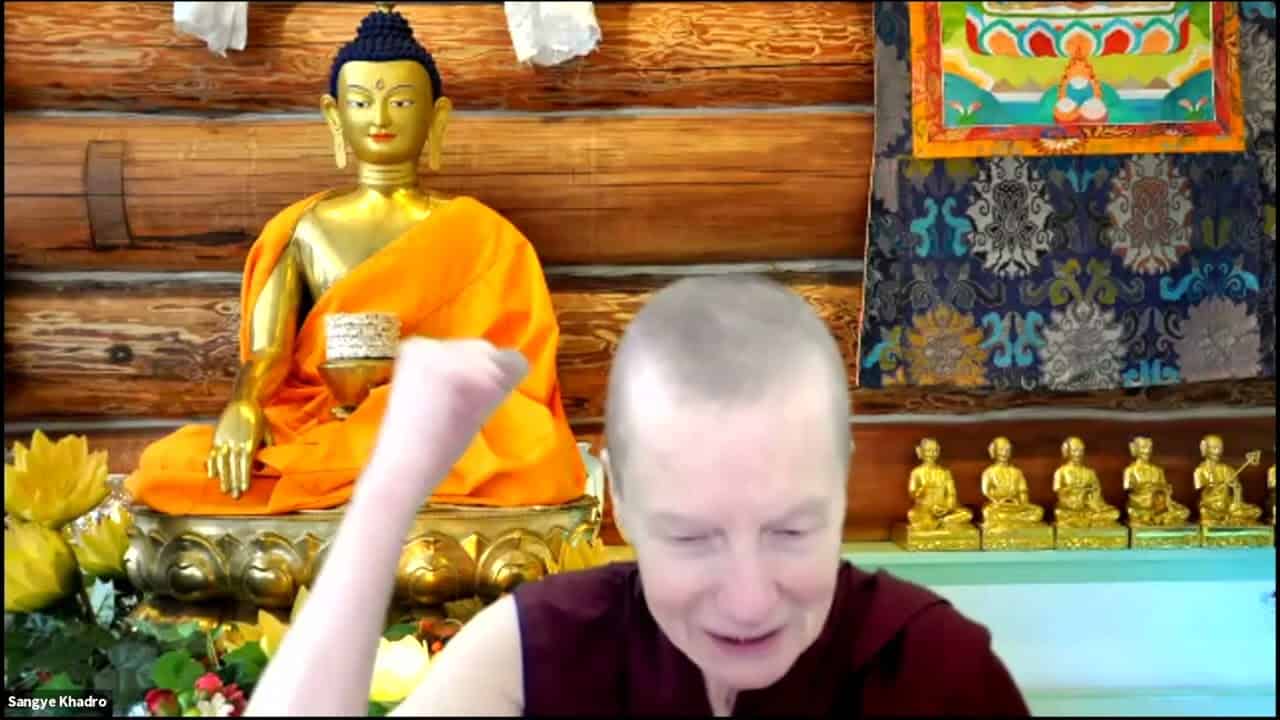
 Venerable Sangye Khadro
  Introduction to Tantra
  May 10, 2021
 Part of a five-part course introducing Tantra taught during an online weekend retreat organized by O Sel Ling in Spain, May 2021
- Prerequisites to practicing tantra
- Misconceptions about tantra practice
- Four kinds of happiness
- Hindrances to happiness
- Parting from the Four Clingings
- Bodhicitta as the essential tantric practice motivation
- Correct view of emptiness
- Tantra and Paramitrayana similarities
The first teaching that Buddha gave after he became enlightened was on the four noble truths. The first truth is true suffering or duhkha. Duhkha means unsatisfactoriness, unwanted experiences, that we have. And he gave different examples of these. He said that birth is suffering, sickness is suffering, aging is suffering, and death is suffering. Those four things are also called four powerful rivers. We are helplessly carried along through life on those four powerful rivers without any choice, without any control. We have to go through those experiences, especially sickness, aging, and death. This is just part of our existence in samsara, cyclic existence.
And the Buddha gave some other examples of suffering, like not getting what we want. Another example is getting what we don’t want. We have lots of experiences where things happen to us that we don’t want to experience: getting injured, losing a partner, a relationship—painful things that we wish didn’t happen and yet they do happen. Another example he gave was losing what we cherish and don’t want to lose. This can include people—that’s probably the most painful experience of loss when someone we love and want to be with us always and forever leaves us, goes far away, or maybe dies. They’re no longer there. But it’s also painful to lose material things, possessions that we like very much and want to hang on to, but sometimes we can’t. They’re lost or broken, stolen, or we can no longer afford them, so we have to give them up.
And finally, the Buddha said that just having these aggregates—meaning our body and mind, this body and mind that we have, which came about as a result of karma and afflictions in our past lives—is suffering. Because with this body we encounter all kinds of problems, even on a daily basis: hunger, thirst, heat, cold, pain, discomfort. And then we have all these mental sufferings: unwanted thoughts and feelings that arise in our mind without choice or control. Some of you might think this is very depressing. You might think, “I don’t want to think about all these problems,” but the Buddha said it’s important that we recognize and acknowledge the problems in our life, in our world, so that we then generate the wish to be free from them, to emerge from samsara and attain the state of liberation, nirvana, enlightenment.
If we don’t have the wish to be free of samsara, there’s no way we’ll be able to attain those higher states. And we can attain them. It is possible; it is doable. And we’re very fortunate right now that we have a human life; we have all the things we need to stay alive: food, clothes, shelter, medicine, friends who care about us and are there to help us when we need help. Best of all, we have the chance to learn the Dharma, the Buddhist teachings, that show us how we can free ourselves from suffering, and best of all, how we can attain the state of enlightenment or buddhahood, just like the Buddha did, so that we can help all other beings be free of suffering as well.
See if you can make that your motivation for participating in this session today and feel the wish to help all living beings and become enlightened. It’s the best way we can help all living beings. And through these teachings, may this help us get closer to enlightenment for the benefit of all living beings.
Misconceptions about tantra
Yesterday, before we finished, we were talking about samsara, which is also called cyclic existence. And according to Buddhism, samsara is a very painful, unfortunate, unsatisfying situation that we are in, as long as we are not yet enlightened or haven’t reached nirvana. According to Buddhism, we need to free ourselves from samsara. That’s the goal of Buddhism, the goal of Buddha’s teachings. And in the Mahayana tradition, which is what we follow in the Tibetan tradition, the goal is even more than that. It is to become a buddha, to become fully enlightened so that we can help all other living beings become free of samsara, and become enlightened, too.
For some of you, these ideas may be new and unfamiliar. Maybe you’re not used to thinking this way. And you might find difficult to accept these ideas; you may have a lot of doubts and questions. And this is normal. In fact, the Buddha said that we shouldn’t just believe his words, but we should investigate them for ourselves and check to see if they are true or not, according to our experiences and according to the experiences of others. We should investigate. And also, the Dalai Lama talks about this a lot. He encourages people to have doubts, to question and investigate their doubts and not just have blind faith. I think Tibetans usually have just blind faith; they have this incredible devotion and feel that whatever the Buddha said is true, whatever the Dalai Lama says is true, whatever the Lama says is true.
And they don’t usually think for themselves. So the Dalai Lama says, “No, that’s not right. You need to think; you need to investigate; you need to check.” So, give yourself time. And do try to think about and investigate, to read more, to ask questions. Try to clear up whatever doubts you have. But we’re talking in this course about tantra, and if someone is interested in practicing tantra, you have the wish to practice tantra. If this person doesn’t see samsara as painful and unsatisfactory, like a prison, and then with that state of mind they do tantric practice then probably the tantric practice is not done for the right reason. You don’t have the right understanding, you’re not doing it for the right reason. And it can even become a way to seek more samsaric pleasures.
And unfortunately, this is the idea that many people have about tantra. Yesterday, just out of curiosity, I went to Google, and I typed in “tantra,” and what came up were a lot of websites advertising how you can have tantric sex, how you can have more pleasure in your sexual relations. That’s the idea that many people have about tantra: it’s just about sex. They think it’s just about ways to enjoy your sex life, to have more pleasure. This is not tantra in Buddhism. So, for anybody who has that idea, maybe you’re in the wrong place. We’re trying to clear up this misconception, this misinformation.
Different types of happiness
In the context of Buddhism, if you’re using tantric practices just to have more pleasure in this very life, that’s like taking something which is medicine and using it as poison. You’re turning medicine into poison. Because tantric practices is actually meant to free us from suffering, free us from samsara, and help us reach enlightenment, buddhahood, so we can help all other sentient beings be free of samsara as well. That’s the purpose of tantra in Buddhism. But if you don’t understand that, and you think it’s just something to have more pleasure in this lifetime, then this is really misusing it. It’s really corrupting it.
But I’m not saying there’s something wrong with pleasure, with happiness, with nice experiences. I’m not. There’s nothing wrong with experiencing pleasure, nothing wrong with happiness, nothing wrong with pleasant experiences. But the problem is that if we grasp at pleasure and nice experiences and think, “This is so wonderful. This is perfect. This is all I need. This is all I want,” then we grasp more and more and more and more. And then we never find satisfaction. Actually, the Buddha said that if we follow grasping attachment and desire then it’s like drinking salt water. It’s like you’re thirsty and you drink salt water. Does that quench your thirst? Does that make your thirst go away? No, I wouldn’t try it. I don’t recommend trying it. It’ll just make you more thirsty. Your thirst doesn’t get quenched; it just increases. Then you want to drink more and more and more and more.
You might even drink yourself to death, but never get your thirst quenched. So the Buddha said desire is like that. If we just have ordinary desire, ordinary attachment for pleasant experiences, and we follow that, and we just try to get satisfaction in that way, we won’t get satisfaction. We just get more and more unsatisfied, more and more thirsty. The problem isn’t pleasure; it isn’t happiness itself. It’s the attachment, the grasping that we have. If we can experience pleasure and happiness and not have attachment to it, that’s fine. But that’s not so easy to do. Because of our habitual tendency to grasp, to have attachment, it’s very, very difficult. But also, Buddhism talks about different forms of happiness, different forms of pleasure.
I read this in one book by a German nun and teacher named Ayya Kema. She explained that according to Buddha, there are four different kinds of happiness, four different kinds of pleasure. The first one is sensory pleasure. That’s what we experience with our five senses: seeing, hearing, smelling, tasting, and then physical, tactile sensations. This is when we see something beautiful, like a beautiful sound; we smell a nice odor; we taste something delicious; we feel nice sensations in our body—lying in the sun, swimming in the ocean, having sex. It’s those kinds of pleasant experiences. It is nice, but they don’t last very long. They last just a short period of time—maybe a few seconds or a few minutes, maybe a few hours, but eventually, they die or stop or disappear. They’re not there anymore.
Another problem with those is that we usually need some external object or situation to be able to have those pleasures. And if we can’t get that external object or situation then we can be very unhappy—even angry. If we can’t see the beautiful things and hear the beautiful sounds that we want, then we can be quite upset, quite unhappy, because we can’t get that pleasure that we want. Another thing is if we have attachment for certain types of pleasant objects and pleasant experiences then that naturally leads to the opposite states of mind—aversion, unhappiness, or even anger—when we encounter the opposite kind of experience. They arise when we see things that are ugly, or we hear sounds that we don’t like, or we smell odors that we don’t like, or we experience tastes that aren’t pleasant, or we have unpleasant feelings in our body.
So, whenever we have unpleasant experiences with our five senses, because we have attachment to pleasant things, then we have aversion and unhappiness when it comes to the unpleasant things. Our mind is constantly up and down—from feeling good to feeling lousy, to feeling terrible. These are faults of pleasant sensory experiences, but that’s only one type of happiness, and that’s actually the lowest level of happiness.
The second type is the happiness that comes from positive states of mind, such as love, compassion, kindness, generosity—just thinking in a positive way, feeling in a positive way. And this is something we all experience when, for example, we’re with people we love and care about, like children. If you’re a parent and you have children, when you’re with your children, you have these beautiful feelings in your heart for your children. Even if you’re not a parent, you feel that way towards other family members, like your brothers and sisters, your pets. Many people have pets—pet dogs, pet cats, maybe birds—and they love their pets so much. So, when they’re with their pet, they have these beautiful feelings of love and care and compassion and kindness. That is another kind of happiness that is kind of more pure, more spiritual, than the first kind. The first kind tends to be a bit selfish, a bit self-centered, like, “Oh, I want to enjoy this delicious food. It makes me feel so good.”
We can be kind of self-centered, ego-centered, with that kind of happiness. Whereas the second kind of happiness is more altruistic, more concerned for others. We’re not so focused on me, me, me, me, me—my pleasure. We’re more focused on others and their happiness and wanting to do what will bring them happiness. So, it’s more meaningful and satisfying and pure than the first kind of happiness based on sense pleasures. That’s something you can check for yourself and see if that’s true.
And then there’s a third kind of happiness, and this is usually called bliss in Buddhism. This comes from meditation. If you train your mind in meditation and you learn to have very good concentration—you can concentrate for longer periods of time—then eventually, you feel more and more blissful. You’ve probably heard about what’s called calm abiding or shamatha. This is a state of very, very strong and deep concentration on an object that you choose—a virtuous object. And you can stay concentrated for a long period of time. You don’t feel tired or bored, hungry, thirsty. You’re just blissful in your body and mind; it’s incredible bliss. I haven’t experienced it, but people who have say it’s the best experience you’ve ever had—better than sex, better than drugs, better than anything that we normally have. It’s just so blissful and so satisfying, and you’re happy to just keep sitting there meditating for long periods of time. That’s a higher form of happiness, a better form of happiness, than what we normally experience.
But we have to work for that. It’s not easy. We have to really put time into practicing meditation and train our concentration more and more, but it’s possible. People do it. And then there’s a fourth kind of happiness, which is the best of all. And that’s the happiness that comes from the wisdom that understands reality—the true nature of things. This is what we call emptiness in our tradition. So, again, it takes time. You have to learn and meditate and practice, and eventually, you gain this wisdom that sees the true nature of yourself, the true nature of others, the true nature of everything in the world around you. That wisdom is said to bring the highest form of happiness, and I think the reason for that is that wisdom is the antidote to all of our afflictive emotions. That’s the kind of weapon or remedy that will eliminate, clear away, all our disturbing emotions, like anger and attachment and jealousy and pride and depression and fear and anxiety. It clear away all these kind of disturbing thoughts and emotions that normally run around in our mind and make us disturbed and unhappy. Wisdom clears those away; it’s the antidote, the medicine, to those.
Once those are gone from our mind then the mind is able to experience incredible happiness and peace and bliss. I really like that explanation because it points out that not all happiness is the same. Not all pleasure is the same. There are different kinds and different qualities of happiness, and probably for most people in the world, it’s the first kind of happiness—of sensory pleasures—that they know and experience. And it’s that kind of happiness that they are looking for. They’re trying to get more and more sense pleasures, but if we have attachment to sense pleasures and we’re constantly running after those and trying to get those and being distracted by those—even when we’re trying to meditate—then they become distracting.
You think about these pleasant experiences you had in the past, or you fantasize about pleasant experiences you want to have in the future, so your mind is just wandering all over the place because of attachment, because of desire, and then you can’t meditate properly. And if you can’t meditate properly, you won’t be able to get the higher forms of happiness—the happiness that comes from loving-kindness, compassion, concentration, and wisdom. If you think about that then it makes sense that being attached to sense pleasure is not only not satisfying, but it’s a hindrance to achieving better forms of happiness, higher forms of happiness. Does that make sense? If these ideas are new to you then you might not be so sure of what I’m saying, but I’m trying to explain why it is that Buddhism says we should try to overcome our attachment to just ordinary sensory pleasure. It does feel good, no doubt about it. It’s very nice. It’s very pleasant, but if we get attached to that and we get stuck on that level of happiness, we won’t be able to achieve the higher forms of happiness, which is the real purpose of Buddhist practice.
Parting from the four clingings
And I wanted to share with you this little text. It’s a very short text. It has only four lines. So this is from the Sakya tradition. It’s one of the four schools of Tibetan Buddhism. One Sakya Lama, whose name was Sachin Kunga Nyingpo, lived in the past, but I don’t know exactly when, what years, the time when he lived. And apparently, it was given to him by Manjushri. Manjushri is the buddha of wisdom. Some of the Lamas would have visions of buddhas like Manjushri and would sometimes get teachings from them. So, this was given by Manjushri to this Sakya Lama. And it’s called Parting from the Four Clingings. Clinging is another word for attachment. We have many different words: clinging, craving, grasping. They’re all kind of different variations of attachment and desire.
Again, this little text is very short. It only has four lines, but it’s actually the same as what we were talking about yesterday with The Three Principal Aspects of the Path. It’s the same kind of teaching, but in a little bit different words. The first line says:
If you cling to this life, you are not a true spiritual practitioner.
“Clinging to this life” means being attached to the eight worldly concerns, being stuck in the eight worldly concerns. It’s living your life, thinking that the whole purpose of life is just to acquire as much money, possessions, things, pleasure, fame, praise, reputation as possible. That’s all you’re concerned about this lifetime—getting all the good things that you can in just this lifetime and not thinking about anything beyond that. You have this very narrow, very limited view of the purpose of life and think it’s just enjoying life as much as you can, trying to get the good things and trying to avoid the bad things, like loss and unpleasant experiences and being criticized and having a bad reputation.
This is someone who’s just totally consumed with the eight worldly concerns, and that’s all they care about. That’s all they’re looking for. That’s the meaning of clinging to this life. Somebody who’s like that is not a true spiritual practitioner, not a Dharma practitioner. Again, that doesn’t mean we can’t have pleasure and happiness in this life. That’s fine. And it doesn’t mean we can’t take care of problems. Like if we get sick, of course we go to the doctor, and we try to take medicine and so on. It’s fine to try to be comfortable and happy and healthy in this life and to avoid bad experiences. But it’s a problem if that’s all you’re concerned about—if your view or your vision is only that. That is the meaning of clinging to this life. In Buddhism, we aspire for more—for bigger things beyond just this life.
If you cling to samsara, you do not have renunciation.
A person might think, “Okay, just this life isn’t that important because one day I’m going to die and then I will take rebirth. And I want to make sure that I don’t get reborn in some bad situation. I want to make sure I have a good rebirth in a good situation with good experiences, not suffering.” And so they engage in Dharma practice, spiritual practice, in order to have a good rebirth in the next lifetime. That’s considered Dharma practice. That is a valid way of practicing Dharma. But they may still be clinging to samsara because their goal is just having good rebirths as a god in heaven, or coming back as a human being but with a comfortable life, with a pleasant life. So, their view is still very narrow. They’re still just thinking about samsara and having pleasant experiences in samsara and not going beyond samsara.
Somebody like that doesn’t have renunciation. We need to open up our mind more and realize that anywhere we are born in samsara is a place of suffering, a place of dissatisfaction, and we need to aspire to get beyond samsara, free of samsara.
If you cling to your own self-interest, you have no bodhicitta.
We’re going to start talking about bodhicitta this morning. Bodhicitta is aspiring to help all sentient beings. You see that all sentient beings are suffering, and you want them to be free of suffering. You want them to be happy. And you want to take care of them yourself. You feel this responsibility, this commitment, to help all sentient beings, just like a mother or a father who really cares about their children. They’re completely dedicated to taking care of their children and not thinking so much about themselves. They aren’t thinking, “Me, me, me—what I want, what I need.” They put their children first.
A bodhisattva is like that. Someone who has bodhicitta isn’t thinking about themselves. They’re not self-centered, selfish. They’re thinking about others, and they want to help others. And they’re completely dedicated to taking care of others. That’s the meaning of bodhicitta. So, if you’re clinging to self-interest—I, I, me, me, what’s good for me, what I want—then that prevents you from having bodhicitta and following the bodhisattva’s path.
If there is grasping, you do not have the view.
Grasping here refers to what’s sometimes called self-grasping—grasping at inherent existence or independent existence. This means grasping at yourself, at others, at everything, as existing in a certain way—existing inherently, independently, from its own side. You’re grasping at that. This is opposite to the view of emptiness. The view here means the view of emptiness, the correct view, the way things really exist. We’ll get to that later today.
So, these four lines are equivalent to The Three Principal Aspects of the Path. The first two lines are equivalent to renunciation, the determination to be free. First is renunciation of this life. The second is renunciation of samsara. And then the third line is equivalent to the second principal aspect of the path, which is bodhicitta, which we’ll start looking at soon. And then the fourth line is equivalent to the third principal aspect of the path, which is the wisdom understanding emptiness, the true nature of things. I think this little text is very nice. It’s good—nice and short—and you can easily memorize it. You can read it every day and remind yourself of the most important aspects of our Dharma path and Dharma practice.
The bodhicitta motivation
Let’s go on and start looking at bodhicitta. This is the second of the three principles of the path that we really need to have at least an understanding of and try to cultivate if we want to practice tantra. It’s an essential part of tantric practice; it needs to be our motivation for practicing tantra. I talked about that yesterday when I said that tantra is a branch of Mahayana, meaning it’s a kind of Mahayana practice. And the goal of Mahayana practice is buddhahood, becoming a buddha, becoming fully enlightened. Why? Why do we want to become a buddha? It’s not because we want to be this great being who’s just so wonderful and has all this knowledge and qualities and experiences and is way up there above everybody else. And then we kind of look down on everybody and think, “Wow, I’m so great. I’m so wonderful.”
That’s not the purpose for becoming a buddha. The whole purpose for becoming a buddha is to help others. The real goal of the Mahayana path is helping all sentient beings because you see that they have suffering, and you feel so much compassion for them, and you want them to be free of suffering. You just find their suffering unbearable; you can’t stand it that they are suffering, and you just want to free them from suffering. And you also have loving-kindness, which means you want them to be happy. You realize they want happiness, but they lack happiness. They don’t have the happiness that they wish for. And you really want them to be happy.
And so, you’re so moved by the suffering of others—you want them to be free of suffering, and you want them to have happiness—that you make this dedication, this commitment, to doing whatever you can in order to help them. And the way to help them is to become a buddha, to become fully enlightened, just like the Buddha did. So, that’s the meaning of what we call bodhicitta: the mind of enlightenment. And bodhicitta is probably something that doesn’t just arise naturally and spontaneously in people’s minds, unless they meditated on it in past lives. Some people may have been learning about and meditating on bodhicitta in past lives, so for them, this thought, this attitude, may arise just naturally and spontaneously in them. But for most of us, it probably doesn’t arise naturally and spontaneously.
But we can develop it. We can cultivate it. We can bring bodhicitta into our mind. It’s possible for everyone to do that. And there are lots of benefits, both for ourselves and others if we cultivate bodhicitta, and we follow the bodhisattva’s path. I remember one teachings Lama Zopa Rinpoche was giving. At one point, he was talking about how we can try to generate bodhicitta, how we can do things with the bodhicitta motivation—our meditation practices, our prayers, our recitations of mantras, even eating and sleeping. He told us we can do those with the motivation of bodhicitta. You can think, “I’m eating this food, or I’m drinking this cup of tea, in order to give myself energy, so that I can continue practicing Dharma, and work for enlightenment, for the benefit of all sentient beings.” We can have the bodhicitta motivation for everything we do—even going to the beach, even sleeping, taking a siesta. You can think, “I am doing this in order to rest myself, relax myself, so I have more energy that I can use to help sentient beings to reach enlightenment. I’m doing this in order to help all sentient beings.” Everything we do can be done with the bodhicitta motivation.
He said that if we do things with the bodhicitta motivation then those activities, those actions, not only become the cause for enlightenment, for buddhahood, and then being able to help all sentient beings, but they also become the cause for all the good things on the way to enlightenment. They are the cause for all the other good results, such as happiness in future lives, being born in a good situation, and having good experiences in our next life—and in all our future lives—rather than being born in a terrible situation with a lot of suffering. So, the bodhicitta motivation is the cause for good rebirths in our future lives.
It’s also the cause for all the realizations of the path, such as calm abiding, samatha, and the wisdom realizing emptiness. There are many different realizations, many different stages that you go through on the way to enlightenment. Enlightenment isn’t something that just happens all at once like that as if one moment you’re an ordinary being, and the next moment you’re a buddha. It’s not like that. But you go through many, many different stages. And these are different realizations, different attainments, that you achieve, which are wonderful. They make you feel so good, so blissful, so satisfied. So, we get all those wonderful experiences on the way to enlightenment.
Basically, what he was saying is that even though our real goal is helping sentient beings, we actually get the greatest benefit by generating bodhicitta and doing things with the bodhicitta motivation. All the happiness and good experiences will fall in our laps; they will just come naturally and spontaneously if we try. And that’s true even if we’re not a bodhisattva yet, but we’re just trying to generate bodhicitta and do things with the bodhicitta motivation. That still becomes the cause for all of these wonderful experiences. In other words, bodhicitta is a good thing to do for ourselves. It’s the best thing we can do for ourselves. It’s also the best thing we can do for others. So, why not? Why not try to do it?
And we’re not just talking about the future lives and so on, but even in this lifetime, if we try to cultivate bodhicitta, doing that means we become a more kind and compassionate person. We’re caring more about others; we’re doing things for others. So, we’ll experience benefit even here and now, because other people will like us. We all want to be liked by others and cared for by others. We want people to be nice to us. If we become a nicer person—more caring, more compassionate, more generous, more kind—then this is how we will be to other people. People will like us. People will be drawn to us, attracted to us; they’ll want to be around us, want to be friends with us. We’ll find we have lots of friends, lots of people who care about us. You can see that with the Dalai Lama. The Dalai Lama is so popular. Wherever he goes, thousands of people want to come and be near him. And they show so much joy, so much love. Everyone’s trying to reach out and get close to him.
Why is that? He’s not like a football star or a movie star. He’s a Buddhist monk. He’s celibate. He doesn’t drink alcohol or take drugs, doesn’t make movies, doesn’t play football. It’s because he’s kind and compassionate. People feel it just by looking at his face, just by being around him and hearing his talk, his laugh, his joy. That’s a good example of how if we can also cultivate love and compassion and altruism and be more caring about others, we ourselves will benefit. People will like us. Our own mind will be more peaceful, more happy. And we’ll sleep better at night. And also our health will be better.
I’ve heard that having more love and more compassion, more positive thoughts and feelings in your mind, is good for your health. It helps your immune system to fight off diseases, like coronavirus. And even if you do get sick or if you do have some kind of physical problem and maybe you have to go for surgery and so on, you’ll recover faster. I’ve experienced this myself. I’ve had a few surgeries, and I was able to recover much more quickly than normal. So, our health will be better. Physically, we’ll be better. Our mind will be better. Our relationships will be better. Even in this lifetime, we’ll experience a lot of benefits from trying to cultivate bodhicitta. In order to have the desire, the energy, the enthusiasm for things, it’s important to try to cultivate bodhicitta and try to do things with the bodhicitta motivation.
And this is a big theme in Lama Zopa Rinpoche’s teachings. He’s always talking about bodhicitta, always encouraging people to have compassion and love and bodhicitta and to do things with that motivation. If you ever listen to his teachings or read any of his books then this comes across very clearly, very strongly.
Methods for developing bodhicitta
There are two main methods for developing bodhicitta in the Tibetan tradition, or at least in the Gelugpa tradition. One of these is called the seven-point cause and effect method for developing bodhicitta. And the other is called the method of exchanging self and others or equalizing and exchanging self and others. That one has five points, five steps, that you meditate on. And the first of those five points is called equalizing self and others. That involves meditating on the fact that you and others—all people and all beings—are equal in wanting to be happy and not wanting to suffer. It’s kind of a simple idea; it’s not very complicated, but it may be something we don’t normally think about. But if we contemplate it then it’s like a step. It’s not fully bodhicitta itself, but it’s a step towards cultivating bodhicitta.
Guided meditation
I thought we could do a little bit of meditation on that. It helps us to open our mind, open our heart, more to others, and it helps us to be less self-centered, focused only on me and my happiness. That’s one of the main obstacles to developing bodhicitta and following the bodhisattva’s path, that sense of “I am more important than everybody else.”
So, make yourselves comfortable and try to sit with a straight back. But that doesn’t mean having tense shoulders. Let your shoulders relax. And check your mind, see if your mind is here, focused on the meditation that we’re doing, or if it’s somewhere else, thinking about other things. If there are other thoughts in your mind, put them aside, let them go, and just let your mind be right here, right now, focused on the meditation. Go into your own mind, your own heart, and see if you can recognize your own wish for happiness and your wish to not suffer. It’s like a little voice deep down inside of us that says, “I just want to be happy, and I don’t want to suffer. I don’t want to be unhappy.”
And please do not feel there’s anything wrong with such a thought. Don’t feel guilty for having such a thought. According to Buddhism, we should be happy. We deserve to be happy. We shouldn’t have to suffer. Nobody should have to suffer. So, it’s completely normal to want happiness, not suffering. It’s okay. It’s acceptable. It’s perfectly fine to have that wish. Allow yourself to feel that way. Accept that feeling, that wish for happiness and not suffering. And you can even go one step further and say to yourself, “May I be happy. May I be free of suffering.”
Now bring to mind someone you know and care about. It could be someone in your family or a friend—a child if you’re a parent. It could be one of your children or a pet. Choose someone you find it easy to care about. Try to have a mental picture of that person as if they are right in front of you. And then focusing on that person, think about how they, too, inside their heart, have the wish to be happy and to not suffer. They feel just the same as you. They want to be happy. They don’t want to suffer. And see if you can go one step further and wish the person to be happy. You can even say that to yourself. “May you be happy. May you be free of suffering.”
Now bring to mind another person. This time, choose someone you’re not so close to. Choose someone you know but you’re not very close to them. You don’t have a strong connection with them, a strong relationship with them. This could be a more distant family member or neighbor, someone at work, even one of the other people joining this course. Bring that person to mind. Imagine them in front of you. And think that this person is just like you and just like the last person you thought of. Deep in their mind and their heart is the wish to be happy, the wish to not suffer. And then go one step further and say to yourself, “May you be happy” or “How wonderful it would be if you could be happy and if you could be free of suffering.”
Now bring to mind a person you don’t like. It’s better not to think of your worst enemy. That would be too difficult. Just think about someone you find a little bit annoying, irritating, or difficult to like. It could be someone you actually know, or it could be public figure—a politician or a celebrity you don’t like. And imagine that person in front of you. First contemplate that this person is another human being, just like you and just like the last two people you thought about. In their mind and their heart is the wish to be happy, the wish to not suffer, just like you. Then see if you can take the next step and wish the person to be happy and free of suffering. You can try saying words to yourself, like “May you be happy” or “How nice it would be if you could be happy and if you could be free of suffering.”
And now, see if you can open up your heart, your mind, to all living beings—all people, all beings everywhere. We’re all the same in that we’re just trying to find happiness; we’re trying to fulfill our needs, our wishes, and we’re trying to avoid suffering and problems, pain, difficulties. And then see if you can wish that to come about. You can even say to yourself, “May all beings be happy and free of suffering” or “How nice it would be if everyone could be happy and free of suffering.” Choose something that is easy for you, comfortable for you.
Benefits of bodhicitta
This contemplation is very helpful, very effective, to open up our mind and our heart to other people and other beings and to start going in the direction of bodhicitta, the altruistic intention. It’s also something you can use when you’re out in the world. You can use it if you go out or if you are at home, maybe you’re watching television and seeing people on TV, then whenever you observe or have contact with other people and other beings, this is something you can remind yourself of. “This is another person—or these are other people, other human beings—who are basically like me. They’re just trying to be happy; they’re trying to find happiness, and they’re trying to avoid suffering and problems.” It really helps open your heart to others, to feel more connected with others.
And that in turn enables us to have more compassion, more love, more empathy, more care. And it’s such a beautiful state of mind to have. And it’s also really helpful to break down barriers. I’m in America right now as you probably are aware. There’s a huge problem in this country with racism. And it’s not only here, it’s in many parts of the world. People of one race or one group of people feel that they are superior, and then they look down on another race or another group of people: us versus them. There’s this attitude of us and them.
It’s true that we are different. There are differences between people. We’re not denying that. But are those differences important? The color of your skin, the way you dress, the kind of food you eat, the language you speak, your religion, your political parties, are those really so important? Are those really a basis for feeling hostile and mistrustful and angry—all these negative feelings that come up in people that can lead to negative behavior that’s uncompassionate and even harmful to others? I think these kind of feelings, like racism and hostility and so on, are based on putting too much emphasis on the differences between us and others. It’s helpful if we put more emphasis on the similarities—the ways in which we are the same. We’re all human beings. We have the same kind of body, skin, blood, bones. When we have pain or we are sick, we don’t like it. We want to be free of our pain, free of our sickness.
When we are separated from our loved ones, when we don’t have food to eat, when we don’t have shelter or a home to live in then we’re unhappy. We don’t like that. So, we’re all basically the same. We’re just trying to find happiness, trying to fulfill our needs, and trying to avoid suffering and problems. And we all deserve that. We all have the right to happiness, and nobody should have to suffer. That’s the Buddhist view. And if we make ourselves more familiar with that way of thinking, it helps so much to break down the barriers and be free of these kind of problems of racism or classism or sexism—all these isms that cause people to be hostile to other people and mistreat other people and not be kind to other people. It’s a very, very helpful method to feel closer and to have more altruism in the way we see others.
Searching for the I
If you want to know more about Bodhichitta, there are plenty of materials, plenty of books, that explain all the different ways of developing Bodhichitta. I really encourage you to look into that and learn more about that and meditate on those methods. They are really, really helpful. They’re really beautiful. Now I’d like to move on to the third of the three principal aspects of the path, which is called the correct view of emptiness. And this is probably one of the most difficult topics in the whole of Buddhism. But it’s also very interesting, very fascinating. I know some people say, this is the thing that attracted them to Buddhism.
When they heard about emptiness, they thought, “Ah, what’s that all about? I want to know more about that.” And they were just so interested, because it’s something we don’t find in other religions, other spiritual traditions. So, we’ve been talking about samsara and all the suffering, all the problems, of samsara. Why are we in samsara? What is it that keeps us in samsara? I mentioned before that karma and afflictions are the main causes of samsara that keep us dying and taking rebirth again and again and going through all these problems. And of karma and afflictions, the main one is afflictions or delusions—these mistaken states of mind. And there are many of those, like anger, attachment, and so on.
But the main affliction is ignorance. Sometimes it’s called confusion. This is a state of mind where we don’t see things as they are. Our way of seeing things is mistaken. And that includes our own self. We all have a sense of I. And most people just go along with their ideas about I—what it is, how it exists—and never question that. Most people never question, “Do I exist the way that I think or not? Do I know myself or not? Am I wrong about who I think I am, what I think I am?” Probably most people never question that. But the Buddha did. The Buddha asked those questions and looked into that. And what he discovered was that he had a mistaken idea about his own self, his own existence, this sense of I. And he realized that that is the root of all our suffering, the root of all our problems—thinking that we exist in a way other than we actually do.
He was able to be free of that. He was able to clear up that mistake in his own mind by realizing the real nature of himself and also the real nature of everyone and everything else. He cleared that up in his own mind. He freed his own mind from ignorance—this mistaken view of things—and realized that that is the way to be really free of suffering. And then he taught his disciples, his followers, this teaching on how to see things in the correct way.
We have this mistake with regard to everyone and everything—all the people around us, all the things around us, all the experiences we have. We see all of these things in a mistaken way. But it’s said that the main problem is the way we see our self—the way we see I. So, we should start our investigation there. It’s recommended that we start by investigating our own sense of self, our own sense of I. And the question to ask isn’t so much “Who am I?” but rather, “What am I? What is this thing we call I? What is this thing we feel inside of us? There’s an I in here. What is that? What kind of phenomenon is it? Does it really exist the way that I think or not?”
In my book, How to Meditate, there are a bunch of different meditations. And one of them is a meditation on emptiness, which was taught by Lama Zopa Rinpoche long, long ago. I don’t know if you’ve ever tried doing that meditation, but it’s very interesting. You’re asked to just sit down and spend some time watching your breath, letting your mind quiet down, become calm, and then try to investigate the sense of I. We do feel that somewhere inside of me, there’s this thing we call I. But what is this I? What exactly is it? And how does it exist? Is it something real, existing from its own side, something we can actually point to and say, “That’s it; there it is right there”? This is difficult to do. It’s not easy to do this. When we try to do it, it usually becomes kind of slippery, like trying to catch an eel in the water. It’s very slippery, and it keeps slipping away from us. So, it’s not easy to do. But it’s also very interesting just trying to do it.
He says that it’s good to first just think about our body and how this thing we call my body is made up of many, many different parts. The body isn’t just one whole thing. But it has different parts: head and arms and legs, and then torso, and then inside many bones, many organs—brain, heart, stomach, kidneys, and so on. So, we think about all these different parts of our body. And we ask ourselves, “Is any of those the I? With any part of my body, can I point to that and say, ‘That’s I; that’s me right there’”? Now, some people might think about their brain and think, “That’s me, my brain.” I once saw an article in National Geographic magazine, and it was about the brain. And they had photographs of a person who was going through brain surgery. So, they opened the top of her head, and there were photographs of what her brain looked like.
And in the article, they were saying that that is her. The brain is her; it’s the person who’s having the surgery done. And so that’s probably what a lot of people think: that this thing inside of our head is me, is who I am. And that’s because of all the research that shows that our thoughts, our feelings, our mental activity, and our sense of self is somehow related to our brain. But is that really how we see ourselves? Do we really think of ourselves as a brain? Most people never even see their brain. We don’t see our brain—nobody sees our brain; it’s inside of our head. But when we think, “I,” when we have a sense of “I,” do we really think of ourselves as this? It’s not a very beautiful thing, I think. If we saw a brain, we probably wouldn’t feel, “Oh, isn’t that beautiful?”
It’s kind of squishy. And there are all these funny different textures to it. So, ask yourself; do you really think you’re your brain? And when it comes to other people, like the people you love, the people you know, do you really think they are their brain? If that’s true then when we feel love for somebody and we say to that person, “I love you,” what we’re actually saying is, “My brain loves your brain.” My brain loves your brain: does that sound right? Does that really match your feelings, your experiences? Do you really feel you are your brain? And do you really feel that when you love another person, it’s your brain loving their brain? That’s how it would be if we were our brain.
But we probably don’t really feel that way, when we think about it. And some people may identify more with their heart. But again, if you think about what the heart looks like, is that really how you see yourself? Do you really see yourself as that organ inside your chest? I think it’s a bit more on the left side. But again, we don’t even see our heart. When we look in the mirror, and we have a sense of “That’s me. I look good today,” or “I don’t look good today. I look terrible today,” are we seeing our brain in the mirror? Are we seeing our heart in the mirror? It’s good to question whatever you might think is your I—whether you think it’s your brain or your heart or maybe even your stomach. It’s good to ask, “Is that really me? Is that really who I am? Does that really correspond with my sense of I?”
You probably won’t find an answer to that. You might end up just feeling confused, but that’s okay. It’s better to be confused, to be uncertain, than to have a sense that there really is a solid, real I: “I know who I am. I know how I exist. I am like this, and I can tell you what to do, and I can get angry at you, because you’re not doing what I want you to do.” Because see, this is the problem, when we have a very solid sense of an I that is beyond question, beyond doubt: “I really exist, and this is what I think, and this is what I feel.” That sense of I leads to all kinds of afflictive emotions, like anger. We get angry at people who we don’t like, who do what we think is wrong. When people don’t do what we think they should do, we think, “I have a right to be angry at that person.” And some people even go further than that and think, “I have a right to kill that person or harm that person or do nasty things to that person.”
The solid sense of I gives rise to feelings of anger, aversion, hostility, and even harmful, hurtful behavior. It also gives rise to attachment, to desire, because when we meet a person that we find attractive, and that person looks like they think we are attractive, they seem to be attracted to us, then the way they look at us, the way they smile at us, the way they talk to us, makes us feel so good. The I feels so wonderful. “Oh yes, this person loves me. This person cares about me. This person sees how wonderful I am. I want to keep this person close to me as much as possible and keep having those nice feelings.” That’s attachment. That’s desire. It’s very self-centered. It’s a feeling of “I want to keep you around because you make me feel so good. I want to keep having those good feelings, so you have to stay there and keep making me feel good.”
Our feelings towards other people are usually a mixture of love and attachment. Some of it is love. Some of it is genuine care about the other person, but if we are honest with ourselves, if we really watch our mind, we’ll probably see that some of it is about me: “You make me feel good, so I want you to be there. I want to be nice to you, treat you well, so you stay close to me and you keep giving me those good feelings.” And it’s the same thing with objects—material things, money, possessions, food, clothes, house—all these things we collect in our life are the things that make us feel good, make us feel comfortable, give pleasant feelings to me, to this real solid I existing inside of us.
If we watch our mind, if we pay attention to what’s going on in our mind, we’ll see that a sense of I is a big part of our life, a big part of our existence, a big part of our way of relating to other people and things and events. We’re always coming from this point of view, I, I, I, I—”I am the center of the universe. Everything revolves around me. I am the most important person of all. I am the king or the queen, the ruler.” But do we ever ask ourselves, “What is this I, anyway? What exactly is it? Does it exist the way that I think?” Like I said, this is a very difficult topic. And realistically, it’s something that can take years or even your whole life to study what the Buddha taught about it and understand what he is talking about, and then be able to think about it and meditate on it.
The merely labeled I
And the point is to get the realization that the I that we normally think is there, isn’t there. The I doesn’t exist the way we normally think. That I is empty. That’s the meaning of emptiness. That’s why we use the word emptiness. The I we usually think is there, a real, solid, independently existing I. There’s no such thing. It doesn’t exist. It’s like a phantom, like a dream, like a hallucination. It seems to be there, but when we look for it, it cannot be found. We cannot find it. That’s the meaning of emptiness. It’s the absence of this real, solid I that normally appears. But that doesn’t mean we don’t exist at all. Some people make that mistake and they think that emptiness means nothingness, non-existence. There is no I at all. I don’t exist at all. You don’t exist. The world doesn’t exist. Nothing exists. That is not the meaning of emptiness. So, please don’t go there.
That’s a mistaken idea. But some people do fall into that. They do go down that road. Sometimes they can end up mentally ill. They end up in a mental hospital. So, be careful and don’t go down that road. Buddhism isn’t saying nothing exists. It’s just saying we don’t exist the way we think we do. The way we normally think about I and everyone, everything, is wrong. That is mistaken. We need to sort of peel that away, clear that away. And then we can see things as they do exist, with the correct view of things. And we have to come to this correct view on our own. We have to realize this on our own. You’ve probably heard the term dependent arising or dependent origination, which simply means everything exists dependently. Everything is dependent on other things for its existence. And that’s how things do exist. That’s how the I exists. How do I exist? I exist dependently.
The I in Madhyamika philosophy, which is considered the highest form of philosophy in Buddhism, is the merely labeled I, the I that is merely labeled. What does that mean? It means that my body exists. There is a body here. It’s made of flesh and blood and bones and skin and cells and molecules and atoms. So, this does exist. There’s also a mind—all the thoughts, feelings, emotions, memories, and so on. Those do exist. There are actually many different parts to me—to any of us—many different components. Some of them are physical, some of them are mental, and they’re changing all the time. The body is changing all the time. Our mind is changing all the time. It’s like sands in the desert—sand dunes being blown by the wind and always changing shape.
There’s this mass of physical and mental components that make up the basis of who I am. And then on top of that, in relation to that, I say I. And we all have names, sometimes several names. Sangye Khadro is my nun name. Kathleen McDonald is the name from my parents, for my family, my legal name. Everybody has at least one name. And we also use this pronoun I when we talk about ourselves. These are just words, just terms and names that we give to this collection of physical and mental components that are constantly changing, that are never the same from one moment to the next. That’s what does exist. That’s the I that does exist. It’s not something fixed, solid, permanent, independent, existing on its own, which is how it feels. We feel as if there’s an I somewhere inside that exists in that way, that’s independent, existing all by itself.
And we feel like that’s the one who’s in charge of everything; it’s the one who tells other people what to do, who likes this and doesn’t like that, who has all these opinions and loves to talk—blah, blah, blah, blah, blah, blah. That I seems to be the boss. Yeah, it’s the boss, the CEO, the one in charge. But that one doesn’t exist. That’s false. It’s a false idea.
Emptiness and tantra
So, that’s just a little bit of an explanation about this point of emptiness. Like I say, it’s difficult. It takes time to understand. But it’s very, very important. And if you want to practice tantra, it’s absolutely essential to have some understanding of emptiness. This will become more clear when we get into what’s involved in tantra practice. Because when we practice tantra, we have to be able to let go of our usual sense of I, our ordinary sense of I, related to this body-mind combination. Because in tantra practice, when you’re doing it fully, you take on a divine identity. You identify yourself with a deity—a buddha figure, like Tara, or Chenrezig, or Manjushri. There are many, many different deities.
These are all buddha figures. You’re transforming yourself into that deity. You’re becoming that deity. But you have to first completely let go of your ordinary sense of self, or I. Actually, I used the wrong term when I said you’re transforming yourself into the deity. It’s not like that. You have to first empty yourself—your ordinary sense of self that’s related to this body-mind combination. You have to completely let go of that, completely empty that. And then it’s your wisdom—the wisdom understanding emptiness motivated by bodhicitta, the wish to help all sentient beings—that arises in the form of the deity. And then you identify with that. It’s not easy to do. And we have to have a good understanding of emptiness, and we have to have at least some certainty about bodhicitta—that this is why we are doing it—otherwise, it just becomes ego-enhancing.
One time I was in a Dharma center, and there was a person who had been coming to the center for quite a while. Somebody asked him to sweep the floor. We were going to have a teaching, and the floor needed to be swept. And so, they asked this man if he could please sweep the floor. He got very upset, and he said, “I am Buddha. How could you ask me to sweep the floor?” This is what can happen if we don’t have a good sense of emptiness—the emptiness of our usual sense of I—and start doing tantric practice. It may be just a big sense of I who becomes the Buddha. And then that’s, again, a corruption of the real meaning of tantra. And it’s just increasing our ignorance, increasing our self-centeredness, our ego, rather than overcoming it.
Commonalities in the Mahayana branches
That’s just a brief introduction. I’m sure many of you have heard teachings on this before. The next section is going into tantra itself and how it is different from Paramitayana. I’ll just say a few words about that now, and then we’ll have a break. Yesterday, I said that Mahayana is the path to buddhahood. It’s the bodhisattva’s path for those who feel this strong love and compassion for all living beings and want to help all living beings and realize that the best way to help sentient beings is to become a buddha, to become fully enlightened. The Mahayana is for those who want to become enlightened. And then within Mahayana, there are two divisions or two branches: Paramitayana, also called Sutrayana, and then the Vajrayana or tantra. So, how are they different? What’s the difference between them? I’ll wait until we start the next session. It’s complicated, but how they are not different.
We’ll look at the ways in which they are the same. They are the same in that they are both paths to buddhahood. Whether you’re following paramitayana or you’re following Vajrayana, your goal is to become a buddha. Why you want to become a buddha is because you want to help all sentient beings. Your wish is to free all sentient beings from their suffering and help them all find happiness.
That’s very important to understand that that’s the purpose of practicing tantra, Vajrayana: to benefit all sentient beings. Also, the six perfections are the main practices of a bodhisattva. The six perfections are giving or generosity, ethics or behaving yourself properly, patience—learning to be patient and not so angry—and joyous effort. Joyous effort is being happy to do what’s virtuous, being happy to do good things, not getting bored and tired of doing good things, but wanting to do more and more and more good things. That’s joyous effort.
Also, there’s concentration: learning to train your mind to stay focused on an object of your choice for longer and longer periods of time. And then the sixth perfection is wisdom, the wisdom of emptiness—understanding that yourself and everyone else, everything else, is empty of the usual way they appear. Those are the things that are in common. Even if you’re following Vajrayana or tantra, you’re doing it to become a buddha, to help all sentient beings, and you have to practice the six perfections. You can’t skip those; you can’t leave those aside. They have to be practiced as well. So, those are the things that are common. And then in the next session, we will look at the differences, how they differ.

Venerable Sangye Khadro
California-born, Venerable Sangye Khadro ordained as a Buddhist nun at Kopan Monastery in 1974 and is a longtime friend and colleague of Abbey founder Venerable Thubten Chodron. She took bhikshuni (full) ordination in 1988. While studying at Nalanda Monastery in France in the 1980s, she helped to start the Dorje Pamo Nunnery, along with Venerable Chodron. Venerable Sangye Khadro has studied with many Buddhist masters including Lama Zopa Rinpoche, Lama Yeshe, His Holiness the Dalai Lama, Geshe Ngawang Dhargyey, and Khensur Jampa Tegchok. At her teachers’ request, she began teaching in 1980 and has since taught in countries around the world, occasionally taking time off for personal retreats. She served as resident teacher in Buddha House, Australia, Amitabha Buddhist Centre in Singapore, and the FPMT centre in Denmark. From 2008-2015, she followed the Masters Program at the Lama Tsong Khapa Institute in Italy. Venerable has authored a number books found here, including the best-selling How to Meditate. She has taught at Sravasti Abbey since 2017 and is now a full-time resident.