Advice to Sravasti Abbey’s Monastic Community
 Geshe Gendun Samdup
  Living in Community
  Jul 14, 2026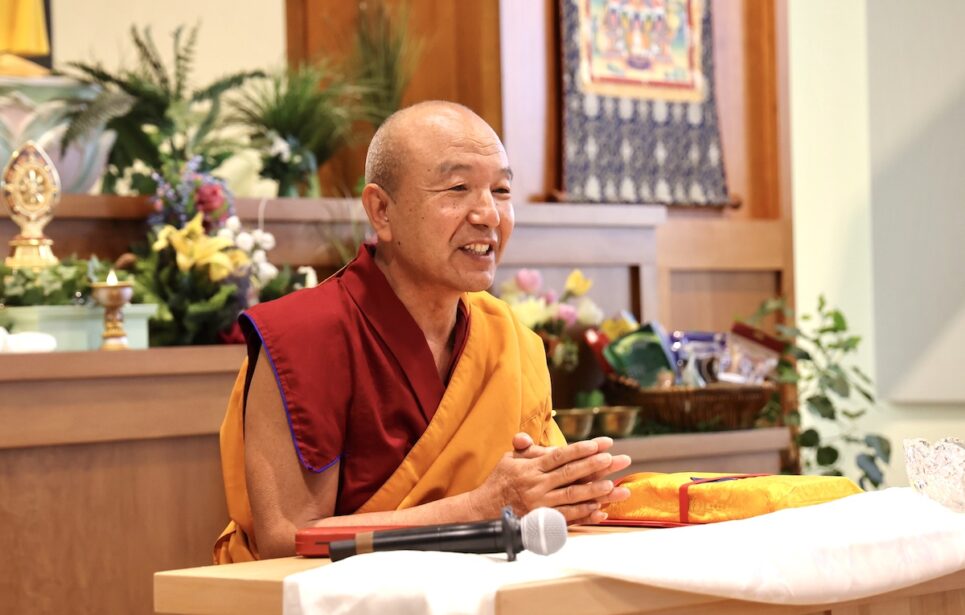
Geshe Samdup, at his July 2026 visit to Sravasti Abbey, offered advice on combining service and contemplation.
In an environment like this, which is so conducive to practice, I feel very joyful and happy. For the teachings last week, I touched on the three scopes of the path, and we discussed them. You were all very receptive. Ultimately, a good life comes down to having a happy life with a meaningful purpose. We are all in the same common state, gathered here to practice the Buddhadharma and engage happily in authentic practice. Being mindful of this happiness is very important.
When it comes to having a meaningful purpose, it boils down to benefiting others and bringing about lasting results. We can benefit others through generosity—specifically, the generosity of material goods, the generosity of Dharma teachings, and the generosity of protecting others from fear. It depends on how much we engage in that generosity, how much it benefits you, and how much you expand it. Personally, I find that only the Buddha’s teachings, the Dharma, can bring this practice of generosity to its highest, most optimal level. Through this reflection, we can see that benefiting others is what truly brings world peace. This will help the Dharma flourish for a long time, and contributing to this will expand our ability to benefit others.
For the Buddhadharma to flourish in its highest state, it is important that people practice. To practice, they need guides and teachers. To become guides, we need hearing, learning, contemplation, and meditation. To support this, we make aspiration prayers. There are two types of flourishing. One is the flourishing of the Buddhadharma; the other is the flourishing of the teachers who serve as the guiding force. This process relies on the scriptural transmission and our gaining realizations. The scriptural transmission refers to giving and receiving teachings, and the teachings come down to the three higher trainings: ethical conduct, concentration, and wisdom. To sustain concentration and wisdom in meditation, the main requirement is the purity of ethical conduct.
With this in mind, all of us hold precepts. They are fundamental because they are the very root of benefiting others. For the Dharma to be established, it needs to be based on the three baskets: the Vinaya, the Sutras, and the Abhidharma. To practice these three baskets, we first need to engage in extensive hearing, contemplation, and meditation. The environment here at Sravasti Abbey is incredibly conducive to that; we have all the resources necessary to practice. I rejoice in this and thank you. With this understanding, encourage yourself, inspire yourself, and work hard. The seniors here have done so much. You should rejoice in their efforts.
Venerable Chonyi: You said Sravasti Abbey has the conducive conditions to practice serenity. But we often find ourselves saying, “But we have so much offering service to do!” How can we hold this reality in our experience?
Geshe-la: Sravasti Abbey is a conducive environment, and in terms of a guide, you need someone who can give you instructions and direct you. There is both an external environment and an internal environment that support this. The external environment is here, and the internal environment consists of sentient beings. With serenity, one might initially look outward, but it is ultimately about internal mental placement. The external environment here is definitely conducive; that is for sure.
Now, it depends on the individuals themselves how much they want to dedicate to that practice—how much time they want to spend and the length of their sessions. That depends on each individual. His Holiness the Dalai Lama made this situation very clear. When he was younger, his activities were immense; it was incredible. I have stated before that regarding when you want to do your sessions—whether in the morning, afternoon, or evening, consider what His Holiness does. He gets up at 2:00 or 3:00 AM to practice, and afterward, he goes to the office to take care of affairs. Then, later in the day, he sits and studies. He is so heavily involved in many activities, yet everything can still be fulfilled.
Therefore, while this environment is highly conducive, individual practitioners must dedicate themselves and find time for their own study sessions and meditation sessions. I have been to several places, and there is no place quite like this, with facilities like the ones you have here. Not only is the environment excellent, but the food here is entirely vegetarian, meaning no living being has been harmed for you to eat. In previous lives, you must have made great aspiration prayers to be here. I was also fascinated by the use of the insect catcher here (it’s from Germany); this non-harmful way of taking insects outside should be viewed as a beautiful symbol of your practice.
Venerable Thubten Chodron: Some monastics think or say: “But I have so much to do—kitchen duty, trips to town, etc.” When they sit to meditate, they feel they don’t have enough mental or emotional space. Can you give them advice on that?
Geshe-la: You can find the answer to this in the Lamrim Chenmo. If you want to understand emptiness, there are three essential factors you must cultivate continuously: 1) engage in extensive study, 2) accumulate merit and purify negativities, and 3) make supplications to the guru and deities.
If you can integrate these three into your practice, anything can be realized. When doing purification and any kind of practice to create merit, combine them with extensive study. The spark that ignites insight is making supplications to the guru and deities. The magnificent perspective is to view the service you do here as purification. Offering service to the monastery and fellow monastics is exactly how you accumulate merit. We need to generate both skillful methods and the wisdom realizing emptiness. Faith and wisdom are both crucial in this process. Studying enhances wisdom, but we must also enhance our faith. Geshe-la thinks of spiritual practice in terms of learning the classical texts, having perseverance, and practicing kindness. Learning the Dharma alone is not sufficient; it is vital to possess the quality of kindness. To sustain both scholarship and kindness, we must have perseverance. All three are important. Whatever duties you are performing for the community, see them as direct actions of kindness.
Venerable Tarpa: We have five of the conditions to gain serenity, but we really need to work on the sixth one, which is having few activities and disengaging from busywork. Being monastics, we work on the first five, especially being content. But without disengaging from meetings, work with contractors, planning teaching schedules, and so on, I feel it’s not possible to truly practice the method to gain serenity. Do we need to set up structures to support practitioners in doing this?
Geshe-la: In Tibetan society, when we do Nyung Ne (fasting retreat done with meditation on Chenrezig), we dedicate ourselves completely to it and are totally absorbed. We can create that structure here. Dedicate three days, then one week, and so on. If you do that, you might not accomplish full serenity right away, but whatever insights or understanding happen during that time will impact you in a deeply positive way when you return to other activities. Even in a normal day, just dedicate one consistent hour purely to practice.
Venerable Tarpa: I have another thought about it. I spoke with Venerable Chodron about this years ago. Isn’t it better to first try to get a correct assumption and then to gain an inferential cognizer? You don’t need deep concentration to gain an inference. It seems to make more sense to spend more time on the wisdom side first. Once we have a correct assumption, it then makes more sense to develop deep concentration.
Geshe-la: This is very true. In previous times, when Je Tsongkhapa consulted Manjushri, Manjushri gave him instructions and told him to use concentration as a base but emphasized that he must study extensively. The more you study, the more insight will emerge. That is why studying the classical texts is imperative.
For example, when we practice concentration, the biggest obstacles are laxity and restlessness. Within restlessness, there is distraction, which has a lot to do with desire and mental wandering. We can only get a handle on those through extensive study. You mentioned correct assumption and inferential cognition; we also have discursive thoughts and conceptualizations. They are quite similar, and we have to understand their specific natures. Similarly, pride and genuine confidence are often mixed up, as are compassion and emotional attachment. People also confuse patience with being naïve. There are so many subtle differences. It is vital to rely on these classical texts to critically analyze these states, because that is exactly how you gain true insight.
Venerable Semkye: I try to develop renunciation—to abandon the three kinds of dukkha (suffering). I try to be content, but I go back and forth. Sometimes I get complacent, and then the wish to renounce arises again. How do I work with this back-and-forth movement of the mind?
Geshe-la: There are three types of laziness: the laziness of low self-esteem (discouragement), the laziness of being distracted by worldly activities, and the laziness of procrastination. To counter these, you must apply their opposite: joyful perseverance. Joyful perseverance also consists of three types: armor-like perseverance, the perseverance of practicing virtuous deeds, and the perseverance of benefiting sentient beings.
His Holiness the Dalai Lama always says we must be mindful and conscientious. It is so important that we hold on to our practice with mindfulness. From my own experience, everything I have learned and teach these days, I hold clearly in his mind. I made a firm conviction because I found these teachings precious and important, so I refused to let them go. Therefore, mindfulness is paramount. Recognize the amazing preciousness of what you are studying. For example, applying this to how we wake up in the morning. The night before, make a strong aspiration to get up and practice or study. Then, you will help you to get up on time. That is the power of mindfulness. In terms of discouragement or feeling down, the ultimate antidote is to rejoice in what you were able to accomplish. Rejoicing is a purely positive thought. It gives you encouragement. When you rejoice, you realize that whatever virtue you have created is never wasted and will impact you positively in future lives. Rejoicing gives you positive hope. This is a very important point to reflect on.
Geshe-la’s talk was translated into English by Nyima Tsam.