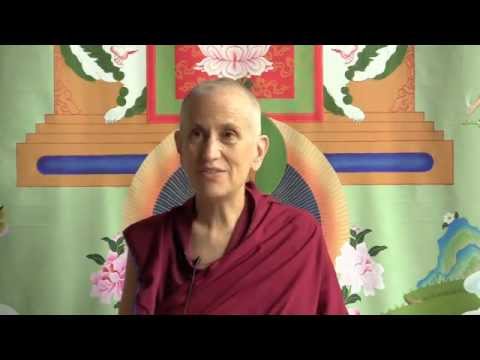
Bodhisattva ethical restraints: Auxiliary vow 45
 Venerable Thubten Chodron
  Bodhisattva Ethical Restraints
  Jun 18, 2012
 Part of a series of talks on the bodhisattva ethical restraints given at Sravasti Abbey in 2012.
- Auxiliary vows 35-46 are to eliminate obstacles to the morality of benefiting others. Abandon:
- 45. Not acting with whatever means are necessary according to the circumstances to stop someone who is doing harmful actions.
Let’s recall our aspiration to benefit sentient beings and to attain enlightenment in order to do so most effectively. Due to that, we want to learn what the trainings are, what to practice and what to abandon, so that we can be of the greatest benefit and so that we can attain awakening. For this reason we’re listening to talks on the ethical restraints of a bodhisattva.
Questions from the previous teaching
Somebody wrote in a couple of questions today, so I thought I’d start with those. First of all, the person is thanking us for doing the Bodhisattva’s Breakfast Corner—doing these teachings and putting everything up on the web. And I would like to say that we’re totally delighted to do that. It gives us great joy to make these teachings available to as many people as want to see them from whatever country they’re in, no matter what their circumstances are. It makes us very happy to know that people we know and people we don’t know are all part of our community and are enjoying these teachings and benefiting from the Buddha’s teachings. So, thank you for the note because it makes us happy to know that we’re doing something that people appreciate.
Then there was a question about whether and when we should approach someone who we notice behaving improperly. It was mentioned that many times we might not actually speak out due to fear of not being taken seriously, of causing anger in the other person, or, in extreme cases, of risking our life if the other person is armed. She says, “Although, of course, it is all very logical to me. I had thought that from a purely Buddhist point of view, since my motivation is only to help others, wouldn’t it be okay for me to risk my life to help others, since alleviating others’ suffering should stand higher for me than attachment to my own life.”
If you’re a bodhisattva and you have really actualized that meditation of exchanging self and others, yes, definitely, you would risk your life to benefit somebody, because in your eyes the other person is more important than oneself. That’s in general, but even within that, you still have to really consider it because if risking your life for something small could end your life whereas that life could have been used to benefit a great number of people, then it’s not so wise to just risk your life for something small. Even if you are a bodhisattva, even if you would have no pain and no selfishness, even if there’s no chances of your being born in the lower realm, still you use discriminating wisdom about what would be the best use of your energy and your time, to give up your body over some small thing or to live for a longer time for the benefit of more beings. But in some cases that person may decide it is of greater benefit to give their life.
What about the rest of us who don’t have the realization of emptiness? We don’t have the ability to just give our body without any kind of attachment, so then what? Here, according to the bodhisattva principles, you should not risk your life because having a precious human life in which you can really develop bodhicitta and develop the wisdom realizing emptiness is very difficult to get, and it shouldn’t be given up in a small situation. On the other hand, if you’ve reached a certain part of the path of preparation, and it seems of greater benefit to give your life, then you could.
Now, you might be an ordinary person who doesn’t have that ability, but something comes in you and you risk your life; that’s fine. If you’re doing it, you’re doing it. Here, I’m thinking of that situation when a child fell off a subway platform and this man just spontaneously jumped on top of the child, flattened him and the train went over them? That man might have been a bodhisattva. Even if he wasn’t, what he did was absolutely amazing, and I don’t think anybody would say he shouldn’t have done it. So, things are different according to the different situations.
The second question was, “You had talked about how you’re irritated by whiners, which again I find very understandable. What confused me was that the discussion went on to describe how we can try and help the whiners, realizing that they are self-centered. But shouldn’t we be much more interested in thinking about how we can change our attitude towards these people to include them in our compassion? The Buddha teaches us how to conquer our own mind, not that of people who irritate us.”
I don’t have a clear remembrance of that discussion, but I’m sure it must have come up to have compassion for whiners. I’m sure, because, of course, even if you’re going to try and help the whiners not to whine, you have to do it with a compassionate motivation. If you’re doing it with an angry motivation, it’s not going to work very well.
45. Not Taking Corrective Action when the Situation demands it.
We will continue with forty-five. This in the broader section of “Not correcting others,” and in particular, “Not repressing those who act very much contrary to the Dharma.” The precept says, “Not taking corrective action when the situation demands it.” What does it say in the red book? It says, “Not acting with whatever means are necessary, according to the circumstances to stop someone who is doing harmful actions.” So, they come to the same point.
This misdeed is committed in relation to people whose behavior is very much contrary to the Dharma.
It’s people who are really doing very negative behavior, it’s not just people we don’t like. And it’s not just small things, so this isn’t an excuse to dump our anger out at anybody, but for people who are really acting contrary to the Dharma.
When out of anger or animosity we fail to scold, punish, or expel from the group people who are behaving badly and it is appropriate to do so, we commit a misdeed associated with afflictions. When we neglect to do so out of sloth, laziness, or carelessness, the misdeed is not associated with afflictions. This situation mostly concerns religious communities but may be found in lay groups such as Dharma centers as well. In either case, when people behave in a way that is very detrimental to the Dharma we should reprimand them, but not out of anger.
What would be an example in a monastery or even in a Dharma center, of somebody doing something that is very detrimental to the Dharma, or contrary to the Dharma that might merit being reprimanded or even expelled?
Audience: Fomenting a schism.
Venerable Thubten Chodron (VTC): Okay, fomenting a lot of disagreement and schism, especially in a Sangha community. What else?
Audience: Openly criticizing the teacher in the presence of students of that teacher?
VTC: Openly criticizing the teacher in the presence of students of that teacher.
Audience: Criticizing them of their qualities or finding fault, just making them look, looking at it through the eyes of ignorance, the eyes of jealousy, or eyes of . . .
VTC: Maybe it would be saying things that would increase doubt, anger, resentment, in the minds of other people.
Audience: Being in a sexual relationship?
VTC: Yes, having sexual relationships in a monastery.
Audience: Seriously misusing offerings and giving them away inappropriately or taking them yourself.
VTC: Yes, like stealing the offerings or things that have been given to the community—you go and you take for yourself or misappropriate, or something like this.
Audience: Using intoxicants or the internet inappropriately?
VTC: You think somebody should be expelled from a monastery for using intoxicants or using the internet inappropriately?
Audience: No, you said be reprimanded or…
VTC: Okay, so that would be a situation of being reprimanded for that, but not necessarily being expelled. At least not the first time. If somebody, let’s say, looked at porn sites repeatedly and had been reprimanded about that, and it had been discussed in the community and the person didn’t change their behavior—because in our precepts there’s not heeding admonition—if a person just really blatantly disregarding the advice of the Sangha community and doing something that’s really detrimental repeatedly, then it could warrant that.
Audience: So, if, for example, a person at the Dharma center doesn’t feel that they actually have a problem…
VTC: What do you do if the person doesn’t think they have a problem? In a monastic community there are ways in which we take care of that. You might talk with the individual personally, one on one, and then you might have a community meeting about it. Then you might really reprimand them in front of the whole community and ask them to be responsible for their action. There are methods that we follow there.
If it occurs in a Dharma center, it’s going to be a different situation because the people aren’t living together. In a Dharma center, people come and go and come and go. So if, let’s say, somebody in the Dharma center has a substance abuse problem, you might talk to that person as an individual or you might, if it’s a regular member of the center, talk to the director or the teacher at the center and ask them to help talk to that person. Depending on the situation, you might contact the person’s family and say they’re having a substance abuse problem and you’d like them to work together with you to help them. You try and deal with it in a creative way.
With lay people it’s also going to be different because you only suggest. If the other person doesn’t heed your advice, there’s nothing really you can do. And there’s nothing really you should do because the person has their own life. If they brought their drugs and alcohol to the Dharma center, if they were drinking and smoking dope there, you could say, “Please don’t come,” because it’s done at the Dharma center. But if they’re doing it privately, you can just try and help the person but I don’t think it would be a situation where you could ask them not to come if they weren’t doing something that was directly harming all the other people at the center.
Audience: But if somebody’s high and coming in high and then, as a group, that still impacts. . .
VTC: If somebody’s coming to the teachings and they’re high, it would impact everybody, so that’s why I said you do the other things: you talk to the person individually, you talk to the teacher, you talk to the director, ask them, or you call the family and see what you could do if somebody had that kind of problem. In the course of talking with somebody, for example, the director of the center could say, “When you’re intoxicated, please don’t come.” They wouldn’t say, “You can never come here.” They would just say, “Please don’t come when you’re intoxicated because it adversely affects the rest of the group.”
These kinds of things are difficult because you need to protect the group. At the same time, you can’t just ostracize the other person because they should be an object of our compassion, and we should try and help them, too. That’s why it says if you do this and you’re angry and resentful, thinking “Oh, I don’t like this person, they’re disturbing everything and they’re causing so many problems, let’s just get them out of here,” then kicking them out for that reason would actually be one of the root ones—the one of taking the robes away from a monastic or making a monastic disrobe. But here, it’s if you don’t correct somebody and the situation really calls for it.
Why wouldn’t you correct somebody?
Audience: Fear.
VTC: Fear of?
Audience: Confrontation, conflict.
VTC: You have a fear of confrontation and conflict, so you hold back. That other person needs somebody to comment on their behavior, but you don’t like having conflict and confrontation; you don’t like risking that that person may not like you afterwards, so you just keep quiet and they continue their bad behavior. That’s a transgression on our part if we’re like that.
This mind that says, “Hum, I don’t want to do it. They have a problem I know, but I don’t want to get involved.” It’s very interesting, isn’t it? Because there are the people who get overinvolved and want to correct everybody and control everybody, and there are the people who are underinvolved, who don’t say anything when something needs to be said. Here we see that both of those things are faults in the bodhisattva practice.
Audience: It wasn’t a Dharma group, but I’ve seen the un-taking-care-of-it destroy an entire group.
VTC: So, you’ve seen the lack of taking care of it destroy an entire group—that’s very clear, isn’t it?
Audience: People just leave, or whatever.
VTC: Yes, when something is happening that shouldn’t be happening and nobody wants to comment on it, after a while many people stop coming or the group just gets so weird because they’re following somebody’s weird ideas or behavior. This is important because sometimes in the name of compassion we think, “Okay, I won’t say anything, I’ll just have compassion,” but then it really adversely affects the whole group. I’ve seen that too—when people come into groups with a lot of anger, and they want to control everything and try and take things over, or whatever. It’s not that you expel those people, but you definitely have to talk to them because they’re not fitting in with the group. You just get one person sometimes to the point where it’s a psychological problem that really sets everybody in the whole community off.
I’ve told you of the story in one community where I lived where there was one young man who was so excited about the Dharma; he just thought the Dharma was so wonderful. One woman came and he said, “You don’t need to take your meds”—he didn’t want anybody to be taking their meds prescribed for bipolar or depression or whatever. This woman followed his advice and was running naked in the center, so clearly somebody needs to talk to that young man who was a member of the center and say, “The advice you’re giving people is not correct. People need to take their meds and there’s nothing wrong with that” and so on and so forth.
You’re shaking your head. You don’t know what goes on; you’re very sheltered here. I’ve lived in community in some places, and it’s amazing what goes on. I lived in one community and one of the monks was flirting with the wife of one of the members who lived in the community. They started having a somewhat sexual relationship in the middle of the community—a monk, yes, and with somebody who was already married.
Audience: [Inaudible]
VTC: I think after a while they must have seen you need to say something to somebody. Sometimes for a while people keep things hidden but eventually it comes out. By that time, it’s usually pretty messy, just amazing things happen.
In either case, when people behave in a way that is very detrimental to the Dharma we should reprimand them, but not out of anger. First we let our anger subside and then talk to them gently and tactfully.
That’s really important: to get over our anger. In the meantime, even though we may be angry, it might be good to bring it up to somebody else. If it’s something really serious, it’s helpful to make other people in the community aware of it, but just by stating the facts and not going beyond that because one’s anger could too easily influence the situation. If you told to a senior member of the community, that member may help you get over your anger and in addition may help you figure out how best to address the situation.
If speaking to them gently and tactfully has no effect, we will try speaking more firmly and sharply, still without any irritation on our part.
Again, that’s the whole thing of you might have to act or speak in a very forceful way but without being mad, and you do it simply to communicate to the other person the seriousness of what you’re talking about.
When all else fails and the people stubbornly persist in their bad behavior, in that case we must oblige them to leave the group, motivated by compassion alone.
So, if somebody doesn’t hear when you speak gently, if somebody doesn’t hear when you speak more aggressively or more assertively, they’re still doing something that is really destroying the harmony in the group or really totally messing up the group’s ability to practice well, then you might have to ask them please to leave. But if you do so, you do so with compassion.
I’ve seen that situation happen sometimes, and it’s often very traumatic for the person who is asked to leave because sometimes they don’t think they’re doing anything wrong or they say, “I have a problem but it’s not that severe.” And then they feel rejected, and they lose their faith in the Dharma, and it’s usually very, very bad. So, you want to make sure that you do that only if the situation is really serious, and if you’ve tried every other way. And then even if you do that, you have to really explain to the person why, in a kind way, and let them know that if they change their behavior, they’re welcome back.
If we do not do this, reprimand them or even oblige them to leave, then we commit a misdeed. Exceptions from the angle of the basis are made in these circumstances: we are waiting for the right moment to act and it has not yet come.
The right moment is when our irritation has abated. Somebody is doing something, and we’re angry and we don’t want to speak out of anger, so we’re waiting until our anger subsides to speak to that person. That time period while we’re working with our own mind to try and calm ourselves down, we don’t commit a transgression because our motivation is ultimately to speak to the person, but we’re just not doing it this moment because, if we did it at this moment, we would be breaking another precept.
With respect to the object of our action, the people who have misbehaved are so angry that it is hopeless to try and explain anything to them. When we are convinced that they will not listen, there is no fault in not taking action.
For example, maybe other people have tried talking to them and they just don’t hear. And they continue and whatever. If you don’t say anything at that point it’s not a fault. However, there’s still the difficulty in the group with that person staying there. But if that person is so angry and so touchy that they won’t listen to anybody, it’s no fault not to say anything but the group will at some point have to do something because it can damage the whole group.
The other exception is the people see their mistake, are sufficiently ashamed and embarrassed about it and will very soon be reconciled with others, which makes further comments superfluous.
So, the other person sees that “I goofed. This is not good. I really regret it, I’m going to try and make amends with the group.” We know they see that, so there’s no sense in saying anything because they’re already going on the right path.
There’s two exceptions in relation to necessity: one is we sense that correcting the people would lead to quarrels, verbal abuse, fist-fights, and eventually to litigation.
But then it’s difficult because you don’t want to stir that person up so much that then it just brings more problems to the group; but also it’s difficult because you’ve got to do something with the person in the group. Because you can’t let them continue doing what they’re doing. On the other hand, you don’t want to do something that’s going to lead to litigation and an outright explosion and everybody going berserky. It can be quite difficult sometimes. That’s why the Buddha always says we should be easy to admonish, and we should listen when people say something. We should at least take it in and consider it instead of being so difficult to speak to.
Another exception is we believe that it would cause a disturbance and finally a split in the spiritual community.
If saying something to that person would cause factions to form in the community, then you wouldn’t say anything, and that wouldn’t be a transgression.
Should we have some discussion about this? People look really uncomfortable, unhappy.
Audience: Well, I’m remembering a time when I needed to do this—it’s very applicable in the workplace. I just didn’t have the skills to do it correctly, but slowly over like a year of coaching with my supervisor, I did it correctly. It took a lot of help; that was the thing that I realized. I’m thinking even in a Dharma place you might need to get help—like talk to senior students, talk to the teacher, get help from mediators, really get a lot of information before each action. By not doing that thing took a long time and got messy because I just was ignorant.
VTC: Okay, you’re saying in the work situation, which in some ways is similar to a community, that you were trying to admonish and help somebody but you didn’t have the skill. You did ask for help and through receiving that help over a period of time, your skill increased and you were able to benefit that person and speak to them. So, you’re saying it’s good at the beginning, if you realize that you don’t really have the skill, ask somebody right away and get some outside help from somebody who knows how to speak in these situations—who could either help you figure out what to say, or by asking a mediator to come in, or by speaking to somebody else who that person might listen to. Because sometimes we’re not the right person to speak to that person, but if we ask somebody else they might listen to that other person.
Audience: All those things helped.
VTC: Yes.
Audience: Eventually someone else told them the same things but he was able to hear it.
VTC: In your situation somebody else eventually told the person the same things that you had been saying, and he was able to hear it. But you’re saying, if you had been able to ask for help earlier, it wouldn’t have dragged on for so long.
Audience: I think for me there’s a number of discomforting places. First is that when I get upset, when I see somebody else’s behavior, I get really, really angry knowing that I’d better just keep my mouth closed and cool down. I go between an urgency to speak then, because I think I’m going to not have another chance; or I go from being really angry to being indifferent. I go into the “whatever” mode, which is like I can’t quite get myself down to a place where I try to look at the perspective of the other person, or to try and get my mind clear and open to be able to speak to them. NVC has helped. I go from anger to just that’s the only option and, if I can’t do that, it’s just like I won’t address it.
VTC: I think this is a very common thing. When people are upset and they’re angry, they realize they’re upset and angry, and they say, “I can’t say anything when I’m upset and angry.” Then the way they deal with their upset and anger is to say, “Well, I just don’t care—whatever. It’s not my responsibility. Somebody else will take care of it.” And then they try and convince themselves that they’re indifferent.
In this kind of situation, the anger doesn’t help but the fake indifference also doesn’t help. Those are the two extremes that I was talking about before. If you act out of anger and you kick a person out or in this case if you just don’t say anything and think, “Whatever, I’m not in charge, not my responsibility,” also that can be a problem. In those kinds of situations it is difficult to work with our mind, to get our mind to be compassionate and really see, “Okay, this person’s acting this way because they have some problem. They’re suffering from their problem. It’s not like they’re my enemy. Rather, what’s going on in their mind is making both of us unhappy,” so having some compassion for the person. But to get our mind there sometimes is quite difficult, especially if there’s some resistance from the other person.
In those situations I think it’s very helpful to go and talk to somebody else. Especially in a community, sometimes you can do things in a way where you ask a question, you’re not angry but you just ask a question. You don’t point any fingers at anybody, but it’s a community meeting let’s say, and you say, “Is such and such behavior appropriate in the community?” You just bring it up as a point of discussion amongst many people. That can be helpful because you may see something from the discussion like, “Oh boy, I was getting angry at something that I don’t need to get angry at.” Or the other person may see, “Oh boy, I’m doing something that is really setting people off and I need to look at this.” That can often be done in that way, and often people can hear it better than if you say something to them personally. Because people get so defensive when it’s a personal thing. Whereas if it’s just a general group discussion, they can often hear things.
Audience: That’s helpful, because what has happened for me is that I overreact to certain personalities, so then it becomes this war of who’s right. I really want to be conscientious. I want to have a motivation of benefit for everyone, but I just get pushed in that place, that “I want to be right” place, so it becomes more of a situation of forgetting about the issue and wanting to be right. The motivation just goes down the toilet.
VTC: Right, it’s very clear when sometimes we do have reactions just to a person’s personality and whatever they do we see fault in it—whatever they do. They say, “Good morning”, and it’s like “Uck! I can’t stand it.” It’s true, isn’t it?
Audience: Yes.
VTC: When we decide “I don’t like somebody,” we find fault with everything they do.
Audience: Especially if you’ve gone from anger to “Oh, whatever.” Then from “Oh, whatever,” you just keep building these little piles of “Oh, whatevers,” and then it just totally filters that person through that “whatever” filter.
VTC: Right, you can’t see the person clearly and then the mind is just so agitated. At those times when we have inner agitation, we know “I need to ask for help with my agitation.” After we get help with our agitation then we think about, “Let’s look at the situation with the other person.” Because very often once we calm down we see there’s no situation to deal with, that our mind is just exaggerating. But like you say, if we get really locked into our position, then we want to be right, and we’re going to fight until the world recognizes that we’re right, and that the way that person said “Good morning” is just not acceptable whatsoever. And then you can see we’re just hanging on to our ego for dear life, aren’t we?
Audience: It happens all day long for me. That’s my practice, it’s just looking into the little pokes at my ego and my attachment to whatever it is.
VTC: This is why I think we need a sense of humor, because we’re always going to get poked, aren’t we? It’s always going to happen, and if we can laugh at it, if we can joke about it, then it defuses it in our own mind.
Audience: Could you give an example of this last point? I’m trying to think when that would cause a disturbance, finding a split in the spiritual community. I think you must be really advanced to know that.
VTC: You can sometimes tell in certain communities. For example, if there’s a certain kind of group-think in a community, you come in and you say something to try and do something, and people could just go nuts about it. It’s a difficult situation because sometimes things really need to be said; otherwise more people are going to get hurt.
Audience: It seems when it’s just a discomfort for me, unless it’s something really blatantly violating precepts or whatever, it seems like there’s so much grey area where I would be slipping around going, “Is this just me? Is it my own perspective? Is this really harmful to people or am I just having my reaction?” There’s so much discomfort and time in trying to figure out what’s actually going on, that things could get quite out of hand while I’m still trying to assess the situation.
VTC: Right, while you’re still stuck in the middle of your doubt, which is all fueled by “I want everybody to like me.”
Audience: It might be. It also just might be not being so very wise.
VTC: Yes, sometimes self-doubt is good. Sometimes it’s not appropriate.
Audience: But it’s kind of scary to hear this kind of scenario because I can see how easily I could get caught up in just not knowing and then not act.
Audience: I just wanted to comment that sometimes when these kinds of situations are happening, we go to the area that’s like “it’s too late,” but it’s actually never too late to do something, ever, because even if there’s a ton of damage done per se, you can learn from that and as a community.

Venerable Thubten Chodron
Venerable Chodron emphasizes the practical application of Buddha’s teachings in our daily lives and is especially skilled at explaining them in ways easily understood and practiced by Westerners. She is well known for her warm, humorous, and lucid teachings. She was ordained as a Buddhist nun in 1977 by Kyabje Ling Rinpoche in Dharamsala, India, and in 1986 she received bhikshuni (full) ordination in Taiwan. Read her full bio.