Bodhisattva ethical restraints: Auxiliary vows 41-43
Part of a series of talks on the bodhisattva ethical restraints given at Sravasti Abbey in 2012.
- Auxiliary vows 35-46 are to eliminate obstacles to the morality of benefiting others. Abandon:
- 41. Not giving material possessions to those in need.
- 42. Not working for the welfare of your circle of friends, disciples, servants, etc.
- 43. Not acting in accordance with the wishes of others if doing so does not bring harm
Let’s generate our motivation, feeling really pleased that we’ve not only encountered the Buddha’s teachings but also the Mahayana teachings—the teachings of The Great Vehicle, the teachings that show us how to purify and cultivate our mind so that we can attain full awakening and become fully awakened buddhas. Having encountered these teachings and having faith in them, let’s really try and practice them while we have the opportunity. Let’s cultivate that bodhicitta motivation and see our lives in terms of the long perspective and what is really valuable for us to do. And in that way, let’s work not simply for the temporal benefit of sentient beings—let alone our own temporal benefit—but let’s work especially for the long-term benefit of each and every living being.
The importance of keeping an open-mind
I got an email today from somebody who was telling me that her boyfriend doesn’t accept the Mahayana teachings and says that the Mahayana scriptures weren’t spoken by the Buddha, so it’s impossible to become bodhisattvas or to attain full awakening. She doesn’t understand enough to discuss it and thinks it’s a fruitless argument to pursue with him. That part’s true, but it made me really think it’s quite unfortunate that this person has that view. While a number of my Dharma friends from the Theravada tradition do have that view, and I certainly respect them for it and encourage them in their practice, I feel that there’s something special in the bodhisattva vehicle, in the Mahayana teachings, that you don’t find elsewhere. And these special points are things that are very natural outcomes from the Pali teachings.
For example, in the Pali canon, the sutras talk about how the Buddha taught the four immeasurables—the four Brahmaviharas: love, compassion, joy and equanimity. And if you look at bodhicitta, bodhicitta is based on that but enhances all of those four. So, it’s not just love for one person or whatever, but equal love for all living beings. And it’s the love that not only wishes them to have happiness and its causes, but also the great love that’s going to get involved in bringing that about. And it’s the great compassion that’s going to get involved in bringing it about. You may have love and compassion by cultivating the four immeasurables, but you’re not necessarily going to have the great the love and the great compassion or the great resolve, which leads you to personally get involved in bringing those things about. In that way, you can see how a bodhisattva as they are described follows very well from the arhat’s practice of the four immeasurables, but it’s really enhancing and expanding them.
Similarly, in the Pali scriptures the view of selflessness is primarily emphasizing the selflessness of person. There’s some doubt whether the Buddha also could have been speaking of the selflessness of phenomena; it’s actually quite hard to tell. In any case, it’s definitely emphasizing the selflessness of persons. In the Mahayana scriptures, they talk also of the selflessness of phenomena. So, it’s expanding and enlarging what the Buddha spoke about in the Pali scriptures. I don’t see them as two cut-off things. It made me kind of sad to hear that. Also, it made me wonder whether that person, her boyfriend, really understood things because even the Pali tradition talks about the bodhisattva vehicle, talks about how the Buddha became a buddha and wasn’t always a buddha. The path to Buddhahood is explained there; it’s not emphasized, but it is definitely there.
I really try and encourage people to have much more open minds. In other words, you may choose a particular path that suits you best, but it’s important to have an open mind about the others instead of saying, “It’s impossible to become buddhas.” If that’s true, how did the Buddha become a buddha? At least we can study the Pali tradition and then the Sanskrit tradition and really see how one builds upon the other and they’re not distinct, cut-off things where we have to make hard and fast decisions about them. Of course, that’s my viewpoint. Other people might like this and this and there’s a line in between, so different things for different people.
We’ll continue talking here about the bodhisattva precepts, the keeping of which is done with the motivation to attain full awakening for the benefit of all beings; it’s done with that bodhicitta motivation. When we properly keep the bodhisattva precepts, especially meditating at the end on the emptiness of our self and the emptiness of the agent, object and action, and remembering that when we’re keeping ethical conduct, it becomes a really surpassing practice motivated by bodhicitta, supported by an understanding of dependent-arising and emptiness. So, while we’re explaining the bodhisattva precepts one-by-one in a more individual way, we should always remember that we want to keep them with the motivation of bodhicitta and also reflect on the dependent arising of us and the object and the recipient, the person we’re acting in terms of and and thus their emptiness when we keep these different precepts.
42. Not Ensuring the Welfare of your Following
We’re still talking about the precepts to abandon—the six ways in which we don’t help others.
The first one was “Behaving very badly in relationship to those who have been helpful to us,” that’s “Not repaying the kindness that people have shown us.” The second was “Behaving badly in relation to those who are unhappy” and that precept was “Not easing others’ distress.” The third was “Behaving badly towards the needy” and the precept was “Not giving wealth to those who desire it.” The fourth one here is “Behaving badly in relation to our following,” the precept is “Not ensuring the welfare of your following.”
This is talking specifically to senior monastics, to teachers who have junior monastics or the lay people at the Dharma center who are following them and considering them their teacher. It’s pertaining to that kind of situation. He says:
This misdeed consists of not caring for our following. In other words, our students or disciples. But it is our responsibility to do so.
So, this is when you have students or disciples, or even if you don’t have students or disciples but there are people who are looking to you because you have more Dharma knowledge with them and they’re seeing you as kind of a big brother or big sister, it could apply to that kind of thing too.
We should look after these people by teaching them the Dharma and if they are poor we should also provide for them materially by seeing to it that they have the basic necessities: food, clothing, bedding and a roof over their head.
Put another way, the four requisites: food, clothing, shelter and medicine. Actually in the vinaya it says that if you take students you are responsible for providing those things for them; these would be for other monastics. I think the idea is that offerings are made to the seniors and then they are used to support the juniors and to support the entire community.
This particular precept is something that is interpreted or upheld differently in different traditions. Basically in the Theravada tradition and Chinese tradition, if you ordain as a monastic you are cared for in terms of the four requisites.
In the Tibetan tradition that’s not necessarily the case. It’s not just in this generation that that’s happened, it also existed before. If you read Geshe Rabten’s biography, he was from a different part of Tibet, I can’t remember if he was from Amdo. He was from Kham? When he came to Sera he didn’t have any benefactor so he was eating just hardly anything or very, very poor quality food. Once in a while somebody may share something with him but often they didn’t. I think this was because the Tibetan monasteries were so large, that’s one reason. They go on pindapat, on alms round, because they were so large. Also I think because they were so large, you automatically have that breaking down into small groups and what belongs to this group and what belongs to that group.
So you had the two colleges in the major universities and within them you had the groups of monks from different localities and then within that you had the monks that surround different teachers. Often the monk, if you were a young boy who joined the monastery, who took care of you may not have been a Dharma teacher, but was one of your relatives. Somebody who was your relative would take care of you but that person may not take care of another young person who comes who is not a relative. So for whatever reason in the Tibetan tradition you weren’t always taken care of.
Although I think they were taken care of better in Tibet than in exile. In exile in some ways, they’ve had to work more as a community to really bring about the community. In any case, still you’ll find in the Tibetan monasteries discrepancies between those who have a lot of resources and those who don’t. Definitely when it comes to their non-Tibetan disciples, you find a great deal of divergence between those who have resources and those who don’t. And the Tibetan lamas, their first priority was to care for their own community and the Tibetans in exile. They had the idea that the Westerners all had money, which is not correct but they had that idea, then the Westerners were more or less left on their own to provide for themselves. That was a very difficult point. I know, I experienced it personally for many years. That’s one of the reasons that we established the Abbey, so that when people come here, once they’re fully ordained they really are cared for. Before that, you still have room and board and your clothes and so forth, you aren’t left on your own.
But you can really see why there’s this precept that if you have students, in order to teach them the Dharma, they have to have at least food in their stomach and a roof over their head and clothes and medicine. Otherwise they aren’t even in a position to be able to listen to the teachings. You provide for them physically so that they are in a state where they can receive the teachings.
In terms of supporting lay people it’s a completely different ball game. Because the relationship between the lay and the Sangha has always been that the Sangha gives the teachings and the lay support through giving resources and so on. This kind of precept I don’t think would apply for lay students unless you have a really serious lay student who wants to practice. But then you would think that that person would ordain, so I don’t know.
If we fail to do so out of anger or animosity, we commit a secondary misdeed associated with afflictions. If we do not look after them because of our sloth, laziness or carelessness, it is a misdeed dissociated from afflictions.
Again, just to review, that’s because with any of these if we do it with anger or animosity, there’s a lot of energy behind that. This division into associated and non-associated with afflictions we’ve seen applies to all these precepts. That’s because with anger or animosity there’s a lot of energy and there’s a strong determination that you don’t want to help this person. That karma is going to be much heavier than if you’re just careless, lazy or slothful. Being lazy, slothful or sleepy, there’s still affliction but it’s called not associated with affliction because there isn’t a strong motivation to actively harm that person. It’s more done just out of forgetfulness or ignorance or something. There’s some negativity but it’s certainly not like having a very resentful, antagonistic mind saying, “I’m not going to support you.” Or with any of the precepts, going against them.
Exceptions in relation to the basis exist—[the basis means us]—when we are ill or we have placed the people concerned in the care of another competent person.
Then that’s fine; it’s not a transgression if we don’t do this. If we’re sick and can’t take care of somebody or we’ve already asked somebody else to take care of somebody and that other person is able to do it, then we’re not responsible.
There are also exceptions in relation to necessity, when it is better for the people not to receive our assistance in the form of teaching or material support and when providing them with it conflicts with monastic rules.
What would be an example of not providing teachings for somebody that could have this kind of reason, where it’s better for the people not to receive the teachings? What would be an example of that?
Audience: Asking for teachings that are more advanced than the person is ready to hear.
Venerable Thubten Chodron (VTC): Asking for a teaching that is more advanced than the person is ready to hear. In that case what is very good to do is to say, “Yes, I will do that but first you have to know the beginnings, you have to read and study the three principal aspects of the path and all this kind of stuff.” Serkong Rinpoche was really wise when that happened. I heard of a story of one man in the early years who came, didn’t know anything about the Dharma and went to Rinpoche and said, “I want to learn Guhyasamaja tantra.” And Rinpoche didn’t say, “Go away, you don’t even know ABC.” He said, “Oh, that’s very good. First, let’s learn the lamrim. When you have a lot of experience with the lamrim and you know Madhyamaka and bodhicitta, then I’ll teach you this.” It was a very skillful way.
What would be another example of not teaching somebody when it would be better for that person not to?
Audience: [Inaudible]
VTC: You mean like if somebody hasn’t requested the teachings? Yes, generally then you don’t teach.
Audience: If it wouldn’t be good for their mind.
VTC: Yes. What would be an example of not being good for their mind?
Audience: The emptiness teachings.
VTC: Okay, if they’re not prepared to hear the teachings on emptiness.
Audience: What about if you’ve given this teaching over and over and the person just isn’t practicing?
VTC: So you’ve given the teachings many times, the person has heard them but they’re too lazy to look up the answers, to read their notes or to listen to what’s been taught before. Yes, that could probably be that, to really emphasize to that person that you need to put forth effort. It would be a way of teaching that person the importance of putting forth your own effort.
Audience: If they come to request with a certain level of cynicism, almost like “Show me” or “Convince me” kind of attitude that isn’t open to it, more like ready to refute.
VTC: Yes, so if the person’s request is not sincere. As a way to help them reflect on their own motivation you might say “No” and encourage them to reflect on their motivation for requesting the teaching.
Audience: I was thinking of somebody I know who’s not Buddhist who has a negative attitude. You would just reinforce that in a way.
VTC: That’s what she’s saying, somebody is cynical or whatever. Yes, somebody who is not requesting teachings with a sincere attitude.
Also regarding that kind of sincerity, if the person requests the teachings but you know that they want to have the teachings so that they can either go and refute it to other people and denigrate the teaching or so that they can go and teach it to other people and make a big name for themselves. When we talk about the three kinds of vessels, the upside-down and the leaky pot and the one that’s dirty inside. If somebody has a wrong motivation, it’s like pouring pure water into a dirty vessel because that person is going to take the teaching and misuse it.
For example, I can’t remember the entire circumstance, but it was after one of these tours of the monks who did the Medicine Buddha puja—built the Medicine Buddha mandala and everything. Somebody called me and wanted me to teach them the Medicine Buddha practice—they weren’t a Buddhist—so that they could then go teach it to all their friends at their yoga center or whatever it was. I said, “Oh, I’m sorry I can’t do that; this is a practice that we explain for people who have refuge in the Buddha, Dharma and Sangha. It wouldn’t be appropriate for you who is not a Buddhist to teach it to other people who are not Buddhists.” So, it’s that kind of thing where somebody is going to take a teaching and in some way degenerate it or change it.
I also met some other people who were making CD’s with chanting and coming up with different melodies for different chants. With the Tara mantra they had a melody that required a few extra syllables, so they chanted the Tara mantra and added some extra syllables to it so it fit their melody to make a CD and then distribute it. That kind of person is not the kind of person you would want to teach because they don’t understand and they’re going to degenerate the teachings. It’s that kind of situation, too, where you wouldn’t give a teaching if somebody requested. Instead you would say, “I’m teaching this, please you come and study. I’m teaching lamrim, or whatever it is, please come study, get a good foundation and take refuge first.”
Where it’s better for people not to receive our assistance in the form of teaching or material support.
Where would it be good, better for the people not to receive your assistance in material support if you had students?
Audience: Maybe if they’re not going to use the time well if you give them material support.
VTC: Yes, if they’re not using their time well or if you’re giving the material support, and they give it to their friends and relatives or to their family. It might be a situation where it’s money that was offered to you as the teacher by people who had faith in the Sangha, and you give it to a student and the student uses it for whatever—their own pleasurable thing or to give the gift to their relatives or their family, something like that.
You don’t provide material or Dharma teachings if it conflicts with monastic rules.
What would be an example of that?
Audience: Teaching a male alone.
VTC: Yes, a guy asks you, “Oh, come and teach me this teaching at eight o’clock tonight in my room.” Well, that just isn’t the appropriate thing to do. That conflicts with monastic rules, doesn’t it? We always have to see what is appropriate and what is not appropriate in terms of the situation we’re asked to teach in.
What I’ve found is many people are not aware that when they invite somebody to teach, the teacher should be sitting higher than everybody else. Sometimes they set it up, the teacher is here and people are sitting in chairs around the teacher. I think if you’re in an auditorium and you’re down I think that’s okay. They’re looking down but I think they’re hopefully getting the idea that you have something to say. But people should always be sitting lower than the teacher and some places just don’t realize that when they set up the seat. I try and tactfully say something, also in a practical level, and say, “I can’t see the people I’m teaching.”
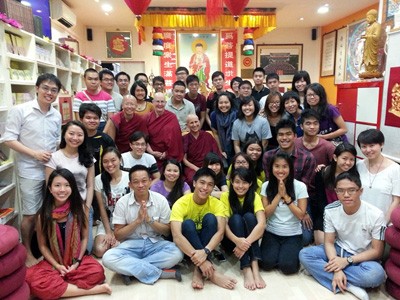
There’s some places like when we were in Singapore recently, where they were able to adjust the seating; they brought in a chair and then it was really nice. I could see the people and they could see me, which is far better. But in other places where I went I was sitting on something like this tall, and I’m small. I couldn’t see past the first two rows and it was a huge room filled with people. Sometimes people aren’t aware of that. If you’re up a little bit that’s showing respect but still for the audience, they can’t see you and that really influences, I think.
Audience: [Inaudible]
VTC: If the teacher doesn’t want to sit higher, it’s fine. But it may be a very informal kind of situation, not a formal Dharma teaching, and they may be meeting with people who are not Buddhist. Because I know when I go to speak to a group of people who are not Buddhist, often I don’t wear my upper robe because people aren’t used to it. I wear just a jacket, the people are not Buddhist and it’s more acceptable for them in that way. So, if out of skillful means, adapting to the way things are done in a particular place, I think that would have some sense.
Then, there’s other situations where people really force the teacher to be higher. I remember when Geshe-la wanted to sleep on the lower bunk, it was a two-tiered bunk. He wanted to sleep on the lower bunk because he’s old, and he wants to get up to the bathroom and it’s easier to get in and out of bed. The other monks were so set, “No, you have to sleep higher than us.” They forced him to get up on the upper bunk. He’s like seventy years old and big and it’s hard for him to get up and it’s hard for him to get down. I think in that situation you do what the teacher says.
I’ve been with Khensur Jampa Tegchok sometimes when I was visiting him at Sera he would cook us dinner or lunch and I’d say, “Gen-la, I should be cooking for you.” And he would say, “No, I’m cooking for you.” Then he had his bed on the floor, he would sit there and he would put chairs out for us and make us sit in the chairs higher than him. I tried to protest but he’s my teacher so I gave up eventually and it felt so strange to sit higher than him. On the other hand, it was also a sign I think, of the closeness that he would do these kinds of things for us, it was really very, very sweet.
Finally there are several exceptions in relation to the potential beneficiaries—[in relation to the people who we could be giving Dharma or material aid to]—if our followers are sufficiently wealthy or capable of finding what they need themselves.
I think this was probably what a lot of the Tibetans thought about the Western monastics, it was not necessarily the case, but I think this is what they thought. If it’s actually the case that they have the wherewithal and they can find what they need, then you don’t need to provide it. Although I really think in a monastic situation, it is much better for everybody to be equal in that way.
We did a skit in 1996 when we had the program, Life as a Western Buddhist Nun. Venerable Wu Yin had us do skits and one group, it wasn’t the group I was in, did a skit about the rich and the poor nun, because this was really the situation of the Western nuns. Some received money from their friends and family or they had their own money and others really were completely broke and had to work in Dharma centers. In the skit there was the rich nun with her nice robes who was going here to receive teachings and going there to receive teachings and walking out the door going everywhere, with her brocade book covers and nice things and then there was other nun, ragged robes with a scarf around her head scrubbing the floor, answering the phone, talking to the lay people, cooking, cleaning, doing everything. We were laughing hysterically because it was so true. That was really very much the situation for many of the people who had to stay behind and work because they didn’t have the money to pay for transportation or teachings. Then the people who had the money and could go off and do that.
That kind of economic difference doesn’t lead to harmony in a community. When we look at the six harmonies that the Buddha talked about in a monastery, it was sharing the resources. We don’t have that kind of economic difference about who can go to teachings and who can’t and who works and who doesn’t work.
In the Tibetan monasteries when they started out, most of the monks had to work in the fields because they had to clear the thing and they didn’t have lay people who worked in the fields like they did in old Tibet. Nowadays, if you offer a certain amount to the monastery you don’t have to work in the fields. So, there are the monks who work in the fields and the other monks who get to do more study because they can offer a certain amount to the monastery.
You can see sometimes, why we do things. I’ve had some experience and seen different things, so it’s helpful to understand why we do things the way we do.
Another situation is these people have already received instructions on the teaching topic, furthermore, they know it well and are capable of practicing it accordingly.
If the people ask something that you know they know well and they can study and practice it well, that’s fine. I think you can include in that. It’s always better to have oral teachings, but if the person has heard the oral teachings before and they can go listen to the tapes or read the transcript or whatever that’s available to them then I think it’s fine.
The intentions of those asking for instructions are questionable. The people originally came from another spiritual tradition, they want only to take the teaching from us and then return to give it to those who belong to their original tradition.
So, this refers to taking the Buddhist teaching, changing it in some way or another and then presenting it as their own teaching or whatever to their own followers.
Other possibilities are that the people requesting the teaching plan to use it to earn their livelihood, to criticize Buddhism, or to gain power over others.
In any case where you feel that the people are going to misuse the teachings, it’s fine to decline to give them.
Audience: We’re still on forty-two, so in the red book, our prayer book, could you comment on that translation?
VTC: It says, “Not working for the welfare of one’s circle of friends, students, employees, helpers, etc.” In forty-two, it’s describing more particularly, when it says “Not ensuring the welfare of your following.” Here “following” is defined as your circle of friends, students, employees, helpers, and so forth. In other words, it’s the people who are relying upon you, who look to you for spiritual guidance.
Audience: Yes, I just think that it’s so not clear, I’ve read these over for many years, and it would never occur to me, except for the commentary reading now, that this is for monastics with students and not just in general.
VTC: Well, like I said, it’s not only for monastics with students, it could be for monastics with monastic students, it could be monastics with lay students and it could be lay teachers with monastic students or lay teachers with lay students.
Audience: Oh, okay.
VTC: And like I was saying, too, even if you’re not in a position of being a teacher, even if people are seeing you as an older Dharma practitioner, it’s important to try and answer their questions and help them out.
Audience: Okay, that’s helpful.
VTC: The main point is to not collect a group of people that follow you and then you just ignore them. When people follow you, you have a responsibility towards them. I think that’s what the precept is getting at.
Audience: [Inaudible]
VTC: What do you mean not able to receive the teachings?
Audience: Like if he has not the right mind for it—he’s actually criticizing the teachings, for example.
VTC: If you’re in the course of giving a teaching and you realize somebody is criticizing the teacher or they don’t have enough background to understand it, then you stop teaching that topic and you start teaching what they need to hear.
Audience: [Inaudible]
VTC: Yes, that’s the obvious thing to benefit them, isn’t it?
Audience: There is a story from some of the folks at Boise when I went there about a teacher who went there to teach. He came up, and no one did any prayers to begin with. He sat there the whole time and then when the time was up, he got up and left. Hours, it was hours. They said that was the most powerful teaching they’ve ever received.
Audience: I’m still curious that teachers or Geshes perhaps, come from another country, will ordain people, and then they go back to their country. These people have the bodhisattva vows and that just seems to still defy reason.
VTC: You say that you’re finding it very difficult to understand why people would come to another country, ordain people, go back to their own country and leave those people there. I think that their view is that it’s more beneficial to be ordained one day in this degenerate age than it is to be ordained your whole lifetime at the time of the Buddha. So, they figure even if these people don’t make it as monastics, it’s okay; they had a few days or a few months or whatever with precepts. Personally speaking, I can understand that, but I think eventually what happen is it leaves the lay people in those countries disrespecting the Sangha because the people who ordain don’t get any training. Then it becomes very difficult to establish the Sangha, because the lay people don’t respect.
So there’s always different ways to look at a situation and make different evaluations.
43. Not Adjusting to Others’ Thinking
Five is “Behaving very wrongly with regard to living in harmony.” The precept here is “Not adjusting to others’ thinking,” or here it says “Not acting in accordance with the wishes of others if doing so does not bring harm to oneself or others.” This actually requires quite a bit of explanation and discussion, we’ll start on it anyway.
This secondary misdeed consists of not harmonizing our behavior with that of our companions in the Dharma.
I think, first of all, that we see in this explanation that it’s about our companions of the Dharma. It’s not just talking about any old person; it’s talking about our Dharma companions. Whereas the way it’s worded in forty-three—“Not acting in accordance with the wishes of others”—could mean whomever. Here it’s specifying, particularly with our Dharma companions.
When it is inspired by anger or animosity, it is associated with afflictions, when sloth, laziness or carelessness-motivated, it is dissociated from afflictions.
Let’s talk about what this means. What does it mean to adjust to other’s thinking or to harmonize our behavior?
Audience: Not criticizing or judging.
VTC: Um-hum, so not criticizing or judging.
Audience: Living with shared values, respecting each other’s willingness to walk in the same direction and support each other.
VTC: Yes, so living shared values and supporting each other.
Audience: I think it’s like if you’re person A and the community says, “Let’s do it this way,” and person B says, “Let’s do it that way.” Then A, trying to meet this, would think “How can I harmonize that? Can I say, ‘Sure, let’s do it the B way.’” Or would it do something so important that I need to have a meeting over it or try and negotiate. But trying to first check, “Can I just let this be a different way, not the way I first thought of?”
VTC: This is a good example that living in a monastic community, people have different ways of doing things and different ideas about doing things. It could be that most of the people agree on a certain point, but you prefer something else. Then to say, “Can I harmonize with these people? The majority wants to do it this way, can I give up my wish and go along with the way other people are doing it?” Or every time there’s an issue, do I have to stand up, make my point and emphasize that, “No, the schedule should not be like that, the schedule should be like this,” and, “No, we should not do things like that, we should do things like this.”
Of course if you think the group is really making a wrong decision, then you should speak up. If you have information that the other people don’t, if you have knowledge that they don’t, you need to speak up for the benefit of the group and share your knowledge and your experience and your information. Not doing so would be really harmful to the community.
But I think this is speaking particularly of our stubborn and willful nature, that attitude of “I want to do things this way and I refuse to do them that other way.” If we have that kind of temperament, things that are very small can become tests of our control and our existence and can be really blown up to symbolize a big deal. It’s like, some people put the glasses upside-down, some people put the glasses right-side-up. Both people think that the way they’re doing it is the most sanitary way, because if you put them upside-down, there’s dirt on the things, if you put them right-side-up, the dirt falls in them. Everybody has the same goal, they just have different ways of actualizing it.
Let’s say the rest of the community wants them upside-down, but every day when we do the dishes, we put them in right-side-up, and we always are saying, “No, they should be right-side-up and they can’t be upside-down.” Consistently rubbing this in, then the issue is no longer really about how you put cups in the cupboard, the issue is about who has power. It’s easy in a community when somebody really wants to assert themselves, they can cling on to some small thing and refuse to cooperate with everybody else in order to establish their power.
In a community you’re aiming for consensus. That’s the way the Buddha always had it; when Sangha decisions were made, it was on consensus. Now, for consensus to work, it doesn’t mean that everybody has to like the decision. It means that people feel that they can live with it. So, you may not like it, but if you feel you can live with it, that it’s not going to destroy anybody’s ethical conduct; it’s not going to cause great disturbance to the Buddhist community. It’s not going to make the monastery collapse. It’s not breaking precepts. You may not like it, but maybe you can live with it for the sake of harmony in the community. This is really something that relates to that thing that we talked about of “I want what I want when I want it” and that mind that we have. That’s the one that needs to be subdued, isn’t it?
So, it’s about learning to harmonize. I think the thing is that every time we give up something, we shouldn’t see it as, “I’m getting walked on,” or “I’m just caving in” or, “They’re taking advantage of me.” Because if we have that kind of thought we’re not actually harmonizing with the rest of the community. We’re still creating a point of future contention because we’ll bring it up at a later point and say, “Oh, you remember when I went along with this? Well, I really didn’t agree and you were forcing me to do blah blah blah blah blah.” So, it’s to really look at things and consider: “Can I harmonize? Can I live with something that is not a big deal in order to create harmony?”
But like I said, if the community is making a decision based on wrong information or they don’t have experience in something that you know about, then you should definitely speak up. Surely during the discussion process, it’s good for people to share all their ideas. But when it comes time to make the decision, then you can still express your idea, but if more people want it the other way and you can live with it, then say “Fine, I’ll go with that.”
Audience: [Inaudible]
VTC: Yes, it’s the whole thing of “I’m one and others are more” and the whole thing of giving up the self-centered thought that says, “I want it this way, my way is right.” That mind that wants to win, that mind that wants to be right, that mind that wants to establish itself.
Audience: And how the self-centered thought calls that a need.
VTC: Yes, exactly—how the self-centered thought calls that a need. This is one area where I think we have to look closely at NVC.
Audience: What I find is that what I have to watch out for in my own self is going along for the harmony and then resenting it; that’s what it is. A resentment rises, and I think that’s what you’re pointing out and the out of that I won’t quite do it. Like, I’ll do it 75% or something. I’ve just been watching this. Like, let’s use the glasses, I don’t care if they’re up or down, but let’s say it was like that, I’ll put them upside-down sometimes, you know something like that. It’s very weird.
VTC: You’re saying that what you notice in yourself is sometimes you will outwardly make it look like you are harmonizing and going along with what the group wants, but actually you don’t quite completely do it and you hold resentment. There’s two things there. One is the resentment which is going to eventually explode and create a lot of bad energy. The second is, you’re not really doing it, it’s kind of a willful, stubborn way. Of course people are going to come along and see that it wasn’t done the way the group had decided or the group decision wasn’t followed through on and then people will get upset. You know, we decided to do things this way and now somebody, I don’t know who, is not dusting the window sill, or whatever.
I think it’s interesting the way you say, and I appreciate your honesty and explaining that you can watch your mind and how your mind kind of goes along but doesn’t go along.
Audience: It’s like a sneaky sort of self-centeredness; it’s very weird. Sometimes I don’t know why I’m not doing it. Because I actually think it’s fine.
VTC: Yes, that’s another point. You actually think it’s okay to do that but sometimes we don’t do it just because we want to establish our individuality.
Audience: [Inaudible]
VTC: Yes, our autonomy—nobody is going to tell me what to do.
Audience: Or we do it but we do a really, really sloppy job.
VTC: Yes, we do it. When it’s your turn on the rotor to do this, it includes doing X,Y and Z so then you kind of sloth your way through it, it isn’t done very well and then you’re grumbling inside, saying, “They really want me to do it like this, but I don’t care what they’re telling me to do.”
So it’s very much that I—that object to be negated—and the emptiness meditation, isn’t it? It’s that belief in a real, solid, concrete me and “Nobody is going to boss me around.” We all have it, don’t we? We all have it. We’ll continue with this one because there’s a lot more to discuss with it, but let’s keep these examples in mind and see how we carry them through.
Venerable Thubten Chodron
Venerable Chodron emphasizes the practical application of Buddha’s teachings in our daily lives and is especially skilled at explaining them in ways easily understood and practiced by Westerners. She is well known for her warm, humorous, and lucid teachings. She was ordained as a Buddhist nun in 1977 by Kyabje Ling Rinpoche in Dharamsala, India, and in 1986 she received bhikshuni (full) ordination in Taiwan. Read her full bio.