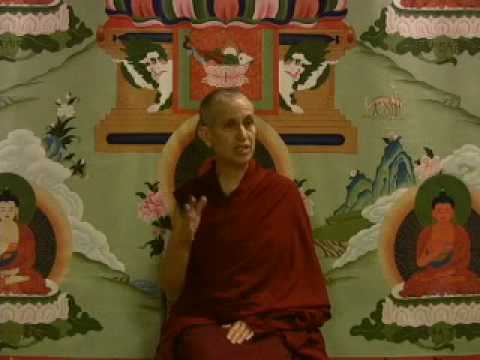
Contemplating death
 Venerable Thubten Chodron
  Seven-point Mind Training
  Nov 20, 2008
 A series of commentaries on Mind Training Like Rays of the Sun by Nam-kha Pel, a disciple of Lama Tsongkhapa, given between September 2008 and July 2010.
- The Dharma is the only thing that will help us at the time of death
- How the karma we create in our relationships follows us when we die
- Contemplating death helps to keep our mind from ruminating on the eight worldly concerns
- Ways to have healthy relationships with our friends, our possessions, and our body
MTRS 10: Preliminaries—Death (download)
Let’s begin by cultivating our motivation and really appreciating not only being a human being, but also having a precious human life. Think about how rare it is to actually encounter the Dharma in samsara and how many causes and conditions we had to create in the past to have this present opportunity. So, not wanting to waste it, let’s really make a strong determination to face ignorance and to demonstrate to ourselves again and again why ignorance is incorrect—both the ignorance of karma and its effects and the ignorance of the ultimate nature. With the heart that really wants to repay the kindness of others, let’s make a strong determination to attain full Buddhahood for the benefit of others by eliminating all the ignorance, and thus all the afflictive and cognitive obscurations that prevent us from being of the greatest benefit to all beings.
Death is certain, continued
We were talking about how death is definite and nobody can escape death. As soon as we’re conceived in our mother’s womb, we’re in the process of dying. We meditate on the certainty of death so that we understand why it’s important to practice the Dharma. We don’t meditate on the certainty of death to get panicky, freaked out, morbid, or anything like that. We meditate on death and begin to see that it’s the Dharma that is going to help us at the time of death. Since death is definite and everything else in our life is not, it behooves us to try and prepare for it.
We were talking about the uncertainty of the time of death, and specifically on the first point under that, which is that there’s no fixed lifespan in our continent. In addition, when a person dies they’re always in the middle of doing something. We cannot plan our death, get everything all set up and all orchestrated like control freaks. We can’t complete everything we want to complete, and then die. It doesn’t work like that. We’re always in the middle of doing something.
Nine days ago my mom was doing her bookkeeping. She wasn’t feeling very well. She hadn’t been feeling well for a few days—well, actually for several years. My sister came and convinced her to go to the hospital. On Monday, she didn’t want to go. On Tuesday, she conceded to go. Then she died early Saturday morning. There she was in the middle of doing her bookkeeping; she still had bills to pay, deposits to make, and accounts to balance. She couldn’t finish them all; she had to go to the hospital. In the hospital, she was telling my sister-in-law what to do to finish up the month’s bookkeeping. But I don’t think she was able to finish giving all those instructions either. Then, she gradually slipped into a coma.
My mom had a difficult death. Thursday night was a really bad night. One reason was because the hospital staff was coming in and running tests and doing procedures. I think even more than that was that she was terrified and exhausted, but she was afraid to sleep. I think she was afraid that if she went to sleep she might die. She stared at the ceiling most of the night with her eyes wide open saying, “I can’t believe this is happening,” or “Can you believe this?” She was having just these two kinds of thoughts, again and again, because clearly her body was not doing what she wanted it to do, and she couldn’t believe what was happening to her. By Friday morning she mustered all of her strength and said, “Please leave me alone.” But some of the tests still continued because my dad wanted to make sure that they did everything possible to save her life, although she was dying. By late afternoon of Friday she was pretty much in a coma and struggling to breathe. She died early Saturday morning. The immediate cause of death was pneumonia but behind that was heart disease and many other things.
When we were talking about it this last weekend, because I went back for the funeral, we realized that my mom had so many health problems in her life—one after another. It’s amazing that she lived to the age of 82. It’s a very good example of the uncertainty of the time of death because my dad, and also my sister, kept saying, “She died so quickly and so unexpectedly.” From my side, I’d been waiting for the phone call for several years because I saw her get weaker and weaker. I realized in talking to the other family members that, when they saw her regularly they didn’t see the gradual decline. Throughout my mom’s life she had many medical problems and she always bounced back. There was one kind of crisis after the other, especially the last couple of years. She fell regularly and experienced many other health issues. Friends and family would receive many phone calls.
So, people thought she would just, hopefully, bounce back from this one, too. But her body was in such a state that that was not to happen. Clearly, the karma had run out. It’s an interesting thing, isn’t it, how we say, “Oh, she went so quickly”? Actually, it took 82 years—it was slow in a way. If you count from the recent years, and take into consideration her very poor health, still, it was happening for a long time. When your time comes, you’ve got to go. It doesn’t matter who’s rooting for you, what hospital you’re in, how many doctors are there, and how many incredible number of procedures they’re running—nothing can stop death from coming.
Death and ignorance
This is a lesson for all of us. I wonder at what point she thought she might be dying. I especially wonder about Thursday night, which was so bad, and then Friday night when she actually died. I know on Tuesday when she went into the hospital, she said to my sister, “Oh, I heard somebody say I might be dying. Is that true?” My sister said, “Well, they’re going to try and make you better.” But we never think that we’re going to be the ones who die, and especially on that particular day. It’s always mañana, isn’t it? “It’s not going to be me, not this time, not in this way.” And yet, the Lord of Death doesn’t listen to anything. Now, of course, the Lord of Death is a mythical character. There’s no real Lord of Death in terms of a being. But if you ask, “What is the real Lord of Death?” It’s ignorance, the ignorance that causes us to be born.
Sometimes when you look at somebody who is dying and you say, “Oh, death is so cruel,” then the thought comes in the mind, “Well, if only we could prevent death, then the person wouldn’t have to suffer, and we wouldn’t have to suffer from separating from the person.” So, the Lord of Death, this mythical character, is cruel for taking away what we treasure. But that’s not the Dharmic view; that’s the worldly view. It’s the worldly view that thinks, “If only we could live forever, then everything would be fine.” Is that true? No!
So then we have to say, “Well, why does death come?” Death comes because of aging. Where does aging come from? It comes from birth. Where does birth come from? It comes from ignorance. If we want to stop the pain of death, either our own or the pain of suffering for the people that we care about, then we have to eliminate ignorance. There’s no other way to do it, absolutely no other way.
It’s not a question of, “If only, if only,” or, “We should have,” or, “Why couldn’t they have?” The real thing is that my mind is overwhelmed by ignorance. What am I doing something to combat my ignorance? Because eliminating ignorance is the only solution to this tragedy of birth and death. The reason we’re meditating on death is so we get some energy to overcome ignorance. Why? Because we see the result of ignorance, and we don’t like that result. We want to do something about what causes that particular result. We want to overcome ignorance, and meditating on death gives us that kind of energy.
This is not about the desire to tweak our samsara and make it so that death doesn’t happen. First of all, that’s impossible. Second of all, do you want to live in this body indefinitely? Even if it doesn’t die, you will still live with a body that gets old and sick. You will live in a situation where you’re constantly encountering misery and separation from what you like. We have to really look deeply at what the situation is.
Conditions for life are few
We’re going into the second point of the second section. The second section is that the time of death is indefinite, and the second point is, “Consider how many factors lead to death while the conditions for life are few.” We usually think there aren’t many conditions that lead to death and that there are a lot conditions that support life. But it’s actually the opposite. So we’ll explore this.
The ‘Precious Garland’ says:
Living amidst the causes of death
Is like a lamp in the wind.
Does a lamp in the wind have a good chance of staying lit? No. When it says, “Living amidst the causes of death,” we’re going to ask, “Well, what are the causes of death if I’m with a bunch of people who are alive? I have food and clothing and shelter and medicine, and there are great hospitals and medical advances. What are these causes of death that you’re talking about?” What’s quite interesting is that they’re all around us. In my mom’s case, the cause of death was some itty-bitty bacteria. That was the immediate cause of death along with the pneumonia. The body weakens and other things deteriorate from not getting exercise. Heart conditions and all sorts of other stuff develops.
I flew down to southern California. There were a number of people who died in the fires in southern California. So, you build a home to protect yourself and then you die in that home when it burns. You build a home to protect yourself, and there’s an earthquake, and you die in that home. You eat food to stay alive but then you eat bad food and get food poisoning. We build cars for convenience and then die in a car accident. We build trains and planes for quick travel and then die in accidents. There are so many unexpected causes of death all around us. Remember we were talking last week about making a list of the people we know who have died? That next morning at breakfast we were talking about the incredible number of ways that we’ve heard of people dying. Somebody was saying their grandfather died while eating lunch.
Audience: My grandfather was having lunch. He tipped his soda up, and there was a yellow jacket inside of the soda, and it went into his mouth.
Venerable Thubten Chodron (VTC): Your grandma made your grandpa lunch every day for years. He was eating lunch and had a soda. He lifted the soda can to take a drink, and there was a yellow jacket under the lid that flew in and stung him. And within twenty minutes he was gone. Who would ever think? We can look around, and see so many ways that people die, and it’s always in the middle of doing something.
The ‘Friendly Letter [by Nagarjuna] says:
As life is as susceptible to harm
As a bubble buffeted by the wind,
It is really amazing that we have the chance
To breathe in, breathe out and awaken from sleep.
Last year, one of my students who came to the Cloud Mountain retreats very diligently every year was an attorney. She had a court case, came home, had dinner with her son, played scrabble and a bunch of games, went to sleep and never woke up. She died of a heart attack. She wasn’t somebody who had prior heart problems. It is amazing that we have the chance to breathe in, breathe out, and awaken the next day. One day, we will breathe out and not breathe in anymore. Or one day we may not awaken from sleep. One of my friends, his sister died from Lou Gehrig’s disease. On New Year’s Day, her husband woke up to find her in the bed next to him, dead.
The ‘Four Hundred Stanzas’ [by Aryadeva] says:
Individual elements are powerless,
But assembledare known as a collection.
Well-being is their (balanced) opposition.
If you look at the body, you see that it’s composed of the four elements: earth, water, fire, and air. It’s a balance; it’s a collection of these. To be in good health, these elements have to have some kind of balance. But they often say that the elements are like four snakes in a vase. Four snakes in a vase are not going to be cool and calm and collaborative. In the same way, the four elements are very difficult to keep balanced; it’s difficult to maintain good health.
The ‘Precious Garland’ [by Nagarjuna] says:
Many conditions are conducive to death,
Few are supportive of life
And even they lead to death,
Therefore, practice the Dharma always.
Like I was saying before, many conditions are conducive to death and few are supportive of life. Even the ones that do support life, if we don’t have them in the proper way, lead to death, like when you’re driving across a bridge and the bridge cracks, or there is an earthquake. The things we have to sustain our life can very easily become the cause of death. You have a telephone, you’re talking on it during a thunderstorm, and you can get electrocuted. So many different things can happen.
Fragility of the body
The third point under this second section says, “Thirdly, consider the uncertainty of the time of death due to the extreme fragility of the body.” We feel like our body’s very strong. It’s like: “Look at my muscles, my big body muscles; I’m young and very strong.” All it takes is one little microscopic bacteria or one little microscopic virus, that you can’t even see, to enter the body and multiply and bye-bye! All it takes is stepping on one rusty nail and not having access to a tetanus shot. All it takes is eating bad food and getting typhoid. All it takes is being in a room with somebody with TB who is contagious and catching TB. There are so many tiny things that can kill us very easily.
Our body is not that strong. The skin is the protection against the outer world, but our skin breaks easily, doesn’t it? You bump it and the skin is broken. Diseases are passed through needles and through sexual contact. Things that are supposed to make you happy, or even treat illness, wind up becoming the cause of death. Our body is not so strong and can’t fight everything off with its defenses. Even things we can’t see can kill it. And then things that we can see can crash it and smash it—and all sorts of stuff. The body’s very fragile.
The ‘Friendly Letter’ says:
If the earth, Mt. Meru, the oceans, and embodied beings
Will be burnt up in the blaze of seven suns
So not even dust will remain,
What need is there to speak of human fragility.
In the ancient cosmology, they see this particular world system as ending in fire through the blaze of seven suns. What it’s saying is, if this world can end, what are the implications for our extremely fragile life? Even if you don’t look at things in this old cosmic view, you can still see that planet Earth isn’t permanent. Eventually, our sun is going to go out. None of these things in our environment will go on forever. If all these things can end, what about this little body that is so fragile? It’s so hard to keep the body healthy, isn’t it? This goes wrong, and that goes wrong. It’s amazing if we keep tally: I have a headache today. My stomach hurts today. My back hurts. My little toe hurts. My arm is sore. I scratched myself. My tooth hurts. This is wrong, that’s wrong—over and over. This body is not something strong.
In thinking about this, the conclusion to draw is not “Therefore, I’ve got to be more attached to my body and pamper it even more.” That is not the conclusion to draw from this meditation. It’s to realize what the nature of the body is and to see that we cannot control the natural processes of the body. Therefore, we have to work on the mind so when the body goes out of whack, our mind can be content and peaceful and have a meaningful thought in it. That’s the point of this. If you just want to get scared about your body getting sick and about dying, just go to the doctor’s office. They have all these charts about all these diseases you can die from. That’s not why the Buddha taught us to think about the fragility of the body. It’s not so that we get more attached and more panicky and pamper the body more. It’s so we really see that it’s the mind we have to work on and then to go about working on the mind.
The ‘Letter to King Kanika’ says:
The Lord of Death is no one’s friend
And His attack is sudden.
So, without putting it off until tomorrow,
Begin to practice the holy doctrine now.
It is not a good idea
To put it off until another day,
For the time will come when you no longer exist
And that could be tomorrow.
Even though we always feel we have plenty of time to live, we don’t know what our lifespan will be. The day that we cease to exist could be tomorrow or even tonight. But we put off our Dharma practice, saying, “I have lots of time in the future, and anyway, my conditions now aren’t so good. If only I lived at this other place, I could practice Dharma better. If only my stomach didn’t hurt, I could practice Dharma better. If only I didn’t have to do this work, I could practice Dharma better. If only I wasn’t so distracted by this, that and the other thing.” We find one reason after another not to practice. But when we cease to exist then there’s absolutely no time to practice. Therefore, your stomach may hurt, your little toe may hurt, and you may be distracted, but you still practice because this is the time we have to practice.
I flew to southern California on Saturday. I got there very late on Saturday, and on Sunday we had to go to the mortuary to make the mortuary arrangements. I asked to see my mother’s body. We made the mortuary arrangements and then were able to go in and look at the body. It was just incredible. You look and Mom does not exist anymore. She’s not there. There’s a body but that person who used to be merely labeled in dependence upon that body is gone and there’s no way to call her back. Then you look—she’s not there. The body’s there, the mind’s not there and the person’s not there. When death happens to us we’re gone. I was thinking about it, because when you die, the person continues in terms of being merely labeled. The general ‘I’ continues. Mom doesn’t exist anymore. The general ‘I’ exists. It’s merely labeled in dependence upon whatever aggregates there are right now, which I have no idea what those aggregates are of my mother, of the person who used to be my mother. But now it’s gone, gone, and no way to call it back. One day it’ll be like that for us, too.
We had the funeral and so many people came and said many things. My mom wasn’t even there to enjoy it. The funeral, held in honor of her, and she’s not there. Isn’t that weird? They have a whole thing in honor of you, and you’re not even there. She’s having some other experience now. Who knows what that experience is and what she’s experiencing right now. I have absolutely no idea. Everybody at the funeral is talking this, talking about that, looking at this, looking at that, talking about my mom, and this story and that story. From her side, she’s having some totally different experience and probably isn’t even remotely aware of what’s going on with the people to whom she used to be so close. Isn’t that weird to think about?
We feel so attached to some people as if we’re always going to be together even after we die. It was quite interesting because usually with my siblings, when we’re together, one of the things we talk about is the health of our parents. In recent years it was always, “How is mom doing?” and “This is wrong, and that’s wrong, and the other thing is wrong with her,” and so much worry and concern about her health. It was so weird, on this visit, we realized that after being so used to talking about her health and trying to make her more comfortable, we don’t need to talk about that anymore because she’s not here. The rest of my family thinks that when you die, that’s it—basta finito, there’s nothing. And I’m sitting here thinking, “Well, what kind of rebirth could she have, and what is she experiencing now? Is there some way for me to help her in what she’s experiencing right now?”
It’s interesting because I flew down on Saturday afternoon; I could’ve gone earlier Saturday, but I had been invited to speak at the American Association of University Women. I felt very strongly that these people were also my mothers; they were just my mothers from previous lives. It was good to be able to benefit them, and attending the speaking engagement would not detract in any way from benefiting the mother of this life. I went from there to the airport, and as I’m in the airport and on the planes, this whole thing about all sentient beings being your mother was so strong. I was thinking, “My mother’s dead; my mother’s dead—do all you people around know that my mother just died? No, but you’re my mothers. Not in this lifetime—you’re not my mothers this lifetime—but you’ve all been my mothers.” So, that same kind of relationship I’ve had with this life’s mother and the kindness I’ve received from this life’s mother, I’ve also received from all these other people. There’s the businessman, the old ladies, the young women, the children, and all these different kinds of people, and I had this sense that they’re all in these different bodies, but they’ve all been my mother. It was quite an unusual feeling to really feel that: your mother’s not here but all your mothers are here.
Our wealth cannot help us
The next point, the third section in the death meditation, is that only the Dharma can help at the time of death.
At the time of death our relatives, friends, body, and possessions are of no help. The ‘Letter to King Kanika’ says:
As the ripened fruit of past actions
You will be completely abandoned.
This life, which is the ripened fruit of past actions, is over—finished, abandoned.
In accordance with your new actions—
The karma that you created—
You will be seized by the Lord of Death.
Nothing but your virtues and misdeeds will escort you.
Since all will return to their destinies,
No one will accompany you.
Understanding this, please practice well.
So, “Nothing but your virtues and misdeeds will escort you.” When we go to places, we like to have company, don’t we? We don’t like to go alone. We like to have company. Our company as we go from one life to the next is our karma—our virtues and our misdeeds. That’s the company that comes with us. It follows us like a shadow follows the body. On a sunny day you can’t cut off your shadow. The karma that we create follows us in a similar way. At the time of death, the body, friends and relatives, possessions—none of them come with us.
When I first got to my mother’s house it was late. I went to bed. The next morning when we were going to the mortuary, we had to bring some clothes for them to dress her. My sister-in-law brought out one thing to ask my dad what he thought. He didn’t like that one. So, I went in with her, into my mom’s closet, to pick out something else. My sister-in-law told me that when her mother died, she remembered just sitting in the closet sobbing because all of her mother’s possessions were there. Apparently, when my brother came—he arrived a few hours earlier than I did—when he went into her room, he broke down.
I was thinking about that, because you go in and there are all the things that belong to somebody that you care about. You’re familiar with a great many of those things. They bring back memories of different events. I was thinking that people break down when they see all of that stuff because they remember the person using those things, and that person isn’t there anymore. You feel the lack of that person in your life. I think the tears come because that person isn’t going to be in your life anymore. My little nephew cried a lot that day because he said, “I can’t believe I’m never going to see Grandma again.” So, we feel the loss of a person in our life.
When I went into my mom’s bedroom, and I went in a few other subsequent times just to look, what came into my mind was, “Here were all the things that somebody used when she was alive, and now she’s gone, and she can’t use them anymore.” They were collected with great care; my mom had very good taste in clothes. They were collected with great care and worn with great care. She didn’t take what she had for granted. Things were not strewn around like they weren’t worth anything. They were very folded up nicely, kept clean and wrapped in plastic. She really appreciated the things she had. She treasured them and valued them well. But now, she can’t use them. They all stay behind—many drawers and closets full of stuff that are of absolutely no use; whereas, at the time when she was alive, those things were useful to her. Those things were objects of desire; if anything happened to them, she would’ve been upset. If spaghetti sauce got spilled on them, she would’ve been upset.
Things that we treasure and we keep close to us and that we feel are so much a part of our identity and that bring back memories of events and being with different people—when you go on, nothing goes with you. Those things don’t mean anything to you anymore. I was looking at all her slippers, her shoes and her robes. She was so sick the last few years that she usually just wore nightgowns and robes. Now, to her, they are all gone. So, we picked out one nightgown, robe and pink slippers, and brought them to the home so they could dress her.
Shri Jagatamitra said (in his ‘Letter to Chandraraja’):
Even if you possess the wealth of a god,
In the next world after your death
You will be as one attacked in a barren land:
Alone, deprived of princes and queens,
With no clothes and bereft of friends,
Dispossessed of kingdom and castle,
Although you may have great power and strength.
Nothing is to be seen and nothing heard,
Not one single person can follow you.
In short, when not even your name
Will then exist, what else is there to say?
He’s saying it to Chandraraja—raja is a king, so it’s the king named Chandra (or moon). Even if you possess the wealth of a god, in the next world after you die you go on alone, with just your karma. None of the wealth comes with you. You might have cars, you might have 401Ks, you might have set up IRA’s, you might have stocks and bonds, you might have a checkbook, you might have a bankbook, you might have lots of furniture, several cars, a holiday house, a boat, and lots and lots of different things. But when we die they all stay here—and we go on alone.
Very often, among the Chinese in Singapore, when somebody dies they burn paper computers, paper houses, paper money, paper cars, all these things in paper—thinking that you can transfer them to your loved ones so that they will have them in the next life. This isn’t so common now but some people still do it. This isn’t a Buddhist practice; it’s a folk religion practice. I always found it incredibly amusing and also poignant and sad that the bank notes they burnt, the paper money that they burnt, was from the Bank of Hell. Somehow there was this notion of, “My relatives are going to be born in hell, and so I will send them money from the Bank of Hell that they can use in hell.” If your family was well off then the amount of paper things they would burn was just huge—boats, cars and houses, all made of paper that were sold especially to be burnt—to transfer to your loved one in their next life.
We may shake our head and think, “That’s a cultural tradition.” But isn’t our collecting lots of stuff just as ridiculous, thinking that we’re going to be able to take any of the stuff we have with us to the next life? And yet, we guard all of our things as so precious: “I don’t want to share with anybody. This is mine. If I give it to you, I won’t have it.” We keep everything for ourselves. But when we die, we can’t take it with us. All the money—and whatever else—stays right here. And we miss the opportunity to create merit through the practice of generosity.We were somehow thinking that we would be able to hold on to all of these things. When we die, it doesn’t matter whether we’re rich or poor. It doesn’t matter if you die in a nice clean hospital bed or in the gutter. Because when you’re dying, your senses are absorbing, you’re not even aware of all of that. And when you’re dead, it doesn’t really matter.
Our friends and relatives cannot help us
What happens to our body after we die? It doesn’t really matter. Some people are so fussy—there are different religions and many different customs. People are so afraid of what’s going to happen to their body. With my mom, we did a ceremony in the chapel, and we went out to the gravesite and put her body in one spot. One of my mom’s friends—her husband is buried just one row up and a few to the side—said to my buried mother, “Oh, and this where I’m going to stay, we’ll be really close to each other. We can chat.”
When we go on, we can’t take any of this stuff with us; our money and wealth stays here. Our friends and relatives, they all stay here. Like I was saying, we had this huge funeral and so many people came that I hadn’t seen in years. I didn’t even recognize many of them because it had been twenty or thirty years since I’d seen them. It was just astounding seeing these people again. And yet, none of us could accompany my mom. Even if we had died at the same time as her, we still couldn’t accompany her. When she was lying in the hospital that Thursday night, being so panicky and fearful, none of us could take that fear away from her. My sister in-law was like a daughter to my mom. When my mom got sick, she asked for my sister-in-law to come, but my sister-in-law couldn’t take the suffering away. My sister was there—she couldn’t take the suffering away. My dad was there—he couldn’t take the suffering away.
All the people we love—at the time of death, they can’t stop the pain of death. They can’t stop us from dying and can’t accompany us into the next life. Now, if we’re fortunate and if we’re a Dharma practitioner, we’ll have some other Dharma practitioners around us who can remind us of the Dharma when we die. But it’s got to be our own mind that switches gears and thinks about the Dharma at that time. Nobody else can think about the Dharma for us. They might encourage us or remind us, but we’ve got to actually do it. My mom and dad were married 61 years. He couldn’t go with her.
Our body cannot help us
And then we leave behind not only our friends and relatives, our wealth and possessions, but also our body. We put together a little PowerPoint with pictures of my mom and showed it. It was quite something to see because we had a few pictures from when she was really little. That body was always with her. Then at the time of death, her consciousness went on, and the person was no longer there, but the body was there. So, you even have to leave your body. My dad made some comment about my mom being very pretty when she was younger. I had never really thought of that. You don’t usually think of your mom in that way. I was looking at those pictures, and my mom was very beautiful when she was young. Then, the body just ages. You could look at one of those pictures of her with this beautiful smile and dark eyes and dark hair and then at the corpse—she can’t take the body with her, and anyway, who would want to take it with them?
The whole purpose of meditating on this and on the fact that at the time of death only the Dharma comes with us is to help us so we practice the Dharma purely and we don’t consume our life with the eight worldly concerns. The eight worldly concerns are all wrapped up with attachment and aversion to sense pleasures, possessions and wealth, friends and relatives, body, reputation, praise and blame. We can spend our whole life very attached to these things and so upset when things don’t go the way that we want. But at the time of death, we separate from all of those things. What comes with us is the karma that we created in trying to procure and protect them.
We can’t take all these friends and relatives that we treasure so much, and who we’re so concerned with what they think about us. We actually think, “How much do I care about those people?” and “How much do I care about what they think about me?” and “How much do I care about them?” and “How much do I care about their approval? What kind of reputation do I have with them?” You can see that two of the pairs of the eight worldly concerns—praise and approval, blame and disapproval, and good reputation and good image, and bad reputation and bad image—both of those pairs are very intricately related with the attachment to friends and relatives. Who do we get praise and reputation and blame and notoriety from? Other people. Yet, at the time of death, we can’t take any of those people with us.
While we’re alive, we can create a lot of negative karma, trying to get a good reputation and grasping at praise and approval. We can create a lot of negative karma protecting our self from blame, disapproval and bad reputation. Many of our negative actions are about that, aren’t they? Somebody talks bad about us, and we’re attached to our reputation, so what do we do? We talk bad about them, and in return, we create negative karma. That person doesn’t come with us when we die. The following year, we may not know them or remember the situation but that karma we created by speaking badly of them, that karma is on our mindstream and comes with us.
Or we feel like, “I really want this, I really want this, I want this, I want this.” You know how our mind gets sometimes: “I want this, I want this.” We can create so much negative karma. Sometimes we might lie to get something that we want. We might not be completely honest in our business dealings in order to get what we want. We may do all sorts of things to get the money to get what we want, or to get the possessions that we want. If those things are threatened, we get so upset and so angry, and we may strike somebody. We may yell at somebody. We may speak harshly to them or ruin their reputation. We can create a lot of negative karma in relation to our possessions and things. None of those possessions come with us at the time of death, but the karma does.
It’s the same thing with the body: we can create so much negative karma out of attachment to this body. I’ve got to get the right kind of this, and the right kind of that—so my body’s always comfortable and it’s fed the right things. We spend a lot of time creating negative karma out of attachment. If our body gets hurt, we get angry and upset. People kill others in retaliation for harm done to their body. We create all sorts of negative karma out of attachment to the body. And yet, the body doesn’t come with us at the time of death, but the karma we create in defending this body, and giving pleasure to this body—that karma comes with us.
I’m not saying don’t take care of our body, and things like that, or not to worry about friends and relatives and money, and to just let everything go. I’m talking about finding a healthy relationship with these things so that we can use them to create good karma. How can we use the relationships, the friends, the relatives and the possessions to benefit other people? How can we create good karma for ourselves and benefit others so that they can create some good karma?
How do we have a healthy relationship rather than a relationship of attachment in which we cling to things, and then we get angry when we can’t hold onto them? How do we have a healthy relationship with our body? How do we have a healthy relationship with the people we live with? How do we have a healthy relationship with money and possessions? We need all these to live. Think about this a lot in the coming week. Think about these points that we just went through. Really think about how you can have a healthy relationship with these things. And think about how the time to practice Dharma is now because we’re not sure when death will come.

Venerable Thubten Chodron
Venerable Chodron emphasizes the practical application of Buddha’s teachings in our daily lives and is especially skilled at explaining them in ways easily understood and practiced by Westerners. She is well known for her warm, humorous, and lucid teachings. She was ordained as a Buddhist nun in 1977 by Kyabje Ling Rinpoche in Dharamsala, India, and in 1986 she received bhikshuni (full) ordination in Taiwan. Read her full bio.