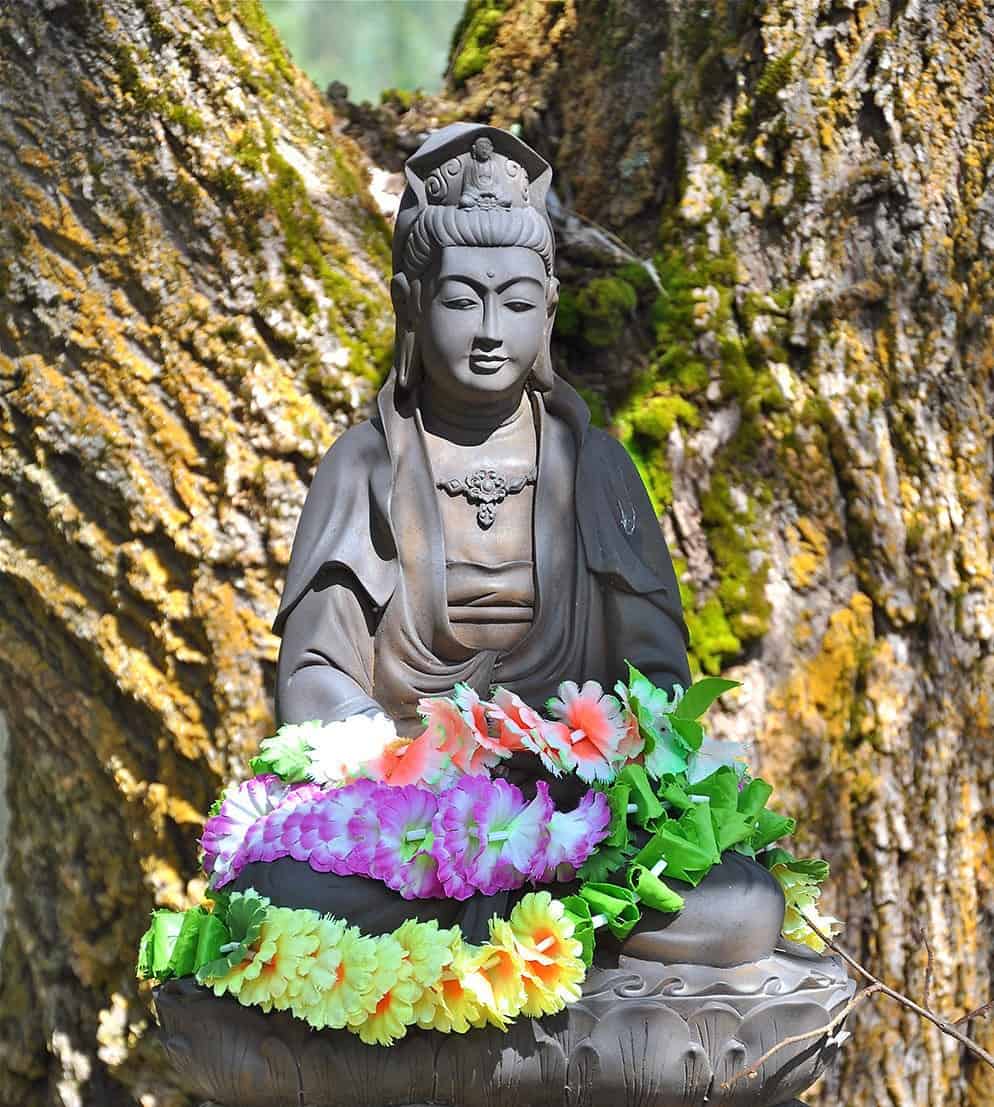
Immeasurable equanimity
05 Awakening the Kind Heart - 2020 retreat
 Venerable Sangye Khadro
  Cultivating the Four Immeasurables
  Nov 29, 2020
 Part of a series of talks by Venerable Sangye Khadro based on her book Awakening the Kind Heart given during a retreat at Sravasti Abbey in November 2020.
- Further teachings on emphatic joy
- Three meanings of equanimity in the Tibetan tradition
- Equanimity: the fourth immeasurable
- An unbiased and even state of mind that regards all beings as equally deserving of our respect, concern, love, and compassion
- Obstacles to equanimity & remedies
- Attachment
- Hatred
- Indifference
- Meditating on immeasurable equanimity
Let’s take a few minutes to try to make sure our motivation for participating in this session is a really positive one, an altruistic one. According to Buddhism, every being has Buddha nature: the potential to totally purify the mind of all faults, all mental toxins, all suffering and causes of suffering, and to develop all the positive attributes of the mind, like love, compassion, generosity, joy, peace, wisdom, and so on. And we have the potential to bring these to the highest point possible, a state of perfection.
In other words, we have the potential to bring our mind to the state of full enlightenment—Buddhahood or full awakening—just like the Buddha did. Every being has this possibility, this potential, but not every being is in the most ideal situation to be able to realize the potential they have and make it manifest, to actualize it. As human beings, we are in a very special situation; we’re in the best possible situation to realize our potential, to know that we have it, and then to do what needs to be done to bring it out, to actualize it. In other words, we can bring our mind to the state of enlightenment, Buddhahood. We’re really, really fortunate with this situation that we have. It’s important to recognize that, appreciate it, and then make good use of it.
Because even among human beings, not everyone realizes the potential they have, and some of them waste it, and some even throw it away. They get so depressed and feel so hopeless and despairing that they take their own lives, which is a great tragedy. So, it’s really important that we appreciate the potential that we have and do whatever we can to at least start actualizing it, to start walking the path towards enlightenment. And it’s important that we make sure that what we do does become the cause of enlightenment; we need to have the attitude of wanting to benefit others, not only ourselves, but others as well. We start with wanting to benefit as many people and beings as possible in the beginning, and eventually, we’re able to open our minds, our hearts, more and more and more to be able to take in all living beings. See if you can make that your motivation for being here and listening and participating in this session. You want to go in the direction of enlightenment to be able to help all living beings, and you’re learning these teachings in order to bring that about, to bring yourself closer to enlightenment for the benefit of all.
Different levels of wisdom
This morning, I have a little bit more to say about the third immeasurable thought: empathic joy. And then we’ll look at the fourth one, equanimity. I was thinking about some of the questions that were coming up yesterday, and how in the context of Buddhism—for someone who’s studying and practicing Buddhism and trying to follow the Buddhist path—then when they are cultivating these four immeasurable thoughts of love, compassion, joy, and equanimity, they’re most probably doing it together with cultivating wisdom. And not only these four, but they’re also cultivating wisdom. And there are different levels of wisdom, different kinds of wisdom. There’s wisdom that understands karma—the law of cause and effect—and impermanence—the changing nature of things—and the four noble truths, which I briefly explained on the first day. And there’s also one of the most difficult topics in Buddhism, the wisdom understanding selflessness. We also call it emptiness in our tradition.
This is the idea of non-self, meaning that there is no fixed, permanent, independent self anywhere within our body and mind. It seems like there’s one. We feel as if we have a real self in there who does things and thinks things and feels things and makes decisions and so on. It seems like it’s there. But when we look for it, we can’t find it. It’s actually like a fantasy—a creation of our mind, a hallucination. That’s a hard one to understand and actually get a realization of. But still, just making the attempt to understand it really helps to reduce the strong sense of self—ego, I—which we usually have, and can mess up our virtuous activities and our virtuous thoughts, such as love and compassion and so on. So, cultivating wisdom, together with the four immeasurable thoughts, will help us avoid the pitfalls that can otherwise happen.
For example, when we cultivate loving kindness, that can get mixed up with sticky attachment: “I like this person because they make me feel good,” and so on. And then yesterday we were talking about compassion fatigue and how that can come about because of the ego: “I want to do this. I want to make this happen. I want to save this person’s life and free this person from suffering.” It’s good to have that wish and do the best you can to bring it about, but if ego gets involved, then there’s this big sense of I and a sense of I want to be successful. I want to accomplish what I’m setting out to do.
And then if that doesn’t happen, we crash and have compassion fatigue. And then with empathic joy, envy can creep in: “Oh, that person has so much, is doing so well, has so many good qualities, is such a good meditator. Why can’t I be like that?” So, if people are learning these four immeasurable thoughts and practicing them and cultivating them—or even just one of them—but they are not learning the wisdom side of the path, then it can be risky. It can be dangerous.
There are a lot of compassion training programs coming up, like the one at Stanford. Also, Emory University has one. I have read about these, but it’s been a while. And I can’t remember if they do talk about more of the wisdom side of things, like impermanence and karma. It might be hard if they’re teaching it to a secular audience who don’t necessarily believe in these things. Well, impermanence is just a fact. That’s not a question of belief. But with karma and selflessness, it can be tricky. Anyway, those are just some thoughts that I had.
Anyway, it is important that if you do want to practice these four within the context of Buddhism, to study the other aspects of the Buddhist path, especially the wisdom side of the path. And it’s important to make whatever attempts you can to understand that side and develop that side and practice that side, because that will really help these four immeasurable thoughts to be good and strong and healthy and not dysfunctional. It can happen. Okay, so here’s a little bit more about empathic joy.
Preventing complacency, self-indulgence and attachment
It mentions in the Pali tradition that another far enemy of that state of mind is boredom. And I never quite understood why, so I didn’t mention it yesterday. But I found an explanation in volume Five of The Library of Wisom and Compassion called In Praise of Great Compassion. And that helped me because boredom often means something like it’s Sunday afternoon and you don’t know what to do. But in this context, it means just not caring about others’ happiness and good fortune and good qualities. Maybe an example might be a little kid who comes home from school, and they’re really excited because they got a report card and they got good grades, or they did some art project and it came out really well. They’re really excited and showing their mom, and the mom says, “Yeah, yeah, yeah—will you help me with the dishes?” The mom is just not sharing in the child’s joy.
We probably do that sometimes. Somebody’s really happy, really joyful about something, and we’re indifferent and not sharing in their joy. I guess that’s the meaning of boredom in this context. And it’s not mentioned in the text, but I was thinking that another enemy of empathic joy could be cynicism. That’s where we only see the negative side of things. Like with people, we only see their faults and their mistakes and their bad qualities and what they do wrong. We’re not able to see the good side of them. I came across something in here about that.
When we consciously cultivate empathic joy, we see so much goodness in the world. Instead of the world seeming bleak and filled with narrow-minded people and corrupt governments, our view will expand to see the goodness in others and the many ways in which people help each other on a daily basis. At present, the source of our empathic joy may be limited to our own personal gain and the gain of those we cherish. As our empathic joy expands, we will rejoice in the virtue and success of others.
I think it’s easy for people to fall into cynicism, especially with the way the news is presented. They usually focus on all the bad news; it’s not so much about good news. You have to look for the good news. So, we do have to make some effort to remind ourselves it’s not all bad out there. There’s a lot of good every day, every minute, every second. Good things are being done, and there are good qualities to rejoice in. That can help counteract cynicism, which again can lead to depression and despair and hopelessness and pessimism—those kind of negative qualities.
And I said something yesterday about how when we meditate on empathic joy, we do it for others and not for ourselves. But then I’m thinking, maybe that’s not completely true. The way it’s explained, like with Buddhagosa and mainly in the Pali tradition, they don’t mention self. They mention others—looking at others and their good qualities and happiness and so on and being joyful about that. But I think it is appropriate to have this kind of attitude about ourself, about our own good qualities and our good deeds. And that’s more what we call rejoicing in Tibetan Buddhism. We were talking about that yesterday. We should rejoice in our practice and our accumulation of virtue and all the good things we are doing and all the good qualities that we have. This is actually really important to do, to counteract self-criticism and self-hatred and also depression and despair and hopelessness, which can lead us to give up our practice altogether. And I think we can also rejoice in the good things we have in our life.
For example, with the meditation on the precious human life, precious human rebirth, we think about all the good fortune we have, the opportunities that we have. We need to recognize that so that we don’t take things for granted and only focus on what we don’t have. So, it’s really important to feel happy about our good qualities, our good deeds, our resources and so on. But we do need to be careful that that doesn’t turn into attachment, which can easily happen when we’re attached to the good things that we have.
And also, other dangers are being complacent, taking things for granted, and even self-indulgence—indulging in all the nice things we have in our life. To prevent those things from happening, we can remind ourselves that all of these are the result of good karma and merit we created in the past. In past lives, we must have done a lot of good deeds to be where we are now and to have what we have now. We worked hard in past lives to have all these things. And we have to work hard in this life to make sure we continue having these good situations in the future as well. We can’t just sit back and relax and enjoy ourselves, because all these good things are going to come to an end; they’re going to run out. And if we don’t create more merit, more good karma, then when these good things run out, we won’t have more. So, these are ways to prevent ourselves from falling into complacency and self-indulgemence and attachment.
But it’s still important to have empathic joy, maybe more in the sense of gratitude—like gratitude for what we have. It’s important in the sense of understanding that it’s the result of certain causes and conditions and making sure we continue creating those causes and conditions and use our life in that way. So, that’s about enough for that particular state of mind, empathic joy.
Different meanings of equanimity
The fourth immeasurable is equanimity. And the Sanskrit term is upekkha, which is the name of our fourth kitty. That’s actually the Pali term. The Sanskrit term is upeksa. It’s a little harder to say. But they are very close, very similar. And the Tibetan term is btang snyoms, which is also probably hard to say for most people. Upekkha is easy. This immeasurable is complicated because the term equanimity has different meanings. It doesn’t always have the same meaning. That’s important to understand because when you come across it in different texts, teachings, and commentaries, you need to understand that there are different meanings of equanimity.
In the Tibetan tradition, there are three meanings of equanimity. One is a type of feeling. Feeling is one of the mental factors that is ever-present; it’s there every minute, every second. There’s a feeling accompanying any of our experiences—our sensory experiences, like seeing, hearing, smelling, and so forth, and also our mental experiences, like thoughts and memories. With every single experience we have, there’s always a mental factor feeling. And there are three types of feeling: pleasant, unpleasant, and the third one is sometimes called neutral feeling. But it’s sometimes called equanimity. And that just simply means neither pleasant nor unpleasant. So, that’s one meaning of the term equanimity. It’s just a feeling that happens.
We don’t have to try. It just happens automatically. It’s actually the result of our karma. The type of feeling that arises is ripening of our karma. It’s easy to recognize pleasant feelings and unpleasant feelings. This third one, neutral or equanimity feeling, is a little harder to recognize, but I just think if we’re looking at a blank wall, then probably there’s that feeling. That is unless we’re in a really happy state of mind when maybe everything looks wonderful, even a blank white wall. But otherwise, it’s just an absence of happiness or unhappiness, pleasant or unpleasant feeling. Then a second meaning of the term equanimity is another mental factor. And it’s actually one of the virtuous mental factors.
There are 11 virtuous mental factors. One of those is called equanimity. And this comes in the explanation of how to develop concentration or calm abiding or serenity. And there are nine stages that you progress through on your way to having actual serenity or calm abiding. It’s mainly on the ninth stage that equanimity comes in. But it’s said to also occur before that. It’s kind of a high state of mind that has equanimity. It’s explained as an evenness of mind. It keeps the mind kind of steady and not affected by agitation or laxity. Those are the two main obstacles to the cultivation of serenity. Agitation is when our mind is just kind of all over the place thinking about other things. Laxity is a kind of sinking of the mind, dull state of mind. So, on your way to developing serenity, you need to look out for those and deal with them and free your mind from them.
And as a result of a lot of effort, a lot of time and energy practicing this kind of meditation, you get to where your mind is able to remain relatively unaffected by agitation and laxity. There’s still a little bit left, but you don’t have to make much effort to counteract them. That’s when this mental factor of equanimity kicks in. It enables the mind to settle and remain on a virtuous object—whatever object you’re using for your cultivation of calm abiding—and it is important for the development of calm abiding. So, you have this equanimity and your mind is able to stay on that subject and then that leads you to actual serenity, actual calm abiding. That’s the mental factor of equanimity. It’s its own mental factor.
And also, in the list of the seven awakening factors, one of those is equanimity. And this is the meaning of equanimity in that context. The third meaning of equanimity is immeasurable equanimity. That’s what we’re talking about here in the context of the four immeasurables. Immeasurable equanimity is explained as an unbiased, even-minded attitude regarding all beings as equally deserving of our respect, our concern, our love, our compassion. So when we’re cultivating the four immeasurables, immeasurable equanimity is when we can see all beings as equally deserving of our compassion and our love.
Immeasurable equanimity
Otherwise, when we cultivate compassion and love without equanimity, then it’s reserved for a limited number of people: our family, our friends, the people we like, the people in our political party—like-minded people. But then there are others over there who have different ideas, different practices, different beliefs, and it’s hard to have love and compassion for them sometimes. A good analogy for this state of mind is a doctor who is practicing properly. They actually take an oath to treat everyone who needs medical attention, to treat all of them and not reject anybody.
I know this man in France who’s a doctor, and he said there was a time when he was asked to go into prisons and treat prisoners, and he said it was quite challenging because some of these prisoners had committed murder and other horrible crimes. He said it was challenging for him to give the same kind of attention to these people that he gave to his other patients. But as a doctor, that’s what you’re supposed to do. You’re not supposed to reject anyone and say, “I’m not going to take care of you; you’re a bad person, and you don’t deserve it.” Ideally, for a good doctor who’s practicing properly, if they have 10 people sitting in their waiting room with runny noses and fevers and sore throats and so on, they have to treat them all. They have to give them the same degree of attention and care. So, that’s an analogy that can help us understand equanimity.
Obstacles to equanimity
Like the other four immeasurables, it has a far enemy and a near enemy. There are actually two far enemies: attachment and hatred. Attachment is where we have preference for certain people, certain beings. We care about them, but not about others. We don’t have the same level of concern and care for others that we have for our friends, our loved ones. And then hatred is another enemy of equanimity. Like in the case of that doctor, with certain beings that we dislike or those we feel may have done really bad things or made others suffer, we think, “Why should I help them? Why should I be nice to them?” These states of mind—attachment and hatred or aversion—are obstacles to equanimity.
And the near enemy of equanimity is indifference. This is an attitude of “I don’t care”—uncaring, indifference. When I was doing research on this, I came across an interview with Thupten Jinpa, who is the author of the Fearless Compassion book. And he said that people often misunderstand the Buddhist teachings on equanimity. He said:
I have consciously avoided overemphasizing the equanimity step in the compassion training program.
That’s actually the first step in the Tibetan tradition, like when we’re trying to develop bodhicitta.
Equanimity is said to be the first step where you view three different people and then try to even out your emotional reaction to all of them and then build on that. Sometimes people take the wrong message out of this and think that compassion and equanimity from a Buddhist perspective means that we shouldn’t be favoring our own children.
“We shouldn’t love our children more than a stranger’s kids”: I don’t think that’s the correct interpretation. Instead, the message is that you should train your mind and heart to a point where you should be able to love the stranger’s kids as much as you love your own. We’re not trying to cultivate indifference, but we’re trying to see that every person deserves love and compassion—the same love and compassion that we have for our children, our siblings, our parents, and so on. But sometimes people misunderstand that. He says that sometimes the message is taken in the opposite direction as a sort of license to disregard your responsibility as parents.
That’s really going too far. And also, in a talk by Alan Wallace, who also does a lot of teaching on the four immeasurables, he said that people sometimes think of equanimity as the same as indifference—being cold and unfeeling—which is not at all the case. Our mind should have strong love and compassion, and then we work on extending those feelings to everyone, seeing that every living being deserves our love and our compassion. Indifference is actually an enemy of equanimity. But also, it is a little complicated because there are different explanations of equanimity given by different masters and in different traditions. It does get kind of complicated when you start looking into this.
And even in the Tibetan tradition, the Mahayana tradition, some masters say that when we’re cultivating equanimity, it is the wish for all sentient beings to abide in a state of equanimity, free of attachment and hatred, free of feeling close to some and distant from others. And that’s actually what the prayer of the four immeasurables says: “May all sentient beings be free of attachment and aversion and have equanimity.” It’s like we’re wishing that for others. There’s nothing wrong with that, but we have to do it ourselves. We have to start with ourselves. So, that’s another way of explaining equanimity: it is working on our own attitudes and cultivating equanimity towards others so that we stop preferring some and rejecting others, caring more for others and not for others. I don’t think that’s contradictory. We do start with ourselves; we have to start with ourselves so we can be an example and a guide for others.
But then we also wish for others to cultivate this state of mind of equanimity. Because think about all the trouble we get ourselves into because of attachment and because of aversion, which is where most people in the world are at; they’re just actively engaging in attachment and aversion towards other people. And that way they get into so much trouble even in this lifetime. And then of course, the karma they create, motivated by attachment and aversion, will bring suffering in future lives as well. So, it is important to wish all sentient beings to be free of those enemies of equanimity.
In the Tibetan tradition, equanimity involves equalizing our feelings towards others—towards so-called friends, so-called enemies, and so-called strangers—and trying to even out our feelings towards them. I’ll talk about that a little bit later. But in the Pali tradition, it’s even more complicated. It’s complicated. Because as this book mentions, the first part of the explanation of the four immeasurables is from the Pali tradition, mainly from Buddhagosa’s text, Path of Purification. According to Buddhagosa, there are 10 kinds of equanimity. But I won’t go through all of those. That’s making it complicated. But it only mentions six in the book.
Some of them are the same as in the Tibetan tradition, like equanimity as one of the three types of feelings and then equanimity as one of the four immeasurables. But when it comes to cultivating equanimity within the context of the four immeasurable thoughts, there is a somewhat different explanation. And I find it quite nicely explained in volume four of The Library of Wisdom and Compassion: Following in the Buddha’s Footsteps. I’ll read it on page 268 of volume four.
Equanimity is explained differently in various contexts. In the Pali tradition, it refers to a sense of acceptance about what is and is not possible. To cultivate it, reflect on the difficult and painful things in your life that haven’t yet been resolved. Consider that these circumstances came into being as a result of karma, your own actions. Karma is real and powerful. Once karmic seeds have ripened, we cannot unripen them. We must accept the situation, stop fighting the reality of what is happening, and cultivate fortitude and equanimity. This will make the mind strong and prevent becoming bitter about life.
So, it seems to be more in terms of the things that happen to us in our life: if we can change them, we do. But if we can’t then we accept them. And it’s about understanding karma; it’s based on a very firm understanding of karma.
The things that happen to us, good and bad, are the result of karma we created in the past. And sometimes we can’t do anything about that. It’s already ripened, it’s already happening. So, getting upset, unhappy, angry, blaming, complaining isn’t gonna help. It’s just going to make things worse. Having a firm understanding of that makes it possible for the mind to remain even and balanced no matter the ups and downs of life.
That’s somewhat different. It’s not contradictory to the equanimity in terms of other people, other beings, but there’s just a little bit of a different emphasis. And then after cultivating equanimity for yourself, then you extend it to others.
When spreading equanimity to dear ones, strangers, people you don’t like, and all beings, recall that beings fare according to their karma.
So, whatever’s happening to your friends, your enemies, strangers—it’s the result of their own karma.
Although you may want to help them, sometimes their situation is such that you are unable to help because of the strength of their karma or because they are not receptive at this moment.
That would definitely help with compassion fatigue, right? Whether you’re a medical worker or a social worker or a therapist or whatever, you’re dealing with people who are suffering, and if you had that perspective of karma, that would really help. You do what you can, but you understand limitations as a result of their karma and your karma and so on. So, that would help you not feel overloaded and fall into despair and so on and so forth.
Abide in equanimity and don’t suffer unnecessarily thinking that you should be able to fix their problem and feeling bad if you can’t. Keep your heart open to them, but realize that just as you can’t always resolve all your own dilemmas caused by your karma, neither can you resolve others’ difficulties.
But it still does include an evenness of mind towards others, friends, enemies, and strangers. It just has this other aspect of understanding karma, which is really helpful. We don’t specifically talk about that in the Tibetan tradition, although maybe because it’s already been done before. Like in the Lamrim, karma comes in the first section of the Lamrim, the initial scope, and then we meditate on it even further in the middle scope when we contemplate all the sufferings of all the beings that are brought about by a result of karma. So, maybe by the time you get to equanimity, you’re already very aware of karma and the limitations of karma. Maybe it doesn’t need to be specifically mentioned. But I find it quite helpful to think in this way.
The explanation in this book—in volume five, chapter one—of the four immeasurables is kind of a high-level explanation. It starts right away talking about the four immeasurables from the Pali tradition. And in that context, they are mainly talked about in terms of using the four immeasurable thoughts to attain the jhanas, to attain these meditative absorptions, which is kind of complicated in a way, but also kind of high-level for many people. Many of us are still just struggling to try to cultivate love for a few people, much less for all people. And that’s true especially in regards to people who may have harmed us or people we find annoying and so on. It’s quite challenging just to have that.
Three categories of people
I think we have to recognize where we’re at and practice accordingly. But it’s still very worthwhile to work on cultivating love and compassion and joy and equanimity, just within our limited scope. Going back to the Tibetan tradition, one way to cultivate equanimity is in the context of what’s called the sevenfold cause and effect method of developing bodhicitta. Equanimity is actually a prelude to that. Before we start cultivating love, compassion and then bodhicitta, it’s said we need to cultivate equanimity.
It’s compared to leveling the ground before building a building. If you want to build a house or another kind of building, the first thing you need to do is to make the ground level and even, using those big machines that move the dirt and make the ground even. Then your building will be strong and firm. In the same way, we’re trying to cultivate love and compassion and bodhicitta: the mind aspiring to reach enlightenment for the sake of all beings. So, the first thing we do is to make our mind level towards others.
Probably most of you are familiar with this meditation, but it doesn’t hurt to go through it again. We need to look at our usual attitude towards other people and beings and recognize that our tendency is to divide people into three groups. It’s not that we do this deliberately or consciously, but it’s due to the presence in our mind of these factors, mental toxins, attachment, aversion, ignorance. So, we divide people into three groups. One group is called friends, which just means the people we like, the people we want to keep close to us, the people we want to stay close to. And then another group is enemies, which is kind of a strong word, but it just means people we don’t like. They could be people who’ve harmed us or want to harm us, but they could also just be people we find annoying or irritating, people we feel aversion for; it’s people we kind of want to stay away from and not get close to.
Then the third group is so-called strangers. And those are the ones towards whom our feelings are more neutral—neither liking nor disliking, but just neutral. Probably the majority of people in the world fall into that group. I think the number of friends is relatively small; the number of enemies, hopefully, is relatively small. But for most people, our feelings are just kind of neutral or indifferent. It’s good to look at this and then understand why we do this, where it’s coming from. According to Buddhism, it’s based on ignorance: the belief in a real, inherently existing, independently existing self or I that we’re attached to. We believe I am the center of the universe, I am the most important being of all. This is where everybody’s at; we’re all like that. We’re born that way.
It’s important not to blame ourselves or feel bad, but to recognize that it’s just our normal situation as long as we’re in samsara. So, based on that view of a real I, we develop an attachment to our I, a concern for our I. We think, “I want to be happy, and I want to make sure I don’t suffer.” From that point of view, we look out at others and there are certain people who appear nice and attractive and they behave the way we like them to behave; they do the things we want them to do. And it’s centered on ourselves: “They’re nice to me.” And that’s what I want, that makes me feel good. So, I want to keep having those good feelings, so I want keep those people close to me and I want to stay close to them. So, then we develop attachment; that’s attachment: “I want to keep those people nearby and be nice to them so they keep being nice to me.” Now, there’s probably some genuine love involved there, but it’s mixed with this kind of self-centered attachment.
And then there are other people we see or encounter, and towards them we have the opposite kind of feeling. We find them annoying or irritating, or maybe they’re actually not nice to me; they do things that hurt me. “They hurt my feelings and make me feel bad, so I want to stay away from them. I want to keep them at a distance and not be nice to them. They don’t deserve it.” They’re mean to me, so they’re the enemy. That’s how people get into that category of enemies—it’s based on me. They may be nice to other people, but I don’t care about that. They’re not nice to me, so that’s what’s important.
Or they don’t do what I want them to do; they don’t behave the way I want them to do; they don’t say the things I want to hear. It’s very ego-centered. “I am most important, so whatever is good for me is good, and whatever is not good for me is not good.” That’s our perspective. And then everybody else who’s not nice to me and who doesn’t make me happy or who doesn’t hurt me falls into the third category of strangers. It’s very helpful to recognize that. It’s kind of painful to recognize it, but again, this is where we’re all at. And we can change it.
Methods for cultivating equanimity
The equanimity meditation helps us to work on this and change this. Although equanimity alone may not be enough to even out our feelings; if we have really strong aversion and anger towards certain people, we probably need to apply antidotes to those states of mind to reduce them. And a really, really strong attachment to other people might require other antidotes to reduce our attachment. But still the equanimity meditation itself can be helpful. So, the usual way of doing the meditation is to bring to mind three examples of these three groups of people: a friend, an enemy, and a stranger.
And I don’t know if it’s really important, but I usually put the friend over here and the enemy over there and the stranger in the middle. And then you just ask yourself, “Why do I have these feelings? Why do I have such different feelings towards these three different people?” So, really go into your heart and your mind and look at that. It can be painful, but we have to look at that. We have to see what our mind is doing. And then ask yourself, “Why do I do this? What are my reasons for having such different feelings for these three different people?” And then ask ourselves, “Are these good reasons? Are these valid reasons for treating other human beings in such different ways?” Again, the ego—the self-centered, selfish mind—becomes very clear there. But also, we might just recognize our reasons are sort of flimsy, not very solid.
I had this experience once with this person I had to work with. Sometimes this person was very, very annoying and so I would get into a state of mind of “Oh, I just don’t want to talk to her anymore. I don’t want to be with her anymore. I just want to stay away from her.” But then it was so easy to remember times when she’d been incredibly kind and helpful and done all these good things for me. It’s like we kind of ignore that. That gets canceled out by one or two difficult encounters. And that doesn’t make sense, does it? It doesn’t make sense to reject someone just because of some unpleasantness or some mistake or some faults that we see in somebody and ignore all the other things. But again, this is what our mind does sometimes.
And another thing that’s helpful is to look at our tendency to see things as permanent. This is, again, not something we probably do consciously or deliberately, but it’s just an instinctive thing. We tend to see the friend as as a friend forever; we think “This person will be my friend forever. We will always have a wonderful relationship. Everything will always go well. We’ll always get along with each other. Nothing bad will ever happen.” But is that true? We have probably all had experiences where somebody we once had that kind of feeling for ended up as an enemy. And it’s the same with the enemy. We tend to feel like “I’ll never be able to get along with that person. It’s impossible, impossible, impossible.” But again, maybe we’ve had experiences where that has changed. Somebody we couldn’t stand or didn’t like at one point in time ended up on the other side as a friend.
And people who are our friends and the people who are our enemies probably started off as strangers. We met them; we saw them. We had no idea about that person; we had no feelings towards that person. And then because of causes and conditions, things happen. They end up either on the friend side or the enemy side. Right? And in the course of time, people switch; they move around. Just seeing that helps us to loosen up our mind and realize that relationships change. People change, circumstances change—we change. And so people move from one side to another.
One time I was leading this meditation with a group of people and afterwards we discussed it. One woman said she put her husband in all three places. And I thought that was actually really spot on. Because even the same person at different points in time—even in the same day, depending on causes and conditions and what’s going on in your own mind—is sometimes a friend, sometimes an enemy, sometimes a stranger. It’s really helpful to see this, because it loosens up our mind and helps us move more in the direction of equanimity.
Now, in the traditional Tibetan explanation, we are asked to think about other lifetimes. This is challenging, of course, for people who don’t believe in past and future lives. But the Tibetans seem to all believe it. And it’s based on the Buddha’s teachings, because in the Pali sutras, the Buddha said that it’s difficult to find anybody who hasn’t been your mother, who hasn’t been your father, who hasn’t been your brother, your sister, and so on and so forth. That’s part of Buddha’s teachings—that we’ve been in every possible kind of relationship with everybody. So, in fact, there’s no such thing as a stranger. Everyone’s been a friend; everyone’s been an enemy; everyone’s been the dearest person to us—our dear mother or our child, our husband, our wife, our spouse, our sister, our brother.
We’ve been in every possible kind of relationship, both positive and negative. We’ve also been enemies; we’ve killed each other, hated each other. So, we’re asked to contemplate that. And if your mind is open to that possibility, that can be really powerful, too. “This person who I can’t stand right now, at another time, in another lifetime, we were so close, we couldn’t bear to be apart from each other for even five minutes. I love this person and they love me”—that kind of thing. It may be challenging to believe that, but contemplating that possibility can help to loosen the mind up. And then with the friend who you feel that way about now—”Oh, I can’t be apart from this person”—at another point in time, you may have been on the opposite sides of a war, hating each other, trying to kill each other, or rivals for something.
That’s the traditional Tibetan way of doing the meditation. And if you’d have trouble believing in past lives, then consider how just in this lifetime, we can see examples of how friends can become enemies, enemies can become friends, and strangers can go either way. That helps to undermine whatever reasons we might have for regarding one person as a friend and another person as an enemy and another person as a stranger, as if those are carved in stone for all of time and will never change. Contemplating this again and again and again breaks down our tendency to put people in these different categories and to hold onto them as if they’re permanent. And it helps to bring about a more even state of mind towards others. Also, it can be helpful to contemplate how “friend,” “enemy,” and “stranger” are just labels and not existing in the person themselves, which is what our mind tends to think.
We see a friend as being wonderful, inherently in and of themselves. But if that was true, everybody else would see the person that way, too. And that’s not true. There are some people who see that person as an enemy; they would put that person in enemy camp. They can’t stand that person; that person drives them crazy. And it’s the same with the person who drives us crazy. For some people, that person is a dear friend; they love them so much and see so many good qualities in them, especially their mother. You can always think of that person’s mother. Even if millions of people see that person as annoying, that person has a mother and a father, and they may have a spouse and kids and a dog, and from those beings’ point of view that person is wonderful.
That’s really helpful, too, to see that these are just labels projected by our mind onto a person that doesn’t exist that way from their own side. But then your mind might think, “Yeah, but they’re blind. They’re motivated by their attachment or their aversion or something.” Okay, then what about Buddha? How does Buddha see those people? Buddha doesn’t have any enemies. Buddha doesn’t see anybody as an enemy—as someone to reject, someone to hate, someone to push away. And also, Buddha doesn’t have any attachment; he doesn’t cling to this person and push everybody else away. So, Buddha has perfect equanimity. Try to imagine how those three beings look from the point-of-view of a Buddha. This is what helps me to have more equanimity.
Not that I’m there yet, but it just helps to even things out. And then other things that are helpful is just to see the things we have in common with all people and all beings, like we all want to be happy. We all want to not suffer. That’s very helpful to meditate on. We’re all in samsara together. We’re all in this painful situation, which is sometimes compared to a big ocean of suffering or to a prison. We’re all in this situation together. We’re all suffering. Why shouldn’t we be nice to each other and help each other rather than fighting and competing with each other? And also, we all have buddha nature: the potential to be free of our suffering and causes of suffering and our delusions and so on and so forth.
Contemplating those ideas are also helpful. There are lots of different points to contemplate to cultivate equanimity. But doing it once isn’t enough. It needs to be done again and again. And the more you do it, the easier it is.
Variations in the four immeasurables prayer
A question came up the other day about the order of the four immeasurables, pointing out that in the Tibetan tradition, there are two prayers. There are actually more than two, but there are two that are most common. One is the one that we’ve been doing before teachings—a short version: “May all sentient beings have happiness and the causes of happiness” and so on. In that prayer, the order is love, compassion, joy, and equanimity. And that’s how they’ve been presented here in this retreat. But there is another version of the prayer—a longer version, which is in the chenrezig practice—that was done the first evening. And in that version, equanimity comes first. So, why is that?
There’s an explanation in this book about that. I’ll read. The long version of the prayer starts with equanimity. So it says:
How wonderful it would be if all sentient beings were to abide in equanimity, free of bias, attachment, and anger. May they abide in this way. I shall cause them to abide in this way. Guru Buddha, please inspire me to be able to do so.
So, you’re calling on Buddha or Chenrezig, or Tara; it could vary depending on which practice you’re doing. But you’re calling on the object of refuge to help me do this. This long version is quite nice because with each of the four immeasurables, there are four different steps that you take. And it says these serve to intensify the emotion gradually. So the first line—like in the case of equanimity—says how wonderful it would be if all sentient beings were to abide in equanimity. So, that’s a wish. How nice that would be if everybody could have equanimity. And the second part says, “May they abide in equanimity,” so that’s going a step further, and it’s an aspiration.
“May this happen”: it’s more than just a wish; it’s an aspiration. And the third is a resolution: “I shall cause them to abide in this way.” We’re saying, “I’m going to do something about it.” So, you go beyond just wishing and aspiring to making some commitment: “I’m going to do it.” And the fourth is a request for help, for inspiration. “Guru Buddha or Chenrezig—or whomever you’re calling on—please inspire me to be able to do so. Please give me the help I need to carry out this resolution.” That’s a really nice way of doing it—going from a wish to a resolution and then asking for help. It’s like that for each of the four immeasurables.
So, for immeasurable love, the second one, it says, “How wonderful it would be if all sentient beings had happiness and its causes. May they have these. I shall cause them to have these. Guru Buddha, please inspire me to be able to do so.” By going in this way, your feeling gets stronger as you go through the prayer. And also your confidence to actually engage in whatever needs to be done to bring it about. And then again, in the short version of the prayer, equanimity comes first.
In the short version of the four immeasurables, equanimity comes at the end, while in the long version, it comes in the beginning. His Holiness ays that placing equanimity at the end emphasizes our wish that others enjoy the peace of being free from attachment to friends, anger toward enemies, and apathy towards strangers. I don’t know if that satisfies your curiosity, but what I was thinking was, it’s probably also in terms of ease. Because I think probably for many people, love comes more easily. We all have family and friends, and we grow up with other people. And hopefully, if our family was healthy and functional, there was love there. So, we felt loved; we felt loving towards others. Love kind of comes relatively easily, naturally. Compassion may be a little more difficult, especially when you’re a little kid. It’s easier to feel love than compassion. You might be scared when you see pain or suffering, and you just want to run away, so it’s a bit harder.
It requires more maturity to feel compassion and then joy also. I remember as a little kid being jealous. I didn’t feel very happy when I saw my friends with toys that I didn’t have. So again, more maturity is required to feel joy. And then equanimity can be really hard. To really have equanimity, that takes quite a mature mind. That’s just my own thought, okay? But that may be a reason why they’re arranged in that way. Also, in the Pali tradition, that is the order. And it said it has to be that order because of using the four immeasurables to attain the four jhanas. There’s a correlation between the four immeasurables and the four jhanas. I’m not going to go into that because it’s very complicated, but you have to cultivate them in that way. You can read that here if you want to know more about that.
But then in the long version, His Holiness says that by putting equanimity first in the long version, it becomes a synopsis of the methods of generating bodhicitta called the seven cause and effect instructions. And the full explanation of that comes in chapter three. But with the sevenfold cause and effect method, even before you start, you cultivate equanimity, like to even out the ground before you start building love and compassion and so on. And then you go on to think of all beings as being your mother; you consider their kindness and generate a wish to repay that kindness. So, the first three factors in the sevenfold cause and effect method are the basis for love, which is the fourth of the factors. And then fifth is compassion.
And then you go on to develop the great resolve: “I will help all sentient beings have happiness and freedom from suffering.” And then finally, you work to generate bodhicitta: “I have to become enlightened to be able to carry this out.” The longer version of the four immeasurables is aligned with the sevenfold cause and effect instruction. I don’t know if that helps answer the question as to why there are different orders. And there’s also a nice little explanation in here of how the four complement each other. So, in terms of the Pali tradition, the four Brahmaviharas are generated in that order: love, compassion, joy, and equanimity. And they need to be generated in that order. Each successive one does not override its predecessor. All four permeate and complement one another.
Compassion prevents love and empathic joy from forgetting the misery of the world or becoming wrapped up in the pleasant feelings that they bring. Love prevents compassion from becoming partial and keeps it focused on all beings, not just those with manifest gross suffering. Empathic joy prevents compassion from sliding into despair because empathic joy remembers goodness and happiness. Equanimity keeps love, compassion, and empathic joy focused on the ultimate aim of nirvana. It makes them stable so they don’t deteriorate into uncontrolled or sentimental emotionalism. So, we need to cultivate all four.
And you don’t have to wait until you have fully developed one before you go on to the next one. You can cultivate all of them at the same time, which is nice in these prayers where we have all four. And we usually recite a prayer of the four immeasurables before teachings and before meditations, just to remind ourselves of these attitudes that we need to cultivate. And for those of us on the Mahayana path, they’re mainly cultivated to help us with our bodhicitta. They lead us to bodhicitta. But even after developing bodhicitta and being a bodhisattva, a bodhisattva will continue to cultivate these four.
Anyway, that’s just kind of a brief introduction to the four immeasurables; it’s a big subject but very wonderful. Any little effort we make in meditating on them is beneficial, even if you don’t have a lot of time to meditate but just use the short version of the prayer. It’s easy to memorize. And just reciting that and trying to do it mindfully and with genuine feelings is so powerful, so helpful, before meditation or at the start of your day before you go to work, in your break time, riding on the bus—whenever.
Q & A
Audience: Is real happiness possible in samsara?
Venerable Sangye Khadro (VSK): That’s a good question. Well, it kind of depends on what you mean by real happiness. In the Lamrim, as I’ve learned it, real happiness means happiness that doesn’t end, happiness that’s genuine. And the only real happiness is actually out of samsara when we attain nirvana or enlightenment. So, only then is it possible to experience real happiness—happiness that’s genuine, stable, lasts and is based on reality rather than fantasies. But having said that, there are different levels of happiness within samsara which are kind of not real happiness, but a sort of happiness.
If you say that there’s no real happiness in samsara then it can feel kind of overwhelming and make people think, “It’s going to take a long time to get out of samsara, so that means I’m just gonna be miserable the whole time.” But relatively, there are different kinds of happiness. I did explain that the other day—based on what I read in Aya Khema’s book—these four different kinds of happiness.
We can experience all four of those happinesses while we’re still in samsara. Remember, the first type of happiness is the one that most people are aware of and are trying to get more of—sensory happiness: nice food, nice music, nice things to look at, nice feelings in your body. For most people, that’s the only kind of happiness. Well, I shouldn’t say that. For many people, that’s the only kind of happiness they know, and they’re grasping at it, trying to get more and more and more, but it’s flimsy. It’s like a rainbow that disappears very fast; it doesn’t last. So, if we can recognize the limitations of that first kind of happiness then it encourages us to strive to have more of the second type of happiness, which is coming from positive states of mind like love and compassion. We can cultivate those.
It doesn’t take a huge amount of time and energy to cultivate more love, more compassion, more altruism—doing things for others. And then we’ll have more of the second type of happiness, which is more stable and more pure and more genuine, relative to the first one. And then when we start meditating and get a little bit of peace in meditation, we can have a little bit of the third type of happiness. And if we start cultivating wisdom—even if it’s not the full-on, direct realization of emptiness, but just getting a more clear understanding of reality and how things are—we can start having a bit more of the fourth type of happiness. We can get little tastes of these relatively better forms of happiness that are available within samsara. We don’t have to wait until we’re out of samsara before we have any happiness.
That’s why I really like that explanation of these different levels of happiness. And it’s not that all happiness is the same. There are different qualities. We just try to have more of the better forms of happiness, but we still need that first level. We need food to eat; we need a nice environment to live in that’s not too hot, not too cold. We need health. There’s nothing wrong with striving for the first type of happiness, as long as that’s not all we care about. We leave it there. Let’s strive to achieve the higher forms of happiness.
Audience: Is the mandala offering a practice of equanimity—specifically the part where we say, “…The objects of attachment, aversion and ignorance; friends, enemies and strangers; my body, wealth and enjoyments: I offer these without any sense of loss”?
VSK: I think we would need a certain amount of equanimity to be able to do that. The real purpose of the mandala offering is to create virtue. Making offerings is one of the most powerful ways of accumulating virtue, merit, good karma. And it’s also a powerful way of overcoming attachment, because when we’re offering, ideally we overcome our attachment to what we’re offering. And especially with that verse, we’re even offering “my body, my wealth, my possessions, my friends, my enemies.” So, we’re really trying to overcome our attachment to those things and offering them to the Buddha. A certain amount of equanimity is needed to be able to think in terms of objects of attachment, aversion and ignorance.
Audience: Could you please speak about forgiveness in the context of the four measurables and in relation to a romantic relationship?
VSK: I think I discussed this earlier more in terms of compassion—that compassion helps us to have forgiveness, because forgiveness is in the context of somebody who’s done something hurtful to ourselves or our loved ones. And so, the natural response is anger and maybe revenge—wanting to hurt them in return. It can be hard to generate forgiveness. Compassion helps because it helps you to understand that the person must have been in a suffering state of mind to do whatever it is they did that was so harmful. When people are in a good state of mind, when they’re happy and so on, they usually don’t do awful things. When people do awful things, it’s because they’re in an awful state of mind—they’re suffering; they’re miserable. Understanding the suffering of the other person helps us have compassion.
And if you can accept karma and think that the person has created negative karma that will bring even more suffering in the future then contemplating that can lead to compassion for the other person. And then that makes it easier to feel forgiveness. So, I think compassion is more appropriate in that situation. Love, of course, helps too, but it can be hard to feel love towards somebody who just done something awful to you unless you already had love before.
Lama Tsongkhapa, in his commentary to Chandrakirti’s Supplement to the Middle Way, which starts off with an homage to compassion, talks about how to develop compassion. And he says that as a basis for compassion, love is important. Otherwise, when it comes to our enemies, instead of wanting them to be free from suffering, we will want them to have suffering. So, it’s as if we start with loving kindness, friendliness, concern for others, for all beings, wanting them to have happiness and then it’ll be easier to have compassion for them, even when they do harmful things. So, he says that prior to compassion, love is important.
But still, in the case of an enemy, someone who’s done an awful thing, it’s probably easier. That’s my experience, but you can try yourself. I think it’s easier to have compassion first, to work on cultivating compassion. I don’t know, I just find that in my experience when there’s somebody I find really annoying, and then I hear that person is having a big problem—they get sick or whatever—then I find it’s easier to feel some compassion for them, even if maybe I didn’t really love them before. But everyone’s mind is different, so you can try different ways and see what works best for you.

Venerable Sangye Khadro
California-born, Venerable Sangye Khadro ordained as a Buddhist nun at Kopan Monastery in 1974 and is a longtime friend and colleague of Abbey founder Venerable Thubten Chodron. She took bhikshuni (full) ordination in 1988. While studying at Nalanda Monastery in France in the 1980s, she helped to start the Dorje Pamo Nunnery, along with Venerable Chodron. Venerable Sangye Khadro has studied with many Buddhist masters including Lama Zopa Rinpoche, Lama Yeshe, His Holiness the Dalai Lama, Geshe Ngawang Dhargyey, and Khensur Jampa Tegchok. At her teachers’ request, she began teaching in 1980 and has since taught in countries around the world, occasionally taking time off for personal retreats. She served as resident teacher in Buddha House, Australia, Amitabha Buddhist Centre in Singapore, and the FPMT centre in Denmark. From 2008-2015, she followed the Masters Program at the Lama Tsong Khapa Institute in Italy. Venerable has authored a number books found here, including the best-selling How to Meditate. She has taught at Sravasti Abbey since 2017 and is now a full-time resident.