Immeasurable joy
04 Awakening the Kind Heart - 2020 retreat
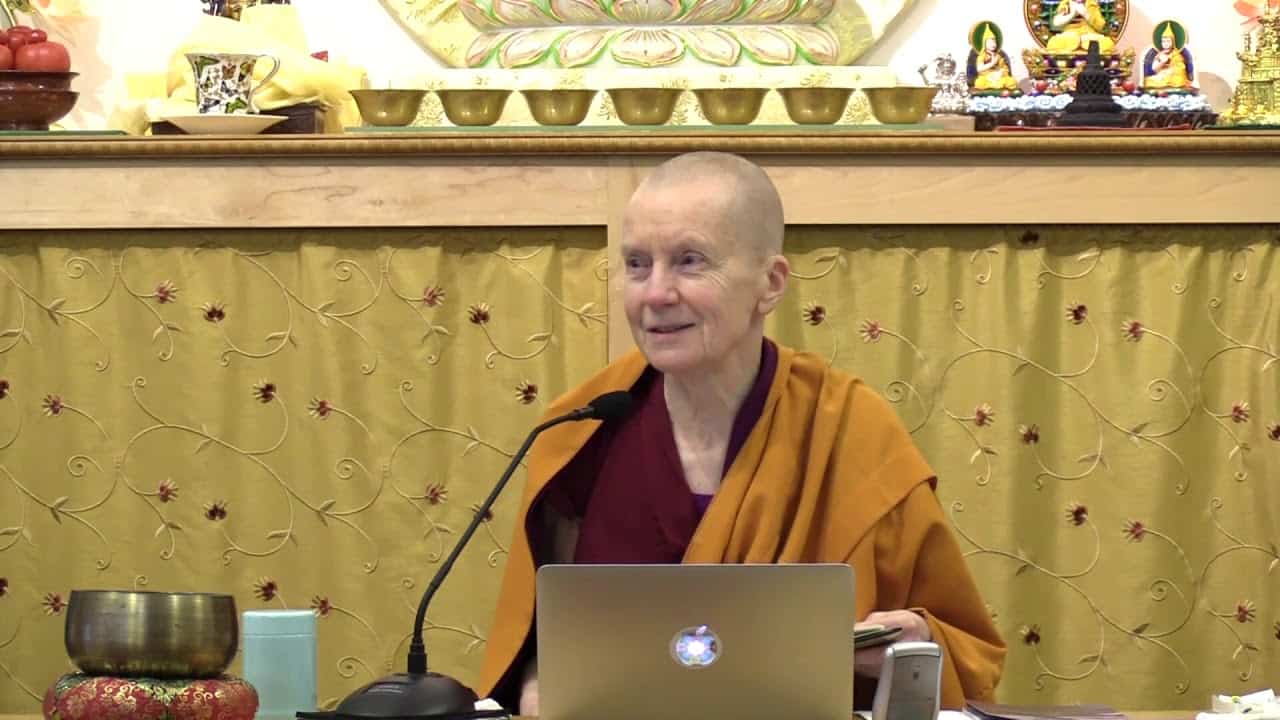
 Venerable Sangye Khadro
  Cultivating the Four Immeasurables
  Nov 28, 2020
 Part of a series of talks by Venerable Sangye Khadro based on her book Awakening the Kind Heart given during a retreat at Sravasti Abbey in November 2020.
- Further teachings on compassion
- Joy: the third immeasurable
- Cultivating a state of mind that rejoices in the happiness, good things, and virtues of others
- Obstacles to empathic joy & remedies
- Jealousy
- Resentment
- Exhilaration, self-centered pleasure
- Joy about others’ unethical actions
- Meditating on immeasurable joy
Let’s start with the wish that whatever we learn in this session this afternoon be beneficial for our own minds to increase kindness, compassion, and other positive qualities and help us decrease self-centeredness, anger, attachment, and other obstacles to having a kind heart. And may it help us progress along the path towards enlightenment so that we can be more and more beneficial to others, both now and in a long-term sense, becoming a fully awakened Buddha so we can help all other beings in the best possible way.
Review: Empathy and compassion
There were a couple of questions that were sent in at the end of this morning’s talk. One is asking if I could talk about the role of empathy and developing compassion and the difference between the two. I did already talk about that this morning, but I’ll repeat it. According to Thupten Jinpa’s book, A Fearless Heart, empathy is the ability to understand another person’s feeling. And it could be any kind of feeling: happy or unhappy, angry, loving—whatever. It’s just being able to understand what another person is experiencing. Whereas compassion is specifically related to their suffering.
And empathy leads to compassion. If we see somebody looking sad, crying, looking like they’re in pain, then we can understand that person is suffering. And then that can lead to compassion. So, it underlies compassion. Compassion arises from empathy. But it does seem there are different opinions about empathy and compassion and what is what, what is the difference between them. And also, I’ve heard some opinions that question the benefit of empathy. Maybe this is a minority view, but one idea someone put forth is that empathy can be used to harm others. Because if we know what causes somebody suffering, and we want them to suffer, we can use empathy to do what makes them suffer.
That’s what underlies torture: knowing what’s going to make somebody suffer, both physically and psychologically. Torture is sometimes psychological. When I mentioned that to one of my psychologist friends, he said that’s not empathy. They have a different meaning of empathy. So, there’s just a lot of controversy. If you go online and search, you’ll probably find different opinions and points of view. And there’s a guy somewhere over on the East Coast who talks about how empathy can lead to burnout. Because if the person has too much empathy, if they’re too sensitive to the suffering of others, then they’re going to become a wreck because they’re just picking up on all this suffering around them.
They’re going to get drained. But I don’t know if the fault there is empathy itself or the person just doesn’t know how to balance. I don’t know if Venerable Thubten Jigme would like to say something; she worked as a psychiatric nurse practitioner before ordination.
Venerable Thubten Jigme: I think in the neuroscience community, they’ve determined that when we have empathy, it triggers in the brain the place where there are neurons that feel pain. And so if you keep with empathy and only empathy, then you would be drained after some time because it’s painful, because it just pains. So, their idea is that you start with empathy that connects you to the person and then you turn your mind consciously to compassion, which is another part of the brain that is nourishing, courageous, all of those positive things.
Venerable Sangye Khadro (VSK): That’s what I understand. That’s good, that’s helpful. Keep the microphone because the second question asked was about how to handle compassion fatigue, especially for healthcare workers, mediators, social workers, and so on. You have more experience in that area than I do. Compassion fatigue: there’s probably a lot of that right now.
Compassion fatigue
Venerable Thubten Jigme: I think a lot of it has to do with the big I, that I’m going to do these things and I’m going to make it better and I’m going to solve the problems and I’m going to heal people. And when you work day-after-day with that kind of mindset, you get beaten down quite quickly because we have no control over all of those things. And so some of it has to do with that kind of view, I think. At least that’s true in my own case. When I had that view, I burned out a couple of times and had to learn from that. So, that’s also my personal experience, I would say.
Venerable Thubten Nyima: Having worked in the area of social work for 14 years with Child Protective Services and seeing what social workers would go through, I think one of the factors in compassion fatigue in that field is that social workers, similar to what Venerable Jigme said, put a lot of investment in helping the families heal and helping them cope in drafting some kind of a service plan. And then when the families don’t comply or when they are not successful in the social workers’ view or where things go wrong, then that is internalized. And it leads to compassion fatigue in some cases.
VSK: So, maybe it’s about having unrealistic expectations of yourself—what you’re able to do, what you’re able to accomplish—and that’s more what leads to compassion fatigue rather than compassion itself.
Venerable Thubten Pema: Similar to what Venerable Jigme said regarding the first question, in Thupten Jinpa’s book, there was one part where he related about Mathieu Ricard going through an MRI when they were testing the effects of meditation on his brain. He was asked to stay with empathy, and he said it was so painful. And then when he moved into compassion, it was such a relief that after that, it’s not really compassion fatigue; it’s staying in empathy without moving into an action.
VSK: Yeah, I remember reading that too. Interesting.
Venerable Thubten Chonyi: It came up in our discussion group a little bit yesterday in relating to social justice, which has a similar problem when it comes to social justice workers, and coming from having an idealistic view that the world should be this way. “I can make the world this way. If I do it this way, it will all be better.” And it’s not coming from an understanding that this is samsara. We discussed how our Dharma practice can really support our realistic view of what we’re walking into. And then the disappointment and the frustration and stuff doesn’t become a weight and get in the way of our genuine compassion to try to make change.
VSK: So again, it’s like unrealistic ideas and expectations. And after lunch, I just kind of quickly googled compassion fatigue and there’s lots of material. There’s even a website—compassionfatigue.org—where you can find all kinds of resources. For anyone who’s facing that, there’s plenty of material available. Normally this isn’t mentioned in traditional Buddhist teachings, except in the explanation of the six perfections. The fourth perfection is joyous effort, which is one of the practices of a Bodhisattva: taking joy in doing virtue and helping others and continuously working for the benefit of sentient beings and creating virtue and so on. There it’s mentioned that sometimes you have to take a break. When you get physically or mentally tired, you need to stop and take a break to refresh your energy. Otherwise, you won’t be able to continue.
I think that’s the general advice for compassion fatigue and burnout, too. Also, I’ve heard and read about signs that indicate this is happening to you and that you need to pay attention to those and don’t just keep going. Don’t just keep pushing yourself. Otherwise, you won’t be able to work anymore. It’s important to recognize the signs and then take care of yourself. And this website also mentioned something about self-care. It doesn’t go into the details, but it’s like certain things you can do each day to take care of yourself. And that will prevent it from happening in the first place. So, there are lots of resources there if you’re interested.
And sort of related to that, some people may have the idea that with compassion, you always have to say yes all the time. You cannot say no. They think that if you’re on the Bodhisattva’s path and you’re working to help sentient beings, generating love and compassion and bodhicitta, altruism, then somehow you’re obliged to always agree to do whatever anyone asks you to do. Always say yes, never say no. Saying no is selfish. And also, there’s this idea of being kind of weak and passive and letting people do whatever they want to do. That’s another misconception people sometimes have about compassion: you should always be nice and sweet and let people walk all over you and do whatever they want.
Again, that can be like “idiot compassion” because that’s not helpful necessarily, especially with children or younger people—students that you are trying to teach and train and take care of. You’ve got to be tough with them sometimes, not just let them do whatever they want. You have to be firm and sometimes say, “No, you can’t do that; you need to do this.” Being compassionate doesn’t mean always being soft and sweet and gentle. You need to be firm sometimes and bring in that wisdom that knows what really is beneficial for this person or these people that you’re trying to help. And sometimes you may need to say no.
If people are asking you to do things you’re not capable of doing, like you’re already burned out and they’re asking you to do more, then sometimes you have to take care of yourself so that you don’t get burned out. That way you can continue to have energy and be able to continue working. So again, balance compassion with wisdom and know what really is good for yourself and also good for others.
Benefits of compassion
Let’s look at some benefits of compassion because if we understand those, then we’ll be more enthusiastic about cultivating it. In the traditional teachings, I haven’t found a list of benefits of compassion as there is for loving kindness. But A Fearless Heart, Thupten Jinpa’s book, has a list of benefits that are supported by research. Research on compassion has shown these benefits can be obtained. One is getting the “helper’s high”: you feel good. And there’s a physiological basis for this because when we do things to help others, it releases endorphins in our system. And that’s like the feel good hormone. So, we feel good when we’re helping others. That’s good for us, but it’s also good for them.
And it also helps with being less lonely. Loneliness is a huge problem. There are so many people, especially in the West but probably also all over the world, who are really lonely, especially if you have a spouse and your spouse passes away. Sometimes there’s nobody else that you have to share with and spend time with. So, a lot of people really suffer from loneliness. And it’s been found that loneliness decreases our lifespan and increases health problems. Being more compassionate and altruistic and more connected with others, more involved with others, doing things for others, will relieve loneliness and help our feeling of connectedness with others. And then we’ll feel more useful.
This is another big problem people often have, especially after they retire or if they’ve been laid off their job: they tend to feel useless. And if you’re feeling that way, then it’s hard to be happy and to have a positive state of mind. So again, compassion will make us feel more useful because we are more connected with others, doing things with others, helping others. Then we’ll feel more useful and have a greater sense of purpose in life. There’ll be less stress. Stress often arises from being overly concerned about me, myself. The more we are focused on others and concerned about others, the less concerned we are about me, then the less worry and stress we have.
Another thing is that kindness is contagious. When people do acts of kindness to help others and other people observe that or hear about that, they feel inspired to also do acts of kindness. It has a ripple effect. More and more people are doing acts of kindness and that’s of more and more benefit for everybody. So, in short, we’ll be happier and healthier. It shows that although compassion is about others—being aware of others’ needs and doing what will help them—then it does help them, but we will also gain a lot from being more compassionate.
And I haven’t really found a list of benefits in the traditional teachings except for Chandrakirti’s text, The Supplement to the Middle Way, where he pays homage to compassion right at the beginning. He says compassion is important at the beginning, in the middle, and the end of the path—especially the Bodhisattva’s path, the Mahayana path. It’s what impels a person to get involved in this path to begin with, and it keeps them going. It gives them the energy to keep going on the path and complete the path, become fully enlightened, fully awakened. And then at the end, when one is already fully awakened—a Buddha—then compassion is what energizes or motivates the Buddha to work continuously for others. So, in terms of the Mahayana path, compassion is a vital; it’s an absolutely essential ingredient. You can’t get to enlightenment without it.
Also, just in my own thoughts, I can see how important it is for our practice. For example, with the practice of ethics, which is such an important part of all Buddhist paths, the basis is non-harmfulness. It’s awareness that nobody wants to suffer. And having that awareness, we stop ourselves from doing things that would cause suffering to others: killing them, beating them, yelling at them, speaking harshly to them, lying to them, and so on. Compassion enables us to live an ethical life, to have good ethics.
And then another practice is giving. Again, if we have more compassion for others and understand their needs, we will be motivated to give as much as we can: material things, dharma, protection, and so on. And then these practices themselves—ethics, generosity—are virtuous practices. They are the cause of good karma and happiness in the future. So, we can see in so many areas of the path that compassion is really important. It’s essential to be able to practice well, to practice properly.
Also, forgiveness is another very important quality. If someone does something harmful to us or harmful to those we care about, naturally, anger comes up. And sometimes it can be very hard to forgive. But compassion helps us to forgive. I’ll talk a little bit more about that later—about how compassion can lead to forgiveness. But if we’re not able to forgive, it’s so painful. Because if we can’t forgive, it’s like we’re holding onto our anger. We’re holding anger in our mind, in our heart, and that’s so painful. And a lot of people don’t seem to realize that. Maybe they think it’s good to not forgive or it’s good to hold a grudge. They might think it’s good to hold onto anger, but they don’t see how they’re making themselves suffer and preventing themselves from being really peaceful and happy by not forgiving. Compassion is a very helpful method or tool to get to forgiveness; it’s a step towards forgiveness. And then in the prayer of the four immeasurables, the line related to compassion says, “‘May all sentient beings be free of suffering and its causes.'” So, there’s a lot to think about there.
Three kinds of suffering
Buddhism has a very extensive explanation of duhkha. Probably most people in the West, most people in the world, when they hear about suffering or duhkha, they think of pain, sickness, grief, loss, depression—really obvious forms of suffering. And from the Buddhist point of view, that is one kind of suffering. One list of different kinds of suffering has three points to it. First is the suffering of suffering, which just refers to obvious experiences that are painful. Everybody can recognize them, even animals. Animals want to get away from hunger and cold and danger and so on. It doesn’t take great wisdom to recognize the first type of suffering: the suffering of suffering.
But Buddhism also explains there are other kinds of suffering or duhkha that are much more subtle and not easy to recognize, such as the second type of suffering, which is called the suffering of change, the duhkha of change. And this is what we normally consider to be happiness or pleasure, like eating food. Of course we have to eat food; it’s not an option. We need food to keep ourselves alive. But most people probably take a great deal of pleasure in eating and probably eat more than they need to, and not everything they eat is good for them. But we tend to regard eating as a pleasurable experience.
But that so-called pleasure, from the Buddhist point of view, is actually another kind of duhkha because it doesn’t last. One thing is that the pleasure is very short-term. It only lasts while you’re eating and maybe a little while afterwards, but eventually it fades; it’s not there anymore. It’s very temporary and short-term. And also, they say that if it was real pleasure, if it really was real happiness or true happiness, then you should be able to just continue eating and the pleasure would just get better and better. But we know that’s not true. If you keep eating, pretty soon it turns into suffering. You have a full stomach and maybe you have a gas and maybe you fall asleep; you can’t stay awake. So, you have to eat within a certain limit regarding the type of food and the quantity of food in order to not have it turn into suffering.
But mainly, the point is that it changes; it doesn’t last. The pleasure doesn’t last: it fades; it disappears. And some people might eat in order to escape from their problems. That’s why we have so many obese people in our country: they feel depressed; they feel lonely; they feel unhappy—whatever. They find a little bit of pleasure from eating. But then they have these other problems, like obesity and heart disease, as a result of overeating and so on and so forth. So, it doesn’t solve their problems, right? They get a little bit of pleasure from the tastes of the food and the sugar in the food or whatever. But the problem is still there. Whatever they’re trying to escape from is still there; it hasn’t changed at all. So sensory pleasures are considered another type of suffering. They’re not really satisfying; they don’t really remove our suffering, and they often just lead to other kinds of suffering.
And then there’s the third type of suffering which is even more subtle and difficult to recognize. And that is just our being in samsara, basically; it’s being a samsaric being, a sentient being, and not an enlightened or awakened being. And that means our mind is not free but is still caught up with or tied up with or under the control of afflictive emotions and karma. As long as we’re in samsara, that’s the situation. There are afflictive emotions like anger, greed, jealousy, pride, and ignorance in our mind; they keep coming up again and again and again.
And under their influence, we create karma, and we already have lots of karma we created in the past that we’re carrying with us as we journey through samsara. And we keep creating more and more karma all the time. So, it’s as though we are imprisoned by these factors within our mind of karma and afflictions. Just that situation in itself is suffering. And there are other kinds of sufferings as well that are mentioned in the teachings, like sickness and not getting what you want and getting what you don’t want and losing what you cherish and so on. There are lists of sufferings.
When we do meditation on compassion for other beings, it is good if we can expand our understanding of suffering beyond just obvious suffering and understand that there’s more suffering than that. Because otherwise, you may feel compassion for people who are impoverished, who are homeless, who are suffering from COVID. But when it comes to the billionaires and the millionaires and the corporate heads and the celebrities who seem to have it all and don’t have too many problems, it’s harder to feel compassion for them. And you may instead feel angry at them, thinking they’re the ones who are responsible for all these other people’s problems. But they deserve compassion, too.
They have duhkha also. So, it’s good to really expand our understanding of duhkha and understand that everyone in samsara—even the devas way up in the higher realms with their long blissful lives—has suffering. They at least have the third kind of suffering, and that is suffering too. The more we can understand the different kinds of duhkha, the more our compassion will be expanded and great and not just narrow focused on the obvious kinds of suffering.
Understanding the causes of suffering
And then the line from the prayer also mentions the causes of suffering. We want sentient beings to be free not just from suffering, but its causes as well. And that’s explained in the second noble truth, the origins of suffering, which mainly are afflictive emotions, greed, hatred, ignorance. It’s these disturbing states of mind and karma actions that are done under the influence of those. Even if sentient beings have very wonderful lives and very little suffering, as long as they still have afflictions in their mind and they’re still creating karma, then they’re not free of suffering. And they’re creating the cause for more and more and more suffering all the time. That’s also very important to contemplate and to wish sentient beings to be free, not just from the immediate suffering that they have right now, but the causes of suffering. We want them to stop creating more and more suffering for themselves in the future.
These are just some ways of contemplating to really have a wide view of suffering and its causes and then a very wide, expansive sense of compassion. In Buddhagosa’s explanation in The Path of Purification, what he advises is to start with somebody who is experiencing suffering, especially someone we know and care about. That makes it easier to generate compassion for them. And then next we focus on a dear one: a dear friend or a relative. Then it’s a neutral person. And then finally, a enemy, a hostile person. He doesn’t mention oneself. I don’t know why. But if we have a tendency to not have compassion for ourselves and even to have hatred for ourselves, then it’s good to include ourselves and make sure we generate compassion for ourselves. I used to wonder why it is that the traditional Tibetan teachings don’t mention compassion for oneself. It’s always about others, others, others.
But then Venerable Chodron and I came to the same conclusion. It’s in the lamrim, the stages of the path. We have the initial scope where we think about precious human rebirth, karma, and so on and so forth. And then the middle scope is where we think about all the different kinds of duhkha and generate what’s called renunciation or the determination to be free, which is “I have to get myself out of this situation of samsara with all this duhkha. I want to free myself from this situation.” And it said that renunciation has to be developed prior to bodhicitta. You have to see how you yourself are in an undesirable situation, an imperfect situation, a situation full of duhkha. You have to generate the wish to free yourself from the situation. And then you go on to think about all other sentient beings who are in samsara and generate the wish for them to be free as well.
If you don’t already have the wish to free yourself from samsara, how can you possibly wish to free others from samsara? It doesn’t work. So, I thought maybe that’s what self-compassion is. It’s not called self-compassion, but it is. It’s the supreme form of self-compassion. It’s not just about giving yourself bubble baths and going for massages and listening to nice music. That might relieve some of your immediate suffering, but as long as you still have karma and afflictions in your mind and you’re still stuck in samsara, you’re still suffering. The supreme form of self-compassion is that I want to get myself out of this situation where I’m suffering. And I keep creating more and more suffering for myself in the future as well.
That’s like self-compassion. That’s the best kind of self-compassion. And then that is necessary before generating real compassion and then bodhicitta for others. It’s kind of in there, but it’s just not labeled self-compassion. The Dalai Lama has learned that many Westerners don’t have good feelings about themselves. And so he talks about this, especially when he’s teaching in the West. He says you have to have compassion for yourself. If you don’t have compassion for yourself, you can’t have it for others. So, he and other Lamas do emphasize the importance of that.
Compassion for difficult people
What can be difficult in the meditation on compassion is generating compassion for an enemy, especially if there’s a person who’s caused suffering to oneself, someone who has harmed oneself or has harmed our friends or our loved ones. It’s already hard enough if they’re harming others over there on the other side of the world, but if we have suffered as a result of somebody’s actions, that can be very difficult to generate compassion. Some things we can do to help with that is, for example, when we are trying to generate compassion for these difficult people, start with easier ones. Don’t start with the hardest one. If someone has abused you and caused you terrible, terrible suffering, that might be too hard to start with. Start with someone who’s just a little bit annoying. Maybe you don’t like the tone of their voice or the way they laugh, or you don’t like the way they do the dishes or whatever. Start with a relatively easier object and then gradually you can work on more difficult ones.
Some things that can help us to overcome aversion, anger, and to have more compassion is just reminding yourself that this is another person basically like me, and they want happiness, and they don’t want suffering. They want to be happy, and they don’t want to suffer, just like me. That really helps a lot to really feel that. And it can also be helpful to try to understand why the person is behaving in such an annoying way. Why are they doing those things? It’s probably some kind of attempt to find happiness or escape from suffering. It’s helpful if you can find out a bit more about what is going on in the person’s mind. Sometimes people are not feeling well, or they’re upset about some news that they just got, and so they’re not really in a good state of mind. Their mind is kind of disturbed by things that are happening in their life. If we try to find out about that, that can really help us, especially if we can remember that we have also been in that kind of situation before.
We’ve received bad news; we’ve been upset and unwell, so how did we behave during those times? We weren’t always in control of what we did and what we said, and we sometimes blurted things out or did things that annoyed others. That can be really helpful to bring that to mind. Because when a person behaves in a way that’s kind of annoying or irritating or harmful, it’s usually because they’re not in a good state of mind. Their mind is not happy and calm and clear and open and positive. There are disturbances in their mind—inner disturbances. And so that means there’s suffering. They’re experiencing suffering and that’s why they’re behaving that way.
If we can understand that, that will soften our mind and open up the possibility of feeling compassion for them and wanting to help them rather than getting angry at them and yelling at them or scolding them or punishing them somehow. That’s one of the best ways of changing our mind towards a harmful or an annoying person. And it may be that we try to investigate that and we find there’s no real reason, no good reason, why they’re behaving that way. They haven’t had any bad news or bad things happening to them, or they weren’t abused when they were a child or whatever. So then it could just be that their afflictive emotions are just very, very strong, very powerful, and just taking over their mind. And they haven’t learned how to manage them. They never learned any methods for how to deal with their mind. So, they’re just helplessly under the control of their disturbing emotions.
And that itself is suffering. It’s a subtle kind of suffering, but it is suffering. And also, what they’re doing, if they are behaving in harmful ways, that means they’re creating the karma that will bring them even more suffering in the future, much more than what they’re experiencing now and even much more than what we may be experiencing now. I found that helpful to consider.
One time somebody was being really nasty to me and I thought, “Well, this person’s probably suffering more than I am.” And I could really feel that way. It was hurtful to be on the receiving end of what this person was doing, but I tried to imagine their state of mind. And I thought, “That’s probably much worse than my feelings, my experiences.” So, that was helpful. And then another thing that’s really helpful is separating the person and the behavior. When someone’s behaving badly, we tend to just lump everything into one and say, “That’s a bad person.” He is bad or she is bad. But that’s not true; it’s not fair, because a person is a complex of many, many different things: many different qualities, many different ways of behaving. Everybody has some bad qualities and makes mistakes, but everyone also has some good qualities and sometimes does good things. Try to separate out the different qualities and different behaviors of a person and see that there’s some good there even though there are some things that aren’t good also.
We can still point out certain actions or certain attitudes and say, “That is not good; I don’t agree with that. I want to try to stop that or change that,” but we can do that without condemning or rejecting the whole person just because of those specific things about them. And also, it’s important to remember impermanence: people change. George Bush has changed. He was somebody I used to get really angry at. I’m sure I’m not the only one. But he voted for Biden—wow. And I think he feels regret for some of the things he did. He recognized there were mistakes. So yeah, just being able to see other aspects of that person was really helpful for me.
The thing that helped me the most was actually the Dalai Lama, because I heard the Dalai Lama say that he liked George Bush. He said, “I don’t like his politics, but I like him as a person.” And that just blew my mind, because I thought, “Well, if he can see good things in George Bush, there must be good things there.” And he’s met George Bush; I haven’t, so he’s in a better position to know. That helped to open my mind and make some space in my mind to stop being so angry at George Bush. But I think it’s the same for everybody. Everybody has some good qualities. And certainly the Buddhas and Bodhisattvas are able to see everyone as lovable and have love and compassion for them and see good things in them. So, we can try to do that as well.
Those are just some ideas that can help us to overcome aversion and hatred that stand in the way of compassion for difficult people, difficult beings.
Audience: Some people online are asking if it’s appropriate to visualize people who have died when doing the compassion and loving-kindness meditations?
VSK: I think so. I think that’s very helpful, because there may be people in our life that we had problems with, conflicts, and we might still be holding on to some bad feelings and some resentment toward them. And maybe they’ve already passed away. I think it’s helpful to bring them to mind and try to overcome our negative feelings towards them and generate love and compassion for them. That’s one reason for doing that. And also, when we do practices such as taking refuge in the Buddha and so on, we are told that it’s good to imagine all sentient beings around us—our mother and our father and other male and female relatives and so on. My understanding is that even if they’ve already passed away, we could still visualize them there. And we imagine them doing the practice and getting the benefit from their practice along with us. So, I don’t think there’s anything wrong with thinking of people who’ve already passed away.
Audience: With tonglen practice, which is unique to Tibetan Buddhism but absent in other traditions, many people mistakenly think that the practice may overload one’s karmic debt if the foundation isn’t strong. So, how can we do this practice of compassion without inciting fear due to misunderstanding.
VSK: I don’t understand the meaning of “overloading karmic debt.” What does that mean? It seems like it’s a way of clearing karmic debt. Venerable Pema, can you clarify this? When you have compassion in your mind, do you then not have loving kindness? Is it like two different mental states?
Venerable Thubten Pema: Well, there are different mental factors. Among the 11 virtuous mental factors, there’s one called non-hatred. And they say that’s love—the nature of that is love. And then another one is called non-harmfulness and that is compassion. So, they are two different mental factors, but I have never heard that one can’t have both of them at the same time. I think one can. I think one can have more than one virtuous mental factor at the same time.
VSK: So, it’s not contradictory. That’s my understanding also.
Audience: I haven’t got clarification yet, but someone else is asking: “Some people believe that compassion makes you weak, so how can we change this idea?”
VSK: I think that’s a misunderstanding of compassion. Read the Dalai Lama’s books on compassion. He will straighten out wrong views. He said compassion makes you strong and courageous, not weak. So, that’s probably because of some misunderstanding.
Like I was saying before, people do sometimes think compassion means you always have to say “Yes,” and you have to give in to everybody’s wishes and let them do whatever they want. That’s a misunderstanding of compassion. Because with compassion, you want to benefit people. And is it really beneficial to always let them do whatever they want, to always say “Yes, yes, yes, yes, yes”? It’s not helpful. That’s why we need to balance compassion with wisdom. And it takes time, of course; it’s not instant. But gradually, over time, we get to understand better what really is helpful for sentient beings and what isn’t.
Audience: The person online has clarified that overloading one’s karmic debt means that if one is experiencing sickness, which is a ripening of past karmic seeds, or I guess past karmic debt, people fear the practice of tonglen would mean taking on more suffering from others, more karmic debt.
VSK: Well, we can’t take other people’s karma. That’s not possible. Each person creates their own karma. Even a Buddha cannot take away another person’s karma. It’s not possible for us to take another person’s karma, so when we’re doing tonglen and we’re visualizing removing the suffering of other beings, we’re doing this in our imagination. And it’s mainly done for our own sake. We’re doing tonglen in order to overcome our self-centered mind and increase our compassion and our altruism. And most of the time, probably 99% of the time, we cannot actually remove somebody else’s suffering. And we certainly cannot remove their karma. So, maybe it’s just a misunderstanding of what tonglen is all about. It’s a practice for working on our own mind. That’s the primary purpose. It helps us to generate stronger and stronger compassion, wishing we could take away the suffering.
If that was possible, we would do it. It’s having that strong a sense of compassion. And we wish to give our karma, our good karma and our happiness and all this, to others. We would like to do that if it’s possible, but it isn’t actually possible, strictly speaking. It’s just a practice to bring ourselves further along the path rather than something literally we are doing.
Immeasurable joy
The next of the four immeasurable thoughts is joy. The Sanskrit term is mudita, which is also the name of another one of our resident kitties. And it’s sometimes called sympathetic joy. The word joy might sound to people, like “Whoopee! It’s my birthday, and all these people are coming to my birthday party and giving me presents! Oh, I’m so happy!” That’s self-centered joy. It’s not that kind of joy, but rather taking joy from or feeling joyful about other people’s joy. When others are happy, when others are having good things happening in their lives—they win a prize; they get a raise in salary; they meet a new person, and they’re in love; they’re just so happy for whatever reason—then we share in their joy.
We feel happy for them. That’s the meaning of sympathetic joy. But I was thinking that maybe it could also be called empathetic joy because there’s empathy involved. We see somebody else happy and we feel happy too. We’re happy that they are happy: empathic joy. But in some other books and contexts, it’s called sympathetic joy. So, this is sympathetic joy or empathic joy. It seems to be based on loving kindness, because if we generate loving kindness, we are wishing others to have joy—to have happiness, to have good experiences.
If we genuinely feel that way then when they are happy, we should be happy, too. “I want this person to be happy” and then when they are happy, when good things are happening to them, we think, “Oh, wonderful! I got what I wished for.” And it’s something we already do experience with people we love and care about, with our family. If you’re a parent and you see your children looking joyful or getting good grades in school or finding a new friend they’re really happy with—when you see your child happy or your sister or brother happy—then you are happy, too, because you love them and you want them to be happy. So, you’re happy when they’re happy. It’s a feeling we experience naturally, but we can cultivate it further. We can increase it so that we feel it more often for more people and in more situations.
In fact, there’s a quotation from His Holiness I found somewhere. He says:
There are seven billion people in the world. That means seven billion opportunities for us to be happy.
Obstacles to joy
It’s just a question of learning how to do it. And it’s a positive state of mind. It’s a virtuous state of mind. So, if we can cultivate it and have it more often, then it’s a way of creating virtue, which in turn is the cause of happiness and good experiences in the future. But there are obstacles to this state of mind. What’s the far enemy? It’s jealousy, envy, and also resentment. It’s another state of mind that resents somebody else’s success, their good fortune and good experiences. We probably all feel that way sometimes. And this is the opposite of joy. Sometimes you see somebody looking happy, having some good thing happening in their life, and instead of feeling happy, you feel unhappy. “I wish they didn’t have that. Why did they have to have it and not me?”
Jealousy is a combination of two poisonous states of mind. One is attachment, because we have attachment to a certain experience or a certain object or a certain good fortune. We want that for ourselves, and we don’t have it and somebody else does. And then we have hatred. There’s hatred, not necessarily hatred of the person, but hatred of the situation: “This isn’t fair. This isn’t right. This shouldn’t be like this. I should have that instead of them.” So, it’s attachment plus hatred. And that is particularly painful. It’s two painful, poisonous states of mind in one. I think we all know how painful it is.
And that is also one remedy for it. It’s to recognize, “This is not making me happy. This is making me suffer. So, if I continue feeling this way and indulging in this state of mind of envy or jealousy, I’m just making myself suffer.” And we might make other people suffer, too, because if we’re in a bad state of mind then the things we do and the things we say might be annoying or painful to others. We might even make nasty comments to the person we’re jealous of, trying to poke a hole in their happiness. Is that really nice? I think we know if we really are honest with ourselves. We know it’s not nice to be that way. It’s not good to be that way. We shouldn’t be that way. But often we just don’t know what else to do. Jealousy is there in our mind, and we just get stuck in it. But we can do things to counteract it.
Remedies for jealousy
Actually, the remedy to jealousy is joy—feeling joyful rather than feeling jealous. But it’s not easy to just make that switch. It’s like going 180 degrees. So, there are things that we can do to move towards joyfulness. One thing is if we understand karma, if we accept karma, if that’s part of our worldview of things, then we can think to ourselves, “Well, there’s a reason why this person has that, and I don’t: they created the karma. They created the causes for it, and I didn’t.” And you might even be able to see that in this lifetime. Maybe that person really did work harder and do more things in order to create the causes for what they have. And we didn’t. Maybe we were lazy.
But it sometimes happens that maybe we did work hard and try to create the causes, but we still didn’t get that. Well, then that’s karma from past lives. In past lives, we didn’t create the karma to have that. So, it’s not a question of fair or unfair. The situation has come about, but it’s the result of karma. We just didn’t create enough karma or the right karma. But karma is not carved in stone; it’s not fixed, permanent, and unchangeable. Karma can be changed. And so, if we really want that thing, if it is something worth striving for, then we can create the causes for it now. Start creating the causes now. And then we’ll be able to achieve that thing in the future—maybe even in this lifetime.
But if we indulge in jealousy and envy, what kind of karma are we creating—good karma? No, that’s bad karma. If we let ourselves get stuck in that and let those kind of thoughts proliferate in our mind, we’re creating bad karma, which means we’re taking ourselves further away from achieving what it is we want. On the other hand, if we practice joy—sharing in the other person’s good fortune and eing happy for them—that’s creating good karma. That’s creating merit. And then there’s a greater chance of achieving that thing that we want in the future.
So, logically, if you accept karma, it makes more sense to at least try to feel joyful and not indulge in jealousy. That’s something we can talk to ourselves about; we can give ourselves a little talk. That might help us to move our mind more in the direction of joy. And then if we do feel inclined to at least try feeling joyful, we can do that—even if we’re gritting our teeth and saying, “I’m really happy for that person. I’m so happy for you.” It may not be genuinely from the heart, but it’s just trying to say that, trying to think and feel that. And we might notice, actually, that it makes a lot more sense, that hat it feels better.
And we probably will feel better because jealousy is so painful. It’s like that expression “Fake it till you make it.” We’re faking joy and seeing that, yeah, it does feel better. It does feel more right. We realize, “This is how I want to be,” and then that will kind of open our mind even more to that way of thinking, that way of seeing things. That’s my experience anyway. And I feel more inclined now to feel joyful, even if it’s not my first impulse. But making myself do it, it just feels better and less likely to feel envy or resentment or jealousy.
And also, it helps us to feel contentment, because that might be part of the issue as well. We might already have a lot going for us, a lot of things, but maybe we’re dissatisfied. We’re discontent with what we have. We want more; we want better; we want what others have. The issue there is a lack of contentment, dissatisfaction, and, of course, self-centeredness. So, we can remind ourselves of what we do have and try to feel happy about that.
We understand, “I do have a lot. I do have enough. I can be happy with what I do have.” Also, one thing I realized about myself is that if I’m not content with what I have and if I have that tendency to want what others have, even if I did get what that person has, eventually I would see somebody else has, and then I would be dissatisfied with what I have and want that instead. It becomes like a never-ending process, like that expression “The grass is always greener.”
It just doesn’t make sense to get caught up in envy and believe in that and follow that. It’s not going to lead to satisfaction and contentment. It just leads to more dissatisfaction and discontentment. So, let’s try to be grateful for and content with what we do have and be happy with what others have. Those are some things that can help overcome jealousy and make it possible to have empathic joy. And here’s something from Sharon Salzberg talking about resentment, which is kind of similar to envy and jealousy. And it can arise when we hear about misfortunes of people we envy, people we’re envious of—if we hear that they encounter misfortunes. She says:
We relish others’ misfortunes when we begrudge them their apparent happiness. Hearing about another person’s success, we might think, ‘Oh, I would be happier if you had just a little bit less going for you right now.’ You don’t have to lose everything, of course—just a slight tarnishing of that glow would be nice. We react as though good fortune were a limited commodity.
So, the more someone else has, the less there will be for us. As we watch someone else partake of the stockpile of joy, our hearts may sink: “We’re not going to get our share.” But someone else’s pleasure doesn’t cause our unhappiness. We make ourselves unhappy because our negativity isolates us. It’s not the other person’s success and happiness that makes us unhappy. It’s our own jealousy. An alternative to feeling painfully cut off is to learn to rejoice in the happiness of others. So, we need to watch our mind and try to notice when this kind of thought or feeling comes up and understand that it’s not going to make us happy. We need to recognize that “This is just a cause of suffering for myself. And if I indulge in it, if I get caught up in it and let it be there in my mind, then I’m just creating the cause of more suffering in the future.” It doesn’t make any sense. It doesn’t make sense to be jealous. It makes a lot more sense to feel joyful, or to at least try to be joyful for the other person.
Near enemies to joy
And then there are three near enemies of joy mentioned. These are states of mind that can look like empathic joy but are not. One is exhilaration, which is self-centered pleasure: “Whoopee! I’m so happy.” That can look like joy, but it’s not about others’ joy; it’s more about me—my pleasure, my happiness—and getting kind of over the top. Remembering impermanence is really helpful for this—just to remind ourselves that all experiences are impermanent; they don’t last. And that includes joy, pleasure, happiness; they don’t last. Remembering that can help us to kind of come down to earth and not be so attached to the pleasure.
Because otherwise, if we’re attached to that happiness or pleasure, then when it does disappear, we’re going to really go down far; we’re going to really get unhappy. It’s much better to try to be more grounded. And another one is insincerity, which is pretending to be happy for another’s success but secretly feeling unhappy or jealous. That may sound like what I was talking about before. But I think as long as you are aware that there is some jealousy, some envy, in your mind but you know that’s not a good state of mind and you’re trying to deal with it—you’re trying to overcome it, trying to practice rejoicing, but knowing that you still have work to do—then I think that’s not quite insincerity.
Insincerity is probably more when you’re in denial about your jealousy: it’s there, but you’re kind of pretending it’s not; you’re not acknowledging it. And then another near enemy is joy about somebody’s unethical action. For example, someone was successful in robbing a bank or getting revenge, and they’re really happy: “Ah, I did that.” If we feel happy for them, that wouldn’t be appropriate. So, we should only be joyful about other’s joy when it’s based in ethics and proper behavior and proper attitudes and so on, and not something unethical. That might seem obvious, but we might slip into that before we realize, “Oh, wait a minute—you did what?”
How to meditate on joy
I found this somewhere online, because in the verse of the four immeasurables, it says, “May all sentient beings not be separated from sorrowless bliss.” And strictly speaking, what that means is liberation, nirvana. It’s explained as wishing sentient beings to have not just the happiness within samsara, but we want them to be free of samsara and achieve liberation, nirvana, which is happiness or bliss that is free of all kinds of suffering and causes of suffering. So there do seem to be differences in the Theravada tradition, the Pali tradition, and how it’s explained in the Mahayana tradition. In the Theravada tradition, the Pali tradition, it says:
Empathic joy is feeling joy at others’ success, merit, good qualities, and happiness.
So, you start by first thinking of a person who’s dear to you, someone who’s good-natured and happy, and whose happiness and success is worthy of rejoicing over. And then you sincerely rejoice at their good fortune. We’re happy about their present good fortune but also thinking of the past and future. We want their good fortune to continue into the future and not come to an end. You do that first with a dear person, and then a neutral person, and then hostile person—people we have difficulty with. We don’t do this for ourselves. [laughter]
Otherwise, that would be the wrong kind of joy—exhilaration. So, it’s wishing others to have happy experiences, pleasant experiences, both now and in the future. One meditation I found online is thinking of these people one by one, and then the phrases that can be used are: “I’m happy that you are happy. May your happiness continue. May your happiness increase. May your good fortune shine.”
You can use those phrases or make up your own, but it’s just being joyful that the other person is happy, that the person has good experiences, and wishing that it will continue in the future and not come to an end. And then in the Tibetan tradition, we have this practice of rejoicing. It’s one of the seven limbs. But the term for “rejoicing” and the term for “joy” are different in Tibetan. The terms are different, but they seem quite similar in that when we do the practice of rejoicing, we’re thinking of the good things. It’s focusing more on good things—good deeds that people are doing, good qualities they have, like when we see them practicing generosity, practicing meditation, studying, being ethical, and so on and so forth. So, it’s good actions, virtuous actions, that they are doing, and we feel happy that they are doing those.
Giving ourselves encouragement
But I also heard Lama Zopa Rinpoche talk about rejoicing in people having beautiful bodies, for example, and a beautiful boyfriend or girlfriend. So, it’s there more as an antidote to jealousy, as an antidote to envy. I guess the term rejoicing can also be used for good experiences—happy experiences, pleasant experiences—that people have. Because otherwise, jealousy is very painful and very negative. So, to counteract jealousy, we’re feeling happy for their success and their good experiences. I just wanted to share something I read in Geshe Palsang’s notes on the seven limb prayer and the Amitabha practice and the rejoicing piece. He says:
One of the reasons for counting the number of prostrations offered and mantras recited is to allow one to rejoice in one’s own efforts and achievements. Like I have offered 10,000 or 100,000 prostrations. How excellent it is, and I rejoice.
And then further on in this little section, he says:
At times we are like young children who need to be encouraged. Hence, we can use the amount of time spent on meditation to quantify it. For example, if an hour in a day is spent on such meditation, you have meditated a total of 360 hours a year. So think, I have spent 360 hours meditating, which is the most supreme virtuosity. And if you feel that’s too little, you can even use minutes as a basis for calculation. I have meditated 21,900 minutes in a year.
I personally don’t like counting stuff, but this helped me be like, “Oh yeah, that’s a nice way to think about it.” I get stressed out about counts, you know? I have a hard time with that, too. But one of my teachers said that the benefit of counting and keeping track of those numbers is because it’s such a long way to enlightenment. There are so many things we have to do to get enlightened, and we can get quite discouraged. So, if we can say we did 10,000 prostrations or 100,000 prostrations, we can feel like we’ve achieved something. We’re getting somewhere.
It’s to give ourselves encouragement. But of course, we should not be attached and proud and bragging. That wouldn’t be right. But it can be helpful just to recall, “Yeah, I am doing good things.” Also, I was listening to some talks that Joseph Goldstein was giving, and he was spending some time in Burma doing a lot of Vipassana meditation quite hard. There was one time when he was speaking to his teacher and talking about some problem he was having in his meditation. And the teacher said, “It’s good to contemplate your ethics”—something like that. And the first thought that popped up in his mind was, “What did I do wrong?” It was like he thought the teacher was saying, “You have to be careful of your ethics,” but that wasn’t what he meant.
He meant contemplating your ethics in terms of how you are practicing ethics—how much good you are doing by not killing and not stealing and so on and so forth. He was saying to encourage yourself, to bring that up in your mind, because I guess his mind was kind of sinking. That’s a standard practice, thinking about the good deeds we are doing, the good karma we are creating and feeling joyful about that. There’s nothing wrong with that.
I have found that rejoicing in my own good qualities was a hard thing to do in the beginning, but it really does counteract that self-hatred really, really well. And also—I’ve seen this in myself and it probably happens with other people—we denigrate ourselves; we denigrate our practice. We sit for half an hour and at the end we think, “Oh, my mind was just all over the place, and I had anger, and I had attachment. I’m such a lousy meditator.” So, instead of appreciating the fact that we sat down and tried to meditate for 30 minutes, we’re just beating ourselves up for what a lousy job we did. If you keep doing that and you don’t rejoice in the effort you’re making and the things you are doing, eventually you’re just going to give up. And that does happen. People just get so discouraged, they stop altogether.
So, it’s really important to rejoice in our own good deeds and our virtues and our attempts at practice and to feel confident that we are doing good. And little by little, step by step, drop by drop, it’s building up, and we are making progress even though it may not seem obvious. But it is happening.
The difference between love and joy
Audience: Could you please clarify the difference between wishing someone joy and wishing someone happiness?
VSK: You mean in terms of the immeasurable of love and the immeasurable of joy? I see. When we meditate on immeasurable love, on loving kindness, we wish them to have happiness. And the way I think of it is: “May they have everything they need to be happy—food and clothes, but also inner qualities.” Because even if you have tons of food and clothes, if your mind doesn’t know how to be happy, then that’s not going to work. So, the inner qualities and virtuous qualities—all the different sources of happiness—”May they have all of those and may they be happy.”
And then the way I think of joy is when they are happy, you are happy for them. When they do have these things that make them happy—outer things and inner qualities and so on—then you’re happy for them. You’re joyful for them, and you want them to continue having those. So, they’re kind of similar, but there’s a little bit different emphasis as I see it. And again, loving kindness is like the opposite to or the antidote to anger, whereas joy is the opposite to envy and jealousy. So, it’s somewhat different. To clarify, this is based on my understanding of immeasurable love; I don’t know if it’s different explanations.
When you wish somebody to have happiness and the causes of happiness, the greatest happiness is Buddhahood, liberation, and then immeasurable joy, or empathetic joy. It’s not to be separated from sorrowless bliss, meaning that whatever happiness you have, you won’t lose it. And the greatest happiness you can have is liberation, Buddhahood. So, it’s slightly different. Well, normally in the explanations of immeasurable love, they don’t necessarily mention Buddhahood. You can include that, but I tend to think that that comes more under immeasurable joy. That’s how I think of it. I think of loving kindness: “I want them to be happy now and to have everything they need to be happy now and in their future lives.”
And then immeasurable joy is going beyond that: “Yes, I’m happy that they’re happy now, but I want them to continue having happiness and better and better happiness up to liberation and enlightenment—all the way to the top.” That’s how I do it in my practice when I meditate on that, but there could be different ways of doing that. Anyway, I’ll have a look at the book and see if that answers that question. And then we have one more—immeasurable equanimity—tomorrow. And there are a few other points as well about the order of the four and so on. So, we’ll finish that tomorrow.

Venerable Sangye Khadro
California-born, Venerable Sangye Khadro ordained as a Buddhist nun at Kopan Monastery in 1974 and is a longtime friend and colleague of Abbey founder Venerable Thubten Chodron. She took bhikshuni (full) ordination in 1988. While studying at Nalanda Monastery in France in the 1980s, she helped to start the Dorje Pamo Nunnery, along with Venerable Chodron. Venerable Sangye Khadro has studied with many Buddhist masters including Lama Zopa Rinpoche, Lama Yeshe, His Holiness the Dalai Lama, Geshe Ngawang Dhargyey, and Khensur Jampa Tegchok. At her teachers’ request, she began teaching in 1980 and has since taught in countries around the world, occasionally taking time off for personal retreats. She served as resident teacher in Buddha House, Australia, Amitabha Buddhist Centre in Singapore, and the FPMT centre in Denmark. From 2008-2015, she followed the Masters Program at the Lama Tsong Khapa Institute in Italy. Venerable has authored a number books found here, including the best-selling How to Meditate. She has taught at Sravasti Abbey since 2017 and is now a full-time resident.