Building trust
-
 Venerable Jenkir Shih
 -
 A Nun's Life
-
Dec 4, 2025
 Venerable Jenkir Shih
  A Nun's Life
  Dec 4, 2025
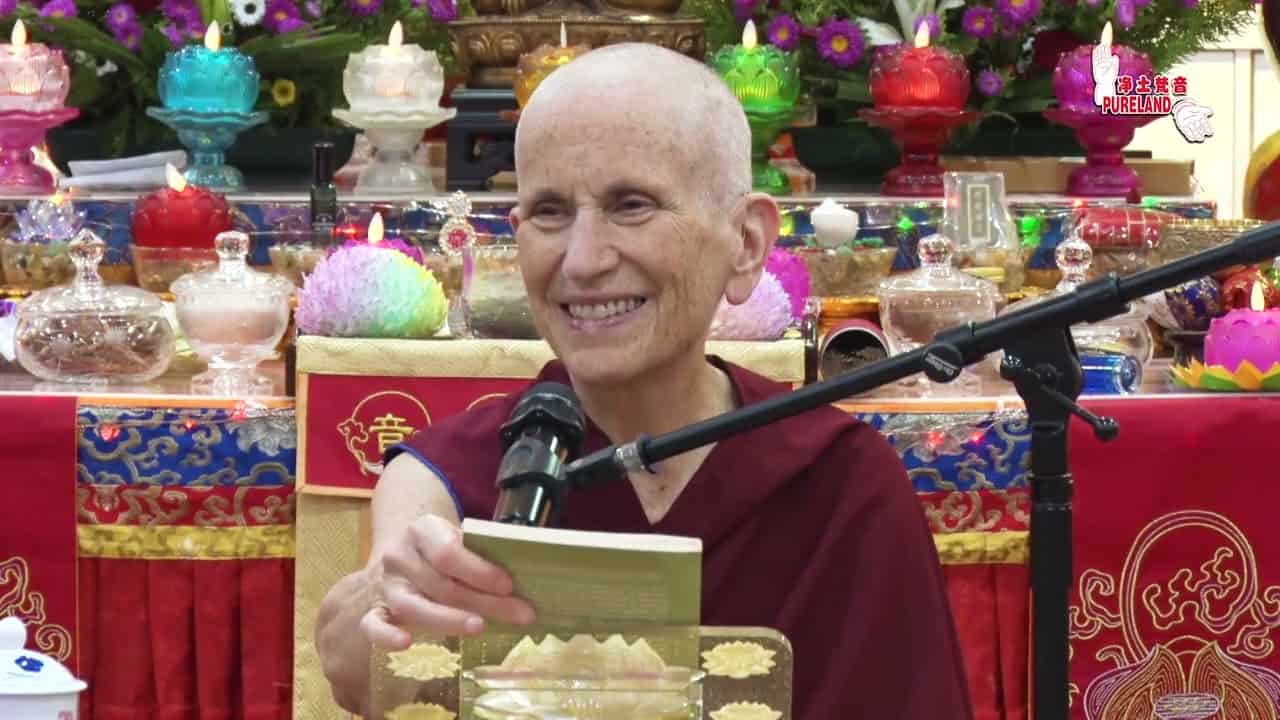
Venerable Jenkir from Luminary International Buddhist Institute in Taiwan gave this brief talk after the course Taking the Vinaya as Our Teacher at Sravasti Abbey in November, 2025.
Thank you everyone for giving me the honor of being here today. I’m truly very grateful for this opportunity to work with all of you for the program of Taking the Vinaya as our Teacher. And I’m also grateful for this opportunity to share a few reflections with you. My topic today is building trust, as Venerable Chodron requested.
The world faces division and uncertainty, whereas trust is the foundation of peaceful relationships. In a world filled with rapid change and uncertainty, many people distrust institutions, distrust relationships, and distrust themselves. Trust is one of the most precious qualities we can cultivate, both within ourselves and with others.
I believe trust grows from three simple but profound qualities. The first is consistency or honesty, the second is sincerity, and the third is integrity. When we do what we say, when our actions correspond to our words, trust begins to form. When our words come from a genuine, sincere heart, trust deepens. And when our actions are guided by ethical intention, trust becomes steady and strong. These qualities echo the Buddha’s teaching of right speech, right action, and a compassionate mind.
I would like to share how to build trust in the sangha from one story that my teacher taught me. I have never talked about this story in public before, even in my nunnery, although it shows how having a vast view helps to build trust.
When I attended Life as a Western nun in Bodhgaya, India in 1996, I was my teacher’s attendant. This was my first time going abroad. My teacher was in her 50s, and I was in my 30s. She was very quick, and I’m very slow. She packed luggage very quickly, while I didn’t. So she became my attendant to help me to pack the luggage. Even when I opened a door, I was so nervous because I was afraid of my teacher. I was afraid that I could not open the door. We shared one room in Bodhgaya, but I could not unlock and open it. My teacher would take the key to unlock the door.
We stayed in a small room, and people would come to the room because it also served as an interview room. After one interview, my teacher turned to me and said, “Jenkir, you farted too loudly.” I was so frustrated and nervous, everything was so stressful for me during that time. I think nobody knew when I was in that situation.
On one occasion, everyone was going to the Ganges River but my teacher wanted to stay, so I also stayed with her. I had already come to the point of feeling I was drowning in darkness. I needed to get out of that mental state; I could not be in that kind of situation anymore. So I stayed behind with my teacher, and I cried for a long time sitting beside her while she was pretending to sleep.
Later I asked her, “Did you hear me crying?” and she replied with kindness, “Yes, what happened?” I told her, “I feel that whatever I do seems to be wrong. Do you dislike me that much?” My teacher was so calm and replied, “You are here to learn how to benefit others and how to reduce your self-centeredness.”
The next day, we had breakfast together with Venerable Jendy and Venerable Jen Chin. My teacher told Venerable Jendy, “From now on, let Venerable Jenkir take on duties that entail speaking in English, such as ordering food.” After that, my teacher wanted me to be a guide for the ordination ceremony, and later I took on other duties.
I find the process of going from distrust to trust very interesting. When I have trust in my teacher, I would be grateful even if she had to teach me how to use the bathroom. But when I lack trust, I feel like she’s always picking on me.
My teacher also taught me that we need to believe that all our Dharma sisters and brothers are genuine practitioners. This is a simple sentence that had a very strong impact on me. I start to meet sangha members going in the direction of our common aspiration. Instead of judging them by the tone of their voice, how they speak, or their body language; instead of judging people based on whether they like me or dislike me, I started focusing on our common aspirations and aims. These are some ways that I start to build my trust in my teacher and in my Dharma sisters and brothers.
I also would like to tell you another story. When I was in India in 2008, I lived in Bir, Himachal Pradesh, to learn Tibetan so I could translate Tibetan texts. One of my friends from Germany came to visit me with a elderly Tibetan couple who were about 83 years old. They were so friendly and kind to host my friend at their home. I used my broken Tibetan to talk to the woman and say, “You have great compassion.” She replied, “No, no, my compassion is small.” I then said, “Your compassion is so great because you really helped my friend.” Her reply was, “Because we are practitioners, hosting someone in our home is just an opportunity for us to practice compassion.” So if I cannot treat everyone like this couple did for my friend, great compassion is missing.
That brings up the question, When we build trust, how can we also have the wisdom to not fall into attachment? Sometimes when we trust someone, we want to always to be with them. This guides us in the direction of attachment. To avoid this, let’s come back to the three qualities I mentioned at the beginning—honesty, sincerity, and integrity. Our thinking and acting with these three brings trust. When trust is present, peace naturally arises and people feel less afraid. Communication becomes clear, conflict softens, compassion has room to grow. When the mind is steady like this, our speech is truthful and our heart is kind and warm.
When we feel that our life is not warm enough, it might come from our lacking a warm heart. Trust blossoms like a lotus opening in calm water. To conclude, may all of us in the future believe that all the Dharma people around us are practitioners. Let us meet in the direction of our own common aspirations.
Let us do the dedication from Shantideva:
For as long as space endures
and as long sentient beings remain,
until then may I too remain
to dispel the misery of the world.
Thank you.