All about White Tara
01 White Tara Grief and Resilience Retreat (2024)
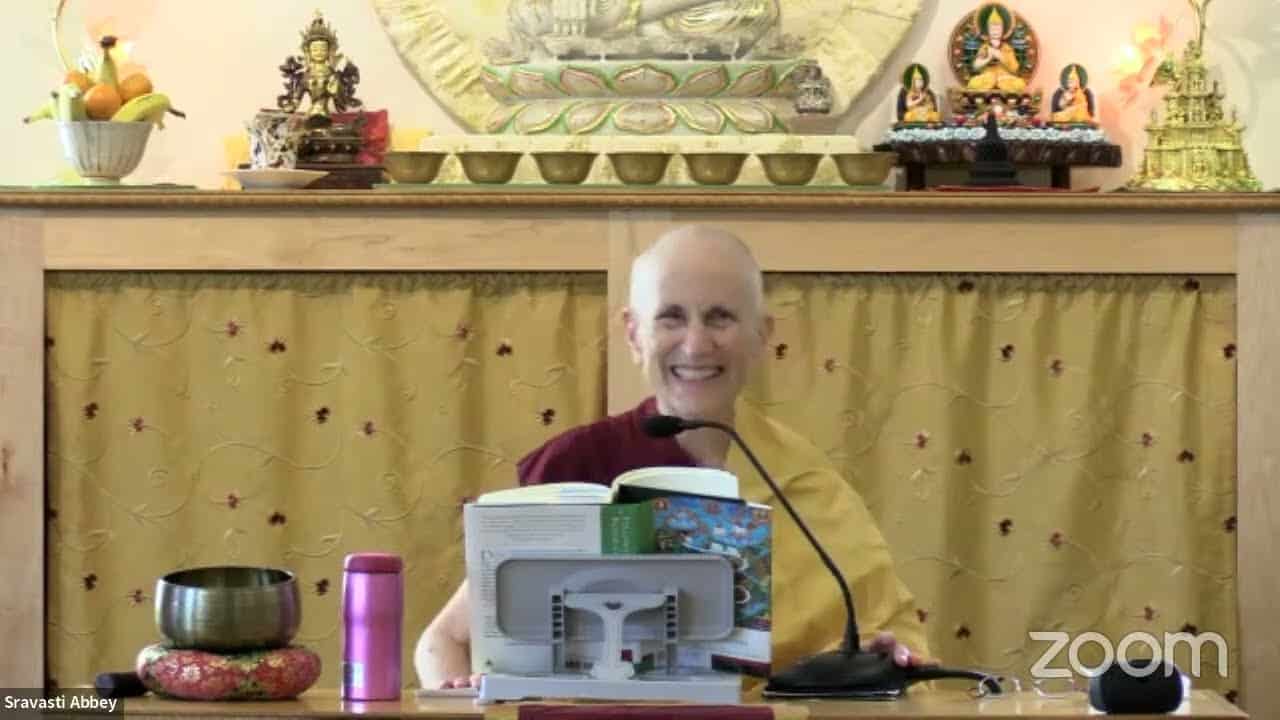
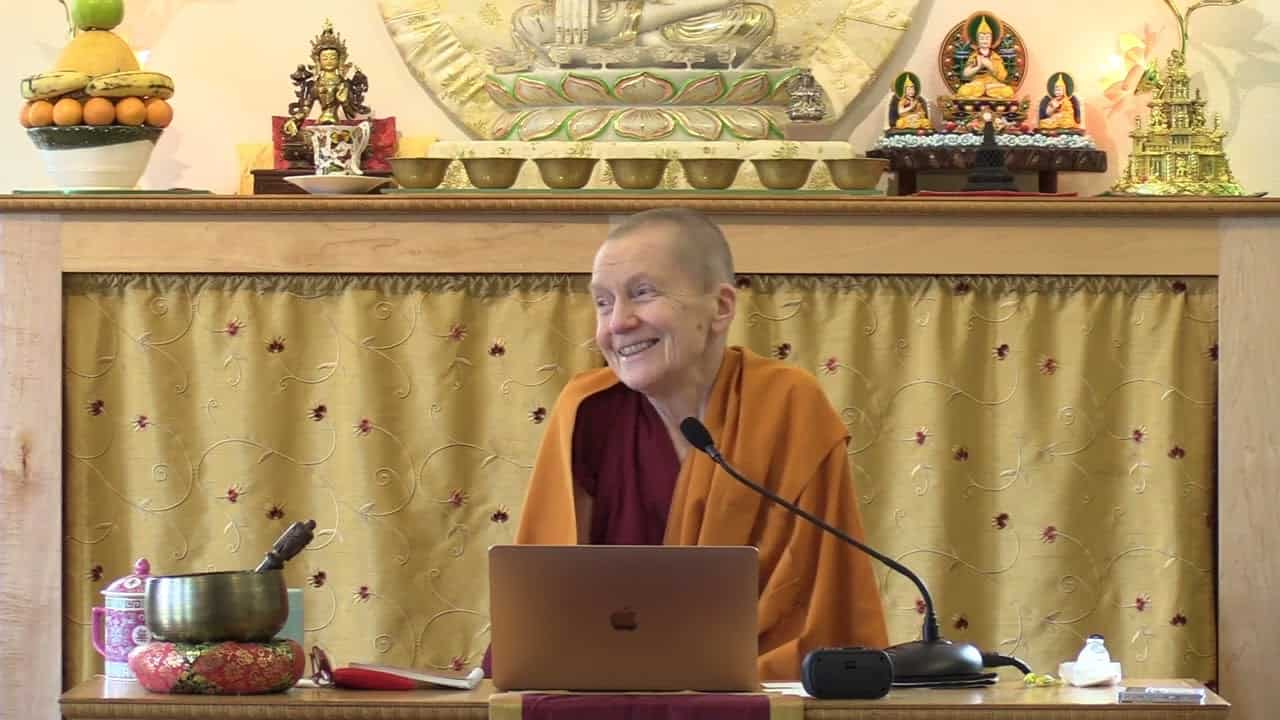
 Venerable Sangye Khadro
  White Tara Grief and Resilience Retreat 2024 with Venerable Sangye Khadro
  Jun 29, 2024
 Part of a series of teachings given during the White Tara weeklong retreat held at Sravasti Abbey in 2024.
- Background and purpose of retreat
- Awareness of death and working with grief
- White Tara as a long life practice
- Explanation of the White Tara sadhana
- Symbolism of Buddhist deities
- Refuge and the four immeasurables
- Visualisation of White Tara
- White Tara mantra
- Questions and answers
Let’s just take a few minutes to generate a positive intention. Let’s really try to feel how wonderful it would be if all living beings could have happiness and its causes and could be free of suffering and the causes of that. How wonderful it be if they could have pure joy free of any suffering, and if they could have equanimity: a state of mind that isn’t affected by attachment and aversion—liking some people, disliking others and so on. How wonderful if we could all have an equal concern and respect for everyone, for all beings. Try to feel how wonderful it would be for that to happen.
And it may sound unrealistic, undoable, but we can at least try to bring those values into our own mind, into our own lives. We can try to live that way ourselves. And in that way, we will be able to benefit others and influence others so that they can also be more like that. See if that makes sense to you, and if you can feel the aspiration to learn things during this retreat, that will bring that about. Just to give a little background to this retreat: last year, I think it was in October, we had a weekend retreat on this topic of grief. We called it “Good Grief.” And actually, that came about as a result of an earlier course we had, I think in the springtime last year, about death and dying called “Ppeaceful Living, Peaceful Dying.”
Background on the retreat
There were a number of women who came to that retreat with the expectation that they would hear about grief, because I think they had all lost their husband and were experiencing grief and they wanted to know about grief. And we weren’t aware that that was their expectation. Normally, we don’t talk about grief; we talk more about how to prepare ourselves for death and to help others who are dying. So then after we heard their feedback, we thought that maybe we should have a course on this topic of grief. We’ve never done it before. And there seems to be a need for it. And so we organized this retreat in October. And it was the first time for the Abbey to host this retreat, and it was also the first time for me to teach that topic. And it was meant to be a residential retreat, an on-site retreat.
But in September last year, we had a little COVID epidemic in the Abbey. I think 23 of us were sick with COVID at the same time. Only two people, Venerable Damcho and Tenzin, were healthy and running around doing all the cooking, doing all the work. It was quite an interesting time. But anyway, we all recovered. But in October, when we were supposed to have this grief course, some people were still testing positive for COVID, so we had to cancel the residential course. But we thought, “Let’s go ahead and do it anyway and have it online.” So, it was an online course rather than a residential course. And I think it went well. I think people really enjoyed it. But this kind of topic is so sensitive. It’s nice to do it in person rather than remotely. And also, it was only a weekend.
And that just seemed like a really short time to cover such a huge topic. So, we decided that this year we would have another course, make it residential and have more time to go into this topic. That’s why we are having this course on grief and also resilience. We are going to be looking at grief. What is grief? How can we work with grief? And then we’re also going to discuss resilience—how to develop our ability to recover from tragedies that happen to us. I think there is a lot of material in Buddhism that can help us to do that. And then we are also doing this practice of White Tara. I think every year during the July 4th holidays, there is a retreat related to one deity. Last year it was Chenrezig, Avalokiteshvara, the Buddha of Compassion. And this year we decided to have it on White Tara. It’s been a while, I think, since there was a White Tara retreat. And people really loved that practice. So, we decided to have another retreat on White Tara. That’s how we ended up having this retreat, combining White Tara with grief and resilience.
White Tara and grief
And there are some connections between them, because grief can occur due to various losses. But probably the main experience of grief that people have is over the loss of a loved one. Someone who is important to us dies. It could be a parent, a partner, a child, a teacher, a friend. When we hear about grief or think about grief, that’s probably usually what comes to mind. It’s related to death and dying. And in Buddhism, we are encouraged to be realistic about death—the fact that it’s going to happen to every single one of us and everyone we know. And, you know, the Buddha encouraged us to think about it, to be mindful of it, to accept it and be prepared for it. That’s the real reason or the purpose of contemplating death: to be prepared for it when it happens. And having that awareness and the sense of how we need to prepare for it enables us to live a better life, to live ethically, try to avoid harming others or doing other kinds of very destructive, harmful actions. Also, it helps with being as kind and compassionate as we can, helping others, doing spiritual practices.
The awareness of death, the mindfulness of death, motivates us, inspires us to live a good life and to practice meditation, to have a spiritual practice. And so, although Buddhism does encourage us to accept the inevitability of death, it doesn’t deny that death is painful. There is certainly awareness and acknowledgement that death is a painful experience both for the person going through it as well as the people left behind. It’s actually one of the examples of duhkha or suffering—what’s normally translated as suffering or unsatisfactoriness. It’s one of the examples of duhkha that Buddha spoke about, for example, in his first teaching—when he explained the Four Noble Truths. So, we meditate on these different types of suffering, these different unsatisfactory experiences in order to generate the determination to free ourselves from this situation in which we do go through these painful experiences and to attain the state of nirvana, peace, liberation, where we no longer have to go through suffering, painful experiences.
So, an awareness of death and the painful reality of death is actually something that motivates us in our spiritual practice to reach a state where we no longer have to go through that experience. Also, it’s normal, it’s typical, for Buddhist practitioners to make prayers—to sponsor pujas and so forth—for long life in order to increase their own life as well as to pray for the long lives of others, especially teachers and so on. There are practices related to long life. And this practice of White Tara is one such practice. It’s one of the most popular practices that is used to create the causes for long life for oneself or for others. And so, in one way, this practice of White Tara is like an antidote to grief because it can prolong the life of someone and at least for a while ensure that that person is there or that we live longer ourselves.
It sort of puts off the experience of grief for a while. But also, it’s helpful when it comes to untimely death. There are different ways that people die, and people can die at different stages of life. And it’s probably more painful when a person dies when they are still young. We kind of feel like “Man, that shouldn’t be happening; they haven’t had a chance to live yet.” Whereas if somebody is in their 80s or 90s or over 100, it’s still painful, but we kind of feel, “Well, they managed to have a long life.” It’s not too surprising that death happens at that time. An untimely death means one that seems to be happening before it should, like in the case of a young person—a child or a teenager, someone who is still young. There are practices that can clear away obstacles to life and enable someone to live longer, to hopefully live a full life.
And I thought of another connection between the White Tara practice and this topic of grief. When we do experience grief, it’s quite painful. And people often feel alone, partly because they’re experiencing pain that they can’t really share with anyone else. And even if they try to talk about it, other people don’t really understand. So, they feel sort of alone in their pain. And they may also feel abandoned, like the person who was there and really important to you is no longer there. And so that exacerbates the suffering that we’re going through and leads us to feeling alone and abandoned. And for those who have developed a spiritual connection—like in Buddhism, especially in Tibetan Buddhism—we do these practices related to different buddha figures, like White Tara, Green Tara, Chenrezig, Manjushri. There are many, many different buddha figures and different manifestations of the enlightened mind. We practice these and develop a kind of connection with them.
That may take some time, although some people feel a connection right away. As soon as they hear about a particular deity or see a photo of a particular deity, they just feel this connection, and they want to do that practice. But sometimes it takes a while to develop that sense of connection. But if you do have that sense of connection, then that can be a source of comfort when you’re going through a difficult situation. You might feel that “I’m not really alone,” that deity you can call on Buddha, Tara, Manjushri. “They are there, and I can call on them. I can bring them to mind, feel their presence, pray to them, talk to them and get help in that way.” In that sense, if somebody does have a connection with a deity like White Tara or Green Tara, then they can bring up that connection when going through a difficult experience. And that can be a source of solace to their suffering and their pain.
Mummy Tara
And Tara is often called Mother Tara. There’s this epithet of Mother Tara. Lama Yeshe used to say Mummy Tara. And the real meaning of that expression is that Tara represents wisdom, and wisdom is like the mother of all the buddhas and bodhisattvas. It’s through the wisdom understanding the true nature of things that beings attain these higher states and eventually enlightenment. So, we say Tara is the mother of all enlightened beings. But for us ordinary beings who are still struggling along the path, she’s also motherly towards us. In fact, she’s motherly towards all sentient beings, looking upon all living beings with compassion, with love, fully aware of the suffering that we’re going through, and ready to help us. She’s just totally dedicated to being there for us; she’s ready to help us when we call on her.
When we’re little kids and we’re hurt, unhappy, having a problem, we run to our mom, usually. That’s the person we go to, because she’s usually the one who’s most understanding and caring and compassionate and able to comfort us. So, it may not work for everybody, but for some people, just having that feeling of Mother Tara there as someone we can turn to for help when we’re in pain is helpful. During this retreat, we’ll be having sessions in which you do the practice of White Tara, so you can get more familiar with that. But we’ll also have talks on various aspects of grief, both from the Buddhist point of view but also bringing in some material from Western views of grief and how to work with it. And this is to help us learn how to manage this experience of grief better. I’m sure most people have already had at least some experiences of grief.
And even if you haven’t had them yet, you probably will. I don’t think anybody can go through life without this experience of grief. So, even if it hasn’t happened yet, it’s good to learn about it, so you can be more prepared for it when it does happen. And also, there are people we know who go through grief, so it’s also good to know about grief. That way, when a friend or family member is experiencing grief, we’ll be able to help them and do things and say things that will be helpful for them rather than make things worse for them. That can happen if we’re really unaware of what’s going on with grief. The things we do and things we say may just make the person suffer more. And we don’t want to do that.
Overview of the White Tara practice
I thought I would start this morning by talking about the practice of White Tara. You already had a chance to do it this morning. And you might have some questions about it. I’ll give an explanation about it, and I’ll try to answer any questions you may have. There isn’t actually a lot of information about White Tara. There’s a lot more about Green Tara. Green Tara is probably one of the most popular deities in Tibetan Buddhism. She’s really, really popular. I’m sure everybody knows Tara’s mantra and also the 21 praises to Tara, which is recited here every morning before breakfast. Also, Tara is the protector of the Abbey. In the Tibetan tradition, I think every monastery has a protector that is prayed to and called on for help when help is needed and so on. So, in the case of this monastery, Sravasti Abbey, Tara is our protector. So, there’s lots of images of Tara around.
And I’m talking about Green Tara. But there are also many different images of Tara and different forms of Tara. There’s Red Tara.There’s Blue Tara. There’s even Black Tara. There’s Yellow Tara. And there’s White Tara. So, there are different forms of Tara. But most of the information you find about Tara is about Green Tara. And when it comes to White Tara, I wasn’t able to find a whole lot of information. But we shouldn’t think that these different forms of Tara are totally different persons, like each of us is a different person, a different personality. Rather, all the different forms of Tara, as well as all the different deities in Tibetan Buddhism—which is really Vajrayana Buddhism, taught by the Buddha—came from the Buddha and the Indian tradition.
All the different deities that we practice are manifestations of the enlightened mind. The enlightened mind, Buddha’s mind, has the ability to manifest or appear in different forms. And they do this to communicate with sentient beings, because enlightened mind itself is invisible. We can’t see the Buddha’s mind. We can’t see an enlightened mind. And the whole purpose of somebody becoming enlightened, of attaining that state of enlightenment, is to be able to help sentient beings to get out of suffering—to be free of suffering and confusion and ignorance, and to eventually become enlightened as well. To be able to communicate with sentient beings who are suffering and confused, the enlightened mind will manifest in different forms. And the reason there are different forms rather than just one is because people are different, right? People have different personalities, different likes and dislikes.
Just look at all the different kinds of foods that we eat: some people like spicy, hot chili while other people can’t stand that. Other people like sweet, mild food. There are so many different kinds of foods for different kinds of people—and different ways of dressing, and different ways of talking. We’re all different. We’re not all the same. We have different personalities, different dispositions, different likes and dislikes. And Buddha knows that and is able to teach in different ways to different people in ways that can benefit them. That’s the reason why there are these different forms of the enlightened mind. But it’s important to understand that they’re all basically the same.
They have the same qualities, the same realizations, the same abilities. They’re just the outer form—the outer aspect is different, but the inner state is all the same. So, ideally, it’s better that we don’t have a discriminating mind and say, “I like green Tara, but I don’t like White Tara.” We can just say, “I just feel more connected with Green Tara and find that practice helps me. I don’t feel so connected with White Tara, but I can see that it’s beneficial for other people.” Ut’s good to have a respectful attitude towards all the different buddha figures, even the ones that look kind of strange or even scary. It’s important to understand that the Buddha manifested that form to help certain people, certain beings. And so, there’s a reason for that.
One place where there’s some information about White Tara is this book called Images of Enlightenment by John Lando and Andy Weber. It explains many of the different deities you find in Tibetan Buddhism. It starts with a description: White Tara is seated cross-legged on a lotus and moon seat and holds her hands in the same pose as Green Tara. The right hand is in the mudra of giving—giving protection or giving whatever is needed. It’s a giving mudra. And then the left hand is in front of her heart, and it’s said that the ring finger and the thumb touching symbolizes method and wisdom. These are the two main attitudes or practices we need to develop on our way to enlightenment. Method refers to compassion, helping others, and wisdom refers to understanding the true nature of things.
So, having those two fingers touching, symbolizing method and wisdom, means we need both of those. They need to be combined and unified in our mind as we are following the path to enlightenment. And the other three fingers are pointing upwards, and they symbolize the three jewels of refuge: Buddha, Dharma and Sangha. She’s kind of similar to Green Tara except that Green Tara has her right leg extended a little bit, whereas White Tara is seated in the full lotus position—both legs are up on the thighs of the opposite leg. And then her special attributes are her seven eyes. She has seven eyes: the usual two, a third one in the middle of her brow, and then eyes on the palms of her hands and the soles of her feet. So, that’s seven eyes all together.
And like those of the eleven-faced Avalokiteshvara, these eyes allow her to look upon beings in every realm of existence with clear-sighted wisdom and heartfelt compassion. Avalokiteshvara is one of the most popular deities in Tibetan Buddhism. And the Dalai Lama is said to be a manifestation of Avalokiteshvara. There are different forms of Avalokiteshvara, but this one has eleven faces, a thousand arms and a thousand eyes because each hand has an eye in the palm of it. And then Tara has seven eyes. So, just like with Avalokiteshvara, the reason for having all these eyes is to be able to see all the sentient beings throughout the universe and understand what’s going on with them—their difficulties, their problems, their suffering—and to have compassion to benefit them and wisdom, knowing what is the best way to benefit them.
And White Tara is specifically associated with practices designed to lengthen one’s lifespan and overcome life-threatening hindrances. In one such practice, she is referred to as Yi Shin Kor Lo, the wish-granting wheel, and the practitioner strives to identify him or herself with this deity and thereby purify all obstacles to longevity. There are different practices related to White Tara. The one that you are doing in the retreat is a relatively short and simple practice. And there are other longer, more complicated practices that I think some people have done in previous retreats here. Usually, you need to receive an empowerment to do those practices, and you actually identify yourself as White Tara after meditating on emptiness, generating the right state of mind. And that’s really the practice that is done to increase your lifespan, if you have life-obstacles.
One time, maybe 15 or so years ago, I got a letter or email from my teacher out of the blue saying there were obstacles to my life. And then there was a list of practices to do to clear away these obstacles. And one of the practices was a White Tara retreat with a certain number of mantras—I don’t remember how many—and also making tsa-tsa: these little images, usually made of clay or plaster or some kind of material in a mold. So, I was encouraged to make tsa-tsas of White Tara. I was very happy to have a chance to do those practices and clear away obstacles. And I am still alive after 20 years, so it shows that it works.
Doing White Tara practice for our teachers
I’ll just read one verse from a text by the first Dalai Lama, Gendun Drupa; it’s an expression of praise to White Tara in this form of the wish-fulfilling wheel.
I prostrate to you with a wheel, the beautiful, liberating Mother Arya Tara, whose wish-fulfilling wheel increases life. Through this request to you, Goddess, please protect me with your power from all the obstacles to my life, as well as from sickness and suffering, and bestow upon me all the common and supreme attainments without exception.
The reason it talks about a wheel is because when you do that particular practice, you visualize this eight-spoked wheel at your heart with lots of different Sanskrit letters or Tibetan letters or whatever, and you recite the mantra . And then there are other visualizations as well. It’s a little complicated but a very beautiful practice. You can do this practice on your own behalf to clear away obstacles and lengthen your life span, but you can also do it on behalf of others. And it’s very common in our tradition to do it on behalf of teachers, especially because it’s so precious to have them in the world. We want them to stay in the world as long as possible because they’re doing so much good for ourselves and for others. Their presence in this world is very valuable, very precious, and we want them to be here with us.
So, it’s quite common to do the practice of White Tara on behalf of spiritual teachers, and also to offer statues of White Tara, thangkas of White Tara, and so on. Venerable Chodron said that it would be good if we dedicate this retreat—the practice of White Tara that we’re doing this week—to the recovery of His Holiness the Dalai Lama. His Holiness just a few days ago came to America. He’s in New York, I believe. And it’s for medical reasons. He had a knee replacement; he’s been having difficulty with the knees for a number of years now. So, we can think of His Holiness and dedicate the merit, the positive energy we’re creating, to his quick recovery and his long life. He has said a number of times over the last few years that he expects to live past a hundred—even a hundred and ten, a hundred and twenty. The age varies, but I think it makes everybody feel quite happy to know that he’s not going to disappear anytime soon.
But still, we shouldn’t just be complacent about that. It’s good for us to create merit, to create the causes for him to live long and dedicate to that. That’s something we can do. And in fact, we do that every day here at the Abbey in the evening. There’s a short one-verse prayer for the Dalai Lama to dedicate all the merit we’re creating to his long life—and to other teachers as well. Everybody has a connection with different teachers and Venerable Chodron, of course, and other teachers that we have met and learned from. I think we value those teachers. We want them to remain with us as long as possible, to continue to teach us and guide us, and to be a good role model for us. So, you can think of all the other teachers who have inspired you and dedicate the practice for them.
The purpose of a long life
There’s something else I’d like to read from this book. You may wonder, “Well, why should I want to live long?” Sometimes we may wonder about that. From the point of view of the Buddhist teachings, the main purpose for wishing to have a long life is to enable one to progress further along the path to spiritual fulfillment.
As the great Tibetan Lama Marpa the translator said, ‘If the only thing people are doing with their lives is giving harm to others and creating negative karma for themselves, then it would be better if they died sooner rather than later.’
That sounds pretty awful. It’s not that we wish people to die. But when you think about a terrorist or somebody who’s creating a lot of suffering, creating a lot of bad karma, would you want them to live a long life in which they continue to do those? Of course, if they change, that’s different. People do sometimes change partway through their lives. They can totally reverse what they were doing before. But if they just continue repeatedly doing harmful things then it’s better if they don’t live long. On the other hand, the situation for those bringing benefit to themselves and others is, of course, just the opposite.
If we are trying to do good for ourselves—like developing our spiritual potential and doing good for others, helping others have more happiness and peace and be free of suffering—then it’s good to live long. Especially in the case of spiritual guides and teachers, the longer they remain alive, the more they are able to lead others along the path to enlightenment. For this reason, disciples in the Tibetan tradition often present their lama with a painting of White Tara or one of the other long-life deities. There are actually two other long-life deities. One is Amitayus, who is male, red in color. And another is called Ushnishavijaya, who is also female, with multiple arms; her image is a little more complicated.
But I think White Tara is probably the most popular; at least that’s what I’ve seen in my experience. She’s the most well-known of the long-life deities. Sometimes disciples will have a painting made of all three long-life deities and then offer that to their teachers together with the request that these spiritual mentors have an uninterrupted lifespan and continue to turn the wheel of Dharma for the sake of all unenlightened beings. These are just some of the practices found in the Tibetan tradition related to White Tara.
Who is Tara?
Venerable Chodron has a book called How to Free Your Mind: The Practice of Tara the Liberator. This is a book about Green Tara and the Twenty-One Taras. In that book she talks about the different manifestations of Tara. She says:
One way to understand Tara is as a manifestation or embodiment of enlightened qualities. Anyone who has attained Buddhahood can appear in the form of any of the deities.
So, there isn’t just one Green Tara or one Thousand-Armed Avalokiteshvara or one Manjushri or one Vajrapani. These are simply appearances, emanations. It means anyone who has attained enlightenment, anyone who is a Buddha, who has that mind of a Buddha, can appear in these different forms. You can have multiple Taras and Chenrezigs and so on all over the universe working for sentient beings. A Buddha’s mind is beyond our present limited perceptual or conceptual abilities. We can’t see a buddha or even really understand a buddha, and a buddha’s experience is beyond our abilities.
All enlightened beings practice for eons to purify their minds and enhance their capabilities in order to benefit us. But they need a way to communicate with us to lead us on the path out of suffering to full enlightenment. Since we are embodied beings who relate to color, shape and other objects of the senses, the compassionate Buddhas appear in various forms in order to communicate with us. Tara, like other meditation deities, is one of those forms. Each deity is a manifestation of the same enlightened qualities—love, compassion, joy, equanimity, generosity, ethical discipline, patience, enthusiasm, concentration, wisdom and so forth—although each manifestation may emphasize a particular quality.
So, we sometimes say, for example, that Avalokiteshvara is the Buddha of compassion and Manjushri is the Buddha of wisdom. But that doesn’t mean Manjushri doesn’t have compassion and Avalokiteshvara doesn’t have wisdom. We shouldn’t think like that. They all have the same qualities. They are all equally enlightened, equally perfected in all good qualities. But the form they take is to emphasize different qualities and help disciples cultivate those qualities in themselves. For example, Tara symbolizes enlightened activity while Avalokiteshvara embodies compassion. Among the diverse forms of Tara, Green Tara, who is described in that book, eliminates obstacles and brings success. White Tara counteracts illness and bestows long life.
In Mahayana Buddhism, the form of Buddhism we practice here, the Tibetan form of Buddhism, our long-term goal is becoming enlightened, becoming a buddha, so that we can benefit all living beings. And that’s not easy, and it’s not something we can do quickly. We need a lot of time to be able to create all the causes for enlightenment, all the different realizations in our mind and so on. And having a precious human life is the most ideal situation in order to engage in those practices for attaining enlightenment. There is a whole meditation—I’m sure most of you are familiar with it—on recognizing that we do have this precious human life and what is the best way to make use of it so that we don’t waste our time and we don’t just take it for granted. We really want to make use of this precious life that we have. And the best way to do that is engage in spiritual practice, Dharma practice. That’s the real reason for wanting to have a long life. It’s not just to have a good time, have more adventures, more pleasures and so on, but so that we have more time and energy to engage in practices that will bring us closer to enlightenment.
Refuge and bodhicitta
There are different ways of doing the White Tara practice—different practices. And the one here in the Red Prayer Book is relatively short and simple. I thought I would just go through it and give a little explanation of it and see if you have any questions about it. It starts with taking refuge and generating bodhicitta. Most of our practices start with that, and when we have teachings we also start by reciting that prayer. It combines two very important practices. Taking refuge is the attitude that we have. For those of us who weren’t born into Buddhist families—most of us, I think—we don’t meet Buddhism until partway through our life. And so we need to first learn what Buddhism is all about: who the Buddha is, what kind of qualities he has, and so on. It’s good to spend some time learning about Buddhism and then deciding for yourself if this is something you want to pursue, something you want to learn more about, engage in and practice, make a part of your life.
I think I took refuge a couple of months after I started learning Buddhism. I really jumped in. But it is good to take your time and really know what you are doing. I think sometimes taking refuge is a little bit like getting married. So, it is ideal to get to know the person before you jump into making such a commitment. But still, it can work out even if you jump into it. For myself, I jumped in really fast but I am still here. But it is best to do it in an informed way so that you really know what you are doing, you really understand the Buddhist path and what you are getting yourself into. Probably many of you have taken refuge. And if you haven’t yet, then it is something you might do later on.
Basically, refuge is based on understanding the Buddha, his qualities and what he did, the Dharma, his teachings, and the Sangha, those who are following those teachings, those who are on the path at different stages of the path. Then understanding their good qualities and seeing their value, we say, “Yeah, this is something I want to rely on. These three jewels are objects that can benefit me.” And then you make the decision or commitment that you will take up this practice and follow the Buddha, Dharma, and Sangha. I like to think of it as just taking them as my guides for the way that I live my life, the way that I practice, the way that I work with my mind and so on—taking my guidance from them.
And it says, “I take refuge until I have awakened.” This is the Mahayana view or attitude—that we take refuge with the goal of attaining awakening or enlightenment ourselves, wanting to become a Buddha ourselves. So, we will continue to rely on the Buddha, Dharma, and Sangha until we ourselves have reached that state of awakening. And that’s refuge. And then bodhichitta is that very attitude of wanting to become a Buddha, wanting to become fully enlightened for the benefit of all living beings. There’s a whole lot about that. We’ll not go into it now. But there are methods and meditations for cultivating that state of mind. And you do those meditations again and again and again, making your mind more and more familiar with love and compassion, the wish to benefit others. And eventually, at some point, this natural spontaneous wish or aspiration to become a Buddha to benefit others will arise. And that’s the real meaning of bodhichitta.
Bodhicitta is when that aspiration arises spontaneously, effortlessly, in your mind. But in the meantime, before we reach that point, we generate it in a contrived way—we work ourselves into that state of mind. So it says, “By the merit I create by engaging in generosity and the other far-reaching practices, may I attain Buddhahood in order to benefit all sentient beings.” We decided a few years ago to change this. Instead of, “May I attain Buddhahood,” we changed it to, “I will attain Buddhahood.” It sounds a little stronger, a little more committed.
So, that’s the expression of bodhichitta: “I will become a Buddha in order to benefit all sentient beings.” And we understand that becoming a Buddha isn’t just a question of wishing; you don’t get there by just wishing for it to happen. But you have to create the causes. And the main causes are what are called the six far-reaching practices or six paramitas—the six perfections. There are different ways of translating that. They are: giving or generosity, ethics—living ethically—patience or fortitude, joyous effort, concentration and wisdom. Those are the main practices one learns and engages in to create the causes to become a Buddha. So, this prayer is basically saying, “I take refuge in Buddha, Dharma and Sangha, and I will do whatever needs to be done to bring about my own attainment of Buddhahood, awakening, to benefit all sentient beings.”
Again, if you don’t really understand that or don’t feel ready to commit yourself to that, you don’t have to recite this prayer even if everyone else is doing it. You can just remain silent and do your own contemplation that you can relate to if it’s comfortable for you. And then the next prayer is the prayer of the four immeasurables.
The four immeasurables
These are four attitudes, four states of mind, that are found in all Buddhist traditions. And they are practices that all Buddhists work on cultivating. And the first is love or loving kindness, which is wishing all sentient beings to have happiness and the causes of happiness. The main cause of happiness is virtue—being virtuous, creating virtue. So, we want sentient beings to create virtue rather than non virtue so that they will be able to experience happiness. And the second is compassion: “May all sentient beings be free of suffering and its causes.” And the main cause of suffering is non virtue, like killing and stealing and engaging in hatred and different kinds of hateful or greedy, selfish behavior. We want sentient beings to be free of all of those.
And then: “May all sentient beings not be separated from sorrowless bliss.” Sorrowless bliss can refer to happiness in the future. We want them in their future lives to be born in good situations, not unfortunate ones, and to eventually attain freedom from all suffering—to attain liberation, enlightenment. We’re wishing higher forms of happiness for sentient beings. And then the last is equanimity, which is a state of mind that’s free of the two attitudes of attachment and aversion: liking some and disliking others. We can see so many examples in the world today of how attachment and hostility—having bias, discrimination, divisive attitudes—lead to so much suffering for oneself and for others. And so, we’re wishing that sentient beings could be free of those attitudes and have equal concern, equal respect, for everyone rather than being biased and discriminating.
Visualization in the White Tara practice
These are practices to set our mind in the right state for engaging in the actual practice of White Tara. And it doesn’t mention any visualization at this point when you are reciting refuge and bodhicitta. Some of you might be familiar with the refuge visualization, like we did last winter during the Retreat from Afar. Some of you may have participated in the main practice where there was refuge, and so you would have learned the visualization for taking refuge. If you are familiar with that, you can do that. Or a simple refuge visualization is visualizing the Buddha. You can imagine the Buddha in front of you and think that the Buddha embodies all the objects of refuge—all the three jewels—and then take refuge in that way.
Then the next is this is kind of the main part of the practice: the visualization of White Tara and reciting the mantra. It describes the visualization of White Tara as being in the space above your head. I won’t go through that whole thing, but it just describes what Tara looks like. And when you visualize a deity above your head, it’s similar with Vajrasattva. There’s a practice we do of Vajrasattva which is also visualized above the head. You shouldn’t imagine it right on top of your head, like sitting on top of your head but with a few inches space between the top of your head and the lotus which is the seat for the deity.
And when it comes to visualization, I know a lot of people have difficulty. I have difficulty even after all these years. So, don’t feel bad if it’s difficult. But it does get better with time. If you just keep working at it, keep practicing it, then gradually it gets better. And I always tell people not to worry if you are not able to have a perfectly clear, complete visualization. Sometimes we expect that of ourselves and then get frustrated if it doesn’t happen. Just do the best you can and try to feel the presence of the deity—try to feel the deity is there even if you are not able to visualize perfectly and clearly. The most important thing is to feel White Tara really is there even if I can’t see her.
And with more practice eventually you will start to see her more. And the whole visualization should be made of light. I know sometimes people have difficulty with that. But I think it’s helpful if you think of a rainbow. We’ve all seen rainbows in the sky. And sometimes they are really bright and almost solid; it almost looks like something solid there, but we know it’s not. It’s just an appearance. And if we try to go there and touch it, we won’t actually be able to. But it can still appear very bright. So, you could think of a rainbow that you’ve seen and think that the image you are visualizing there above your head is similar to that. It appears, and it’s very bright, but it’s not solid, like our bodies and other material things that we contact. And so again, that probably takes time to get that sense of her appearing and made of light—bright, radiant—and not solid.
And for myself, when I do visualizations, I really like to imagine the facial expression as being very loving. You can use your own mind to make the face the way you like. But that’s what I like. I like to see a smiling, sweet, peaceful face. And it says here that she looks at you and all sentient beings with complete acceptance and compassion. I try to imagine that expression. And again, if it’s difficult to visualize, don’t worry about that. But try to feel, “Oh, up there above my head is this Tara. And she has love and compassion for me and every other living being in the universe, not the slightest anger. There is no anger; there is no criticalness, no judgmentalness, no negative feelings at all—just pure, unconditional love and compassion, accepting us as we are. She can see all our messiness, all our afflictions, all our problems, all our mistakes. She doesn’t judge us. There’s no judgmentalness at all, just complete acceptance as we are.” I think it’s very helpful to contemplate that and try to feel that this is the attitude Tara has towards us and every other living being.
Then it describes that at her heart is a moon-disk, horizontal. This is like a flat disk made of light that represents the moon. And in the center is the white syllable TAM. The seed syllable TAM represents her enlightened qualities, her enlightened realizations. So again, don’t worry if you can’t actually visualize it. Just think that that’s there at her heart. And light radiates from the TAM. And you can imagine it going all throughout the universe. And then it brings back all the life force that has been scattered or lost. And that dissolves into the TAM in the form of light. I have to admit, I don’t really understand the meaning of this—what life force is and how it can get scattered or lost. But apparently that’s something that can happen. We have a certain amount of karma. They say our lifespan, how long we live, is mainly due to our karma we created in past lives.
We created the karma to be in this life, to have this life, this body. And part of that karma also includes how long we have to live. So, we have a certain amount of karmic energy to live a certain amount of time. And we don’t know how long that is. But it is mainly the result of our karma. I think life force means that energy we have to remain alive to continue living. Somehow, that can get scattered or lost. So, we imagine the light going out from the TAM and bringing back that life force, that life energy that may have been scattered and lost. And it comes back and absorbs into the TAM, the seed syllable at Tara’s heart in the form of light. And then a second time, light rays go out from the TAM, and they hook back the power and inspiration of all the buddhas, bodhisattvas, and those who have attained the realization of long life.
That might be if you can accept that there are buddhas and bodhisattvas. Buddhas are those who have already attained enlightenment. The bodhisattvas are those who are on the way to enlightenment, who are bound and determined to get to enlightenment. And they are at different levels, different stages, of that. And so those are beings who have incredible love and compassion and dedication to helping all living beings and a huge amount of positive energy, merit. So, we imagine that energy from the Buddhas and Bodhisattvas again coming back and absorbing into the TAM. And then the essence of the four elements of earth, water, fire, and air, as well as the space element, absorb into the TAM in the form of five-colored nectar light, white, yellow, red, green, and blue.
In the Buddhist tradition—and it is similar in other Asian traditions—there is this explanation of elements. And the four elements earth, water, fire, and wind are said to be what composes all physical matter. Everything that is physical or material, including our bodies and all the material things in the world around us, are composed of these four elements. And the earth element doesn’t mean dirt, and the water element doesn’t mean water, but rather, they are more like properties of all material things. I’ve always had difficulty understanding this, but I’m trying to understand it. The earth element is the property of solidity, hardness. Wood is a good example of the earth element; it contains a lot of earth element. And in our body, our teeth and bones are good examples of the earth element; they are very hard and solid.
The water element is the property of cohesion, of things sticking together. We also have a lot of water element in our body—a lot of liquids, blood and mucus and phlegm and all the cells. The cells in our body contain quite a bit of liquid. And also, in the external world, there are all the different bodies of water, but even more solid things do contain a certain amount of water.And then the fire element is the property of heat. In our body, we have a lot of heat. The normal temperature of our body is ninety-eight point six, which is pretty warm, right? That heat in our body enables us to stay warm, and it also enables digestion. Digestion is related to the fire element. There is also a fire element in the world around us—of course, the sun. But again, everything does have a certain amount of heat in it, even if it is just a little bit.
And then the air element is the property of expansion and movement. In our body, the most obvious example of the air element is breathing. But also, there is a lot of movement going on in our body. Just being able to move our body—our limbs and our mouth and our eyes and so on—is due to the air element. But also, within our body, the movement of all the different parts—like cells going from one part to the other, blood going from one part to the other—is due to the air element. It allows movement. So, our body is made of these four elements, and also all the material things in the world around us are made of these four elements.
And the space element, sometimes that’s added. The space element isn’t something solid, but it’s just the space, empty space. We have a lot space in this room; we also have space in our body, like in our stomach, especially when we haven’t eaten for a while, in our mouth. And so again, we find space, the absence of anything solid. And it’s said that the power of our internal elements can get deteriorated. And this can affect our lifespan. If the power of our internal four elements is deteriorated, then that can decrease our lifespan. And so, in this visualization we are collecting the essence of the external four elements, the four elements outside of us, and having it come into us.
First it goes into the TAM in Tara’s heart, above our head, and then later we’ll visualize it coming into us and filling us and re-energizing our own four elements, restoring any of those that have deteriorated. And this will in turn affect our life and enable us to live longer. There’s also a connection, I think, with disease. They say that when the four elements are in balance then we’re healthy. But if they get out of balance, if something goes wrong with the four elements in our body, then this is how we get sick or why we get sick. So, that’s what’s going on there with that visualization.
And then the five colors are related to the four elements. Let’s see if I can remember what is what. I think yellow is the earth element; red is the fire element; green is the air element; white is the water element; and then blue is the space element. These five colors are related to the five elements. Then after all that absorbs into the TAM at Tara’s heart, we imagine light and nectar flowing into us, filling our bodies and dispelling all negative karma, disturbing attitudes, negative emotions, disease, interferences and dangers of untimely death. You can imagine whatever negative stuff there is in your body and also in your mind—like afflictive emotions—get flushed out of your body. It’s very similar to Vajrasattva practice for those who are familiar with that. You imagine them going out in the form of dirty liquid and your body becoming pure and clear like crystal. Your mind, too, becomes clear and blissful. So again, just try your best to do this visualization and don’t worry if it doesn’t work. You do this visualization while reciting the mantra.
The meaning of the mantra
People always like to know what they are saying, but when they translated Buddhist texts into Tibetan they didn’t translate mantras. Mantras are always in Sanskrit. I don’t know Sanskrit; I am not a Sanskrit scholar. But there are explanations of meanings of the different syllables. Mantras usually start with Om. And om doesn’t really have a meaning, but it symbolizes the body, speech and mind of the enlightened beings, like Tara. You can think om represents Tara’s body, speech and mind which we aspire to attain. We want to be like her. We want to have that kind of body, speech and mind. Tara means liberate. It’s Dolma in Tibetan.
And we have three different liberations here. The first, tara, is liberating from obstacles to the initial level of the path. In the lamrim, the initial level of the path refers to the kind of practices we do first, which are mainly taking refuge and then learning about karma and doing the best we can to live according to karma, avoiding bad karma, creating good karma. Those are kind of the first steps we take on the path.
And then tuttare liberates from obstacles to the middle level of the path. And the middle level of the path basically involves just thinking about this situation that we are in, which we call Samsara or cyclic existence. It’s the situation where we aren’t enlightened; our mind still has afflictions, and we are still having to experience death and rebirth and different kinds of suffering. It’s a very unsatisfactory situation. So, we think about that and generate a strong determination to free ourselves from it and attain what we call liberation or nirvana.
And then the third, ture, is another form of tara, and this refers to liberating from obstacles to the great level of the path. The great level of the path is the Bodhisattva’s path: the path of developing bodhicitta, aspiring to help all sentient beings and becoming enlightened to help all sentient beings. Those three levels of tara are related to the three levels of the path, the lamrim, that we want to attain.
And then mama means my or mine. Ayur means long life. Punye is merit, living ethically. And then here it says jnana—sometimes it’s pronounced jyana or jnana—and this refers to transcendental wisdom. And then the next syllable is pushtim. They used Tibetan letters to translate from Sanskrit into Tibetan, so it gets a little complicated. I don’t fully understand, but some letters get turned around backwards. There is a sha that gets turned around. And some pronounce it sha, but some don’t pronounce it at all. So, when you hear the mantra recited, sometimes they say pushtim and sometimes they just say putim.
There was this one recording that we found of some monks and they were just saying putim. So, there are different versions, different ways of pronouncing that. And the meaning of that term is increase. And then I couldn’t find a translation for what kuru means, but maybe it means please. It’s also in the Vajrasattva mantra; there is a kuru in there. And that kind of makes sense because we are asking Tara to increase our long life, merit and transcendental wisdom. And it just makes sense that we say please, like we are taught as children. You don’t just ask for things. So, we request her to “Please increase.” But I am not sure. And then soha, the last syllable, that is usually found at the end of mantras as well. And that means “May the meaning of the mantra take root in my mind.”
We are asking for Tara’s help to increase our lifespan, our merit, our wisdom, so that we can accomplish all the stages of the path and become a fully enlightened Buddha for the benefit of all living beings. That is basically what it means. And if you are doing this practice on behalf of somebody else rather than yourself, then instead of mama, which means mine, you would put the name of the person, like Joe or your lama’s name. You would insert their name and then recite the mantra. In the book about Tara by Venerable Chodron, it says:
A mantra is a set of Sanskrit syllables uttered by a buddha when in deep meditative equipoise on the nature of reality.
In other words, mantras aren’t just invented by people, but they come from the mind of a buddha, a fully enlightened being in their deep wisdom. So, I like to think of a mantra as an expression of the enlightened mind in the form of these syllables. We recite a mantra in order to calm our energies, to concentrate our mind, and to approach a state of meditative equipoise so as to help our own mind transform, to become more pure and more concentrated. In this practice, we recite the mantra of White Tara twenty-one times. Then we receite the other mantra, which is the regular mantra of Green Tara: Om Tare Tuttare Ture Soha.
It doesn’t have those additional syllables in the middle. And we spend more time reciting that mantra. And at the end of the mantra recitation, we think and feel liberated from all negative karma, afflictions, and so on and so forth, and we generate the wish to use our life in a meaningful way to transform our mind, to develop these positive qualities, and to benefit others.
And when Tibetans do practices together, I don’t think they usually have these kind of fancy tunes that some use for reciting mantras. They don’t usually sing; they just kind of chant it in a monotone. But whatever chant you have would be fine. What they usually do is chant the mantra together out loud a few times, and then they go silent and let people continue chanting on their own more quickly and silently. That’s how it should be done. So, whatever tune you use is fine. There are all these YouTube videos of mantras being chanted—often with very melodious music in the background and so on. It’s very beautiful. But in a retreat situation like this, I think it’s better to keep it kind of simple and unadorned. But when you go home, you can look those up and maybe have them playing. It’s quite nice to have then in the background as you are doing your work and so on—to have these mantras playing just to help keep your mind in the practice.

Venerable Sangye Khadro
California-born, Venerable Sangye Khadro ordained as a Buddhist nun at Kopan Monastery in 1974 and is a longtime friend and colleague of Abbey founder Venerable Thubten Chodron. She took bhikshuni (full) ordination in 1988. While studying at Nalanda Monastery in France in the 1980s, she helped to start the Dorje Pamo Nunnery, along with Venerable Chodron. Venerable Sangye Khadro has studied with many Buddhist masters including Lama Zopa Rinpoche, Lama Yeshe, His Holiness the Dalai Lama, Geshe Ngawang Dhargyey, and Khensur Jampa Tegchok. At her teachers’ request, she began teaching in 1980 and has since taught in countries around the world, occasionally taking time off for personal retreats. She served as resident teacher in Buddha House, Australia, Amitabha Buddhist Centre in Singapore, and the FPMT centre in Denmark. From 2008-2015, she followed the Masters Program at the Lama Tsong Khapa Institute in Italy. Venerable has authored a number books found here, including the best-selling How to Meditate. She has taught at Sravasti Abbey since 2017 and is now a full-time resident.