Identifying afflicted ignorance
100 Middle-Length Lamrim
 Venerable Sangye Khadro
  Stages of the Path
  Feb 19, 2026
 Part of a series of weekly teachings on Lama Tsongkhapa's Middle-Length Treatise on the Stages of the Path to Enlightenment.
Refer to the slides for the teaching.
- Reflection on wisdom as the key to freedom from suffering
- Uncontrived renunciation, the entry to the path of accumulation for the fundamental vehicle
- Does a bodhisattva need uncontrived renunciation before entry to the path of accumulation?
- Two Mādhayamika views
- Identifying afflicted ignorance
- Ignorance is the basis of all faults
- The superimposition of a self of persons and a self of phenomena
- The conceived object of ignorance is called self or inherent existence
- Two kinds of objects of negation
- The view of the transitory collection and it’s two divisions
- Differing views of the observed object of the apprehension of a self of persons
- Questions and answers

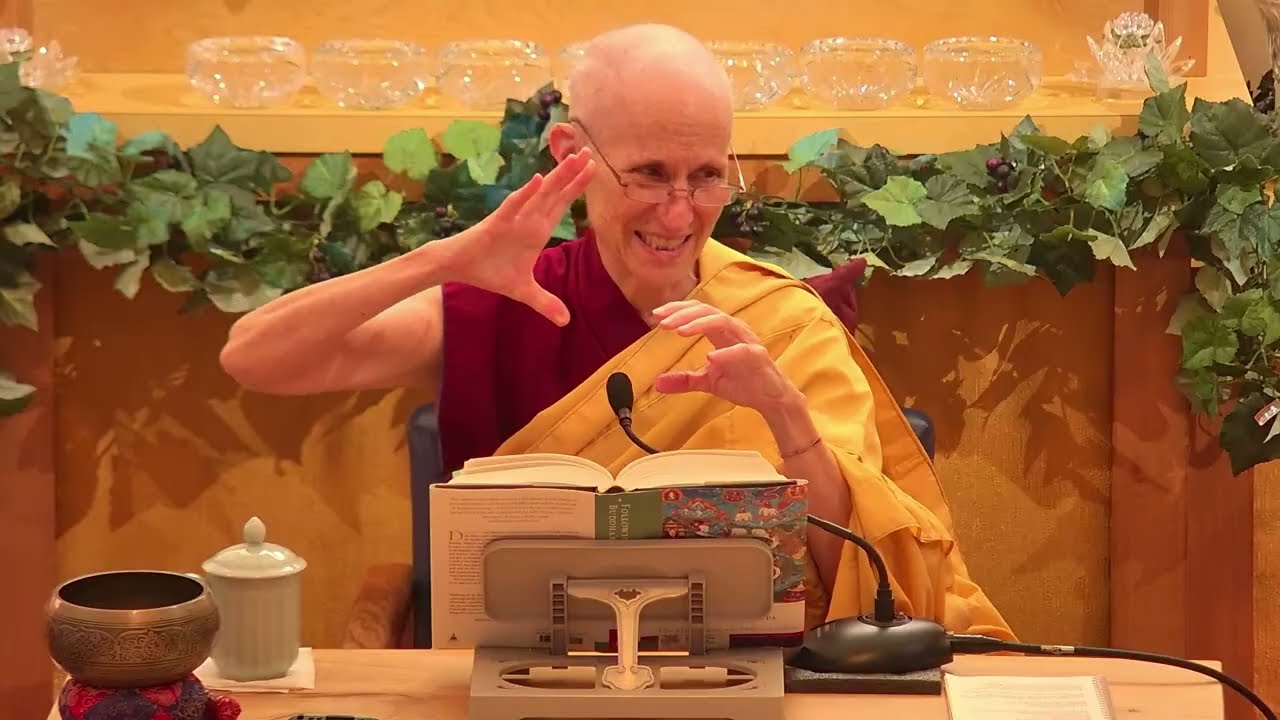
Venerable Sangye Khadro
California-born, Venerable Sangye Khadro ordained as a Buddhist nun at Kopan Monastery in 1974 and is a longtime friend and colleague of Abbey founder Venerable Thubten Chodron. She took bhikshuni (full) ordination in 1988. While studying at Nalanda Monastery in France in the 1980s, she helped to start the Dorje Pamo Nunnery, along with Venerable Chodron. Venerable Sangye Khadro has studied with many Buddhist masters including Lama Zopa Rinpoche, Lama Yeshe, His Holiness the Dalai Lama, Geshe Ngawang Dhargyey, and Khensur Jampa Tegchok. At her teachers’ request, she began teaching in 1980 and has since taught in countries around the world, occasionally taking time off for personal retreats. She served as resident teacher in Buddha House, Australia, Amitabha Buddhist Centre in Singapore, and the FPMT centre in Denmark. From 2008-2015, she followed the Masters Program at the Lama Tsong Khapa Institute in Italy. Venerable has authored a number books found here, including the best-selling How to Meditate. She has taught at Sravasti Abbey since 2017 and is now a full-time resident.