Menu:


Monastic Life


About this section:
The Buddhist community includes monastics and lay people. Both are necessary for the preservation of Buddhism. However, monastics choose a life of vowed simplicity, a life directly related to the preservation and dissemination of the Dharma to benefit others. They are the core of that lifestyle that all Buddhist practitioners are committed to. In the articles here, Venerable Chodron shares with us the joys and difficulties of being a nun and the special challenges of being a Western Buddhist nun. As His Holiness the Dalai Lama notes, all Buddhist nuns have a unique role to play in the evolution of Buddhism where the universal principle of the equality of all human beings takes precedence. If you've ever wondered what it would be like to be a monastic, you'll find these articles intriguing and stimulating.


Return to 'Monastic Life' Home Page.

Help with Listening to Audio Recordings


Eight participants spent an intense and fruitful 2 ½ weeks exploring their choice as well as aspirations to ordain. Two monastics, one trainee and five lay students lived in community.

The schedule included offering service, teachings on the history of the Vinaya and the original sangha by Venerable Chodron, and group discussions on key issues and questions about ordination.

There was also daily practice morning and evening as well as long walks in the forest. The retreat ended with skits and a sharing of everyone’s experience. Retreatants felt this time at the abbey extremely clarifying and inspiring.


EML retreatants and Venerable in the garden with Buddha

EML retreatants and Venerable in the garden with Buddha


Eric sanding the porch

Eric sanding the porch


Gedun with walking meditation prayer wheel

Gedun with walking meditation prayer wheel


Jyoti and her authentic Indian dahl

Jyoti and her authentic Indian dahl


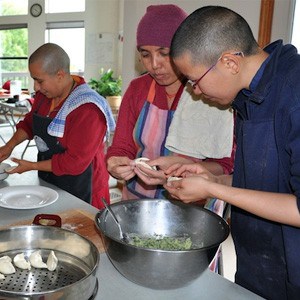
Team building - applesauce making

Team building - applesauce making


Tsundru clearing the new garden

Tsundru clearing the new garden


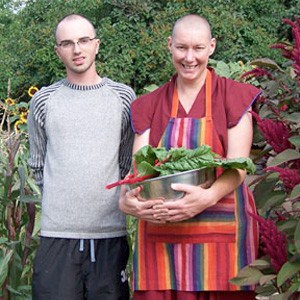
Venerable Tenzin Chogkyi and Gedun in the garden.

Venerable Tenzin Chogkyi and Gedun in the garden.


Exploring Monastic Life 2006
Conducted by Ven. Thubten Chodron©
Sravasti Abbey, USA
August 2006


Session 1

Part 1. [21 min] : Download mp3 file
Part 2. [19 min] : Download mp3 file
Part 3. [22 min] : Download mp3 file

Setting a proper motivation for hearing teachings.
Overview of the topics to be covered in this program and why they are important.
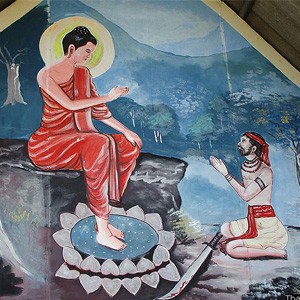
The Buddha's life.
The Buddha's whole life is a teaching in how to practice.
What really is renunciation?

Part 4. [23 min] : Download mp3 file

Questions and answers/Discussion:
  • Discussion on Buddha appearing in this world due to the karma of beings who had the karma to benefit from the Buddha’s teachings.
  • The different views of the Buddha held by the Theravada and Mahayana traditions.
  • Explanation of one of the 12 deeds of the Budda.
  • Discussion on how the 5 companions who criticized and left the Buddha when he decided to abandon ascetic practices were actually contributing to the Buddha’s Enlightenment.
  • How is it possible for ordinary beings to become omniscient?
  • Telling someone enlightenment can be attained in this lifetime and telling someone it’s going to take 3 countless great eons are not necessarily contradictory.

Back to Top


Session 2

[22 min] : Download mp3 file

Explanation before taking of the 8 Mahayana precepts. How the one-session precepts came about. ~ Why taking precepts is an important practice in all traditions. ~ Why these particular precepts? ~ What it means to have the bodhicitta motivation.

Back to Top


Session 3

Part 1. [29 min] : Download mp3 file
Part 2. [26 min] : Download mp3 file

Setting a proper motivation for listening to the teachings.
Is there a need for monastic life?
Stages in the development of the Sangha/monastic community.
From being a group of wanderers to gradually settling in one place and becoming more structured and organized.
Development of the Vinaya and Pratimoksha vows.

Part 3. [29 min] : Download mp3 file

Questions and Answers/Discussions:

  • How things changed after Buddha's parinirvana. The impact on an organization when its founding leader passes away.
  • Discussion on the issue of bhikshuni status.
  • Were all the precepts made at the time of the Buddha?
  • Discussion on the 8 Garudhamma.

Back to Top


Session 4

Part 1. [36 min] : Download mp3 file

Setting a proper motivation for listening to the teachings.
The development of the Sangha community. T
he development of individual Sangha communities with its own guidelines for living in that community. ~ How the Sangha community developed and how it became different in different Buddhist traditions because of different physical, social and cultural environments, though they are all rooted in how the monastics lived at the time of the Buddha.
The development of the Vinaya: As the community developed, precepts about how to live together as a community also came about. Precepts cover 2 kinds of faults: naturally negative and those which the Buddha prohibited. ~ The difference between the Vinaya and the Pratimoksa. ~ Historians see Vinaya as a code of law for the community, but most monastics see it as a code of training.
The rise of the monastic universities around 5th century AD with its emphasis on debate. How it came about and how the Sangha became easy targets for invaders.
Buddhism spread to Tibet during the time these monastic universities existed. The Tibetan tradition inherited this system of debate but the purpose has changed.
As Buddhism comes to the West, it is important to know what things we do not change and what are just forms that can be modified. E.g. Which part is Buddhism and which part is culture?

Part 2. [21 min] : Download mp3 file
Part 3.
[20 min] : Download mp3 file

Classification of precepts. Defeat, Remainder/Suspension, Lapses with forfeiture, etc.
Purpose of having novice ordination – a stepping stone to full ordination.
Ven. elaborates
on the precept of not handling money or doing business in today’s context.

Back to Top


Session 5

Part 1. [34 min] : Download mp3 file
Part 2. [32 min] : Download mp3 file

Talk by Ven. Chokyi: Some of the most significant